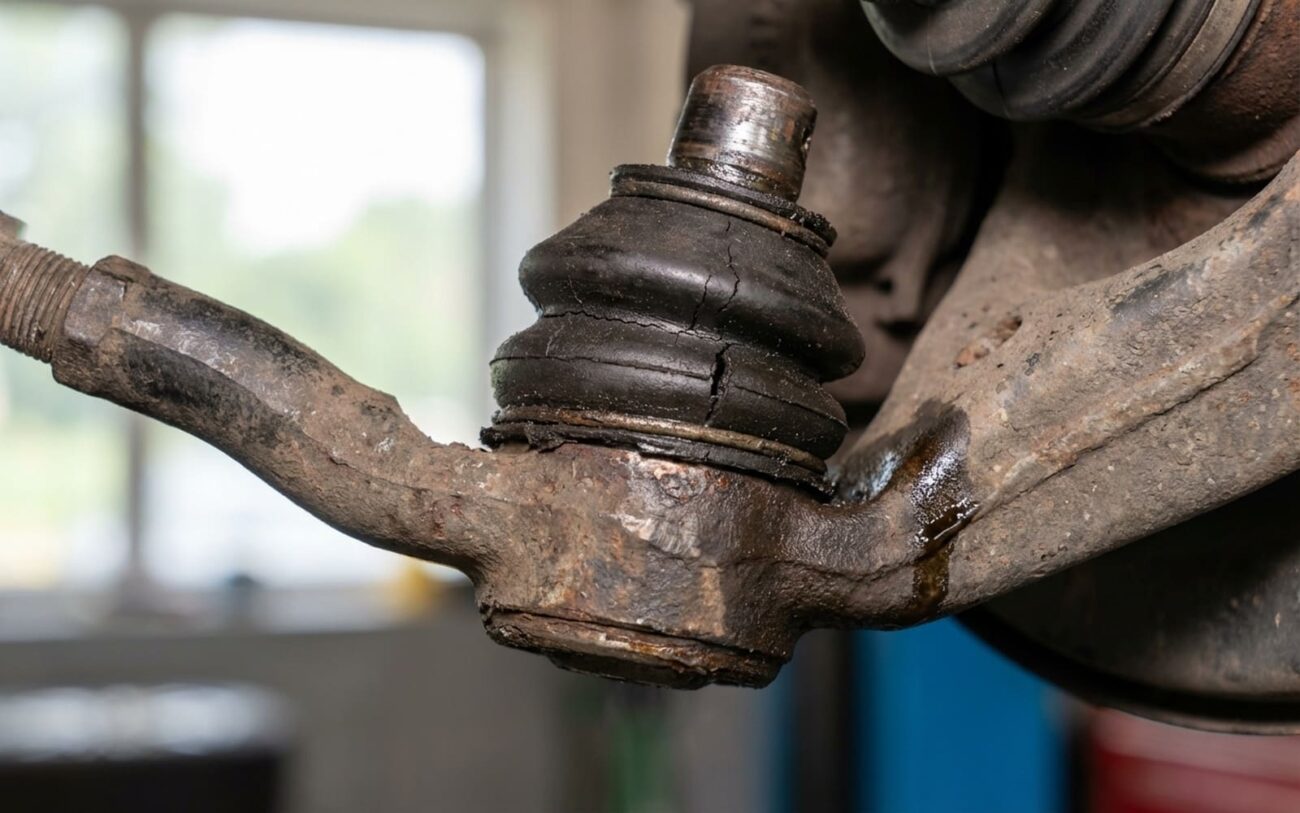
Alright, let’s talk about tie rod ends and steering linkage. After twenty-five years under cars, I can tell you these parts are critical. They’re what connect your steering wheel to your front wheels, plain and simple. When they start to go bad, your car isn’t just loose; it’s potentially dangerous. This isn’t a problem that sneaks up on you, though. Your car will give you clear signals if you know what to look and listen for.
What Your Car is Telling You: Symptoms of Worn Steering Linkage
The first thing most folks notice is excessive steering wheel play. I’m not talking about a little bit of slop, a quarter-inch or so – that’s often normal. I mean you can turn the wheel an inch or two, sometimes more, before the front wheels even think about moving. That “dead zone” is mechanical slop, pure and simple. Inside the tie rod end, a ball stud is supposed to pivot snugly in its socket. When that internal bearing wears down, that tiny gap turns into noticeable looseness. It’s like trying to stir a pot with a spoon that’s too small for the handle – you get a lot of movement without much action.
This play usually comes from the inner or outer tie rod ends, or sometimes a worn center link in older steering systems. It can also come from inside the steering rack itself or a loose joint in the steering column, but we’ll get into how to pinpoint that in a bit.
Slack: > 2.0″
The Mechanic’s Ear
“A sharp, metallic clunk isn’t just a noise—it’s the sound of a worn joint suddenly taking up slack under load.”
Then there’s the noise: a distinct knocking or clunking from the front end, especially noticeable when you’re turning at low speeds or going over bumps. This isn’t a soft thud or a squeak; it’s a sharp, metallic clunk. It’s the sound of that worn joint suddenly taking up all that slack when the load shifts. In my experience, this is one of the most reliable indicators of a failing tie rod end. Now, don’t jump to conclusions just yet; worn ball joints, strut mounts, or even control arm bushings can mimic this sound, so we need to test it properly.
And finally, your tires will often tell the story before anything else breaks. Take a good look at the tread on your front tires, especially the inner and outer edges. If you see a feathered or scalloped wear pattern – where the tread blocks are worn at an angle or look like they’ve been “scooped” – that’s classic toe misalignment. What happens is, with loose tie rods, every bump or dip lets the wheel shift slightly forward and back, scrubbing the tire sideways. That’s what causes that uneven wear.
My Diagnostic Approach: Pinpointing the Problem
The front end of a car is a busy place, packed with parts that move, wear, and make noise. The trick is isolating where that play or noise is actually coming from. I’ve got a systematic way I check things out to avoid replacing parts you don’t need.
Checking for Play and Clunks (The “Shake Test”)
This is my go-to. Get the front end of the car safely off the ground – a good jack and jack stands are non-negotiable here. Then, grab one of the front tires firmly at the 9 o’clock and 3 o’clock positions. Now, shake it side to side, hard. While you’re doing this, have a good look at all the steering and suspension joints.
-
If you see movement at the outer tie rod end’s ball joint before the wheel turns, that’s your culprit. The ball stud will wobble in its socket.
-
If the entire steering rack shaft moves side-to-side but the tie rods don’t immediately follow, the play is likely internal to the steering rack itself – a more involved repair.
-
For inner tie rod ends, you’ll need to peel back the rubber boot on the steering rack. Have a helper gently rock the steering wheel back and forth (engine off, ignition on). Watch the inner ball stud. If it wobbles or moves excessively, that’s where your play is.
-
To rule out other issues: If the movement is at the lower control arm, you’re looking at a bad ball joint. If the strut shaft moves in the upper strut mount, that’s a strut issue.
Diagnosing Excessive Steering Wheel Free Play
For this, I usually have a helper. With the car on the ground (or lifted, but on the ground is often better for this specific test), have them rock the steering wheel gently back and forth, just enough to take up the slack but not enough to turn the wheels. Get under the car and watch the entire steering linkage. You’re looking for where the movement stops being translated.
-
If the steering column moves, the rack shaft moves, but the inner tie rod doesn’t, then the inner tie rod end is worn.
-
If the inner tie rod moves, but the outer tie rod doesn’t, then the outer tie rod end is worn.
-
If the steering column is moving but the rack shaft isn’t, check the steering column couplings. I see this more on older front-wheel-drive cars.
Tire Wear Clues
For that feathered or scalloped tire wear, it’s a dead giveaway for dynamic toe change. While you’re doing the shake test, watch the ball stud in the tie rod end. If it’s wobbling, it simply can’t hold the alignment, and that’s what’s scrubbing your tires. Don’t confuse this with cupping from bad shocks; that wear pattern is usually more uniform across the tread, not just the edges.
Why They Fail: Root Causes I See Most Often
So, why do these parts give up the ghost? It almost always comes down to the ball-and-socket joint. Inside that housing, a hardened steel ball stud pivots in a bearing. Over time, that bearing wears down, creating microscopic clearance that just grows with every turn of the wheel and every bump you hit.
The “Sandpaper” Effect:
A torn rubber boot is the primary accelerant. Once that boot is compromised, road salt, dirt, and moisture get right in there, turning the protective grease into a grinding paste. I’ve pulled joints apart that looked like they’d been packed with concrete – no wonder they failed.
In cold climates, especially where they salt the roads, corrosion is a real killer. Salt can seize the ball stud, making steering stiff and heavy, or it can attack the threads, making replacement a nightmare without damaging the steering rack. I’ve even seen tie rod studs snap clean off from corrosion fatigue on older SUVs – that’s a terrifying failure mode.
One quick clarification: a worn control arm bushing or ball joint affects wheel alignment and stability, but that’s a suspension issue. A leaking steering rack seal is a hydraulic problem. Don’t confuse these with a bad tie rod end.
Getting It Fixed: My Approach to Resolution
Safety First, Always.
Look, steering components are safety-critical. If you’re unsure about torque specs, don’t have the right tools (like a proper separator), or just feel uneasy, please defer to a professional. A failed steering repair isn’t just an inconvenience; it can be fatal. This isn’t the place to cut corners.
Outer Tie Rod End DIY-FEASIBLE
Inner Tie Rod End Professional Only
Seized or Bent Components Professional Only
Post-Repair Validation: Don’t Skip This
Replacing the part isn’t the end of the job. Once everything’s buttoned up, lift the front end again and use a pry bar to check for any play in the new joint – there should be absolutely zero movement. Then, take it for a test drive. The clunking should be gone, and the steering should feel tight and responsive. Most importantly, get that alignment done right away. I always tell my customers to keep the printout from the alignment shop; it’s a good baseline and proof the job was done correctly.
Cost, Risk & When to Walk Away
Here’s a general idea of what you’re looking at for these repairs. Remember, prices vary wildly by vehicle, region, and shop.
| Repair Type | DIY Cost (Parts) | Shop Cost (Parts & Labor) | Success Rate | Risk if Failed |
|---|---|---|---|---|
| Outer Tie Rod End | $40 – $120 | $200 – $400 | 98% (when done right) | Rapid tire wear, sudden separation (catastrophic loss of steering) |
| Inner Tie Rod End | $60 – $150 | $300 – $600 | 95% (requires special tools/skill) | Steering rack damage, fluid leaks, premature failure |
| Complete Linkage (Both sides, inner & outer) | $200 – $500 | $800 – $1,500 | 99% | High labor cost if not needed, continued steering issues |
Prevention & Monitoring: Keep Them Healthy
-
Inspect those boots during every oil change. If you see a crack, a tear, or any sign of compromise, replace it immediately. A $50 boot replacement can save a $300 tie rod end.
-
In salt belts, spray the tie rod threads with a corrosion inhibitor like Fluid Film every fall. It’ll save you a world of pain (and possibly a torch) when it comes time for replacement.
-
Perform a monthly “shake test.” Just rock the front tires at 9 and 3 o’clock while the car is on the ground. You’re feeling for any subtle looseness or clunking. Early detection is everything here.
