I’ve been fixing lighting systems for over 25 years—long enough to see DRLs go from a luxury feature to a legal requirement, and modules go from simple relays to full-blown computers. When the DRLs die but the low beams still work? That’s not a bulb issue. That’s a module problem. And no, you can’t just throw a new one in and walk away. I’ve seen shops do that. They end up chasing ghosts.
Here’s What Actually Fails
On most vehicles from the early 2000s on up, the DRLs aren’t run by a relay or a switch. They’re managed by a control module—sometimes standalone, sometimes baked into the BCM. This thing turns the lights on at startup, dims them when you flip the headlights, and talks to the instrument cluster. When it dies, it doesn’t always throw a code. And when it does, the code might not point directly at the module.
The classic symptom? All DRLs dead. Zero output. But turn on the low beams manually—boom, they work. That’s not a fuse. Not a bulb. Not a broken wire to the headlight. That’s the module failing to send the “go” signal. The low beams bypass the DRL logic, so they’re fine. But the automatic daytime function? Gone.
And don’t get me started on the intermittent ones. Flickering DRLs on a 2016 Silverado? I’ve had three this month alone. One was a corroded connector. One had cracked solder joints. The third? A voltage spike from a failing alternator that cooked the CAN transceiver. All different causes. Same symptom. You can’t guess your way out of this.
| Symptom | Real-World Cause | How I Know It’s the Module |
|---|---|---|
| All DRLs out, low beams work | Failed output MOSFET or internal processor lockup |
I use a bi-directional scan tool to command the DRLs on. If the BCM says “yes” but there’s no voltage at the output pin—module’s dead. No debate. |
| DRLs stuck on, even in dark | Shorted output driver or failed relay inside module |
Disconnect the module. Test resistance from output pin to ground. Less than 5 ohms? That’s a short—and if the harness checks clean, it’s inside the unit. |
| Flickering or pulsing DRLs | Failing voltage regulator, cracked solder joint, or moisture damage |
I scope the power and ground pins. If supply is clean but output is jittery, it’s not the BCM. It’s the module. A multimeter won’t catch this. |
| U-code for lost communication | Dead CAN transceiver or corrupted firmware |
Check CAN bus resistance at the connector—should be ~60 ohms. If it is, and voltages are present (2.5–3.5V), swap in a known-good module. If the U-code follows the module, you’ve got your answer. |
Why It Failed (And I Don’t Mean “It Just Died”)
These modules don’t fail randomly. There’s always a reason. I’ve opened dozens. Here’s what I find.
Thermal cycling is the big one. The output drivers heat up under load, cool down when off. Over time—usually 8 to 12 years—this cracks solder joints. I’ve seen it on GM trucks, Fords, even Toyotas. The joint looks fine until you flex the board. Then the circuit breaks. GM even issued a bulletin for this on 2010–2014 Suburbans. They didn’t fix it. But at least they admitted it.
Voltage spikes are next. A bad alternator regulator, a jump-start with reversed cables, or a load dump from a weak battery—any of these can send a surge through the system. The DRL module is solid-state. It doesn’t like spikes. One good hit, and the microcontroller is toast. No code. Just silence.
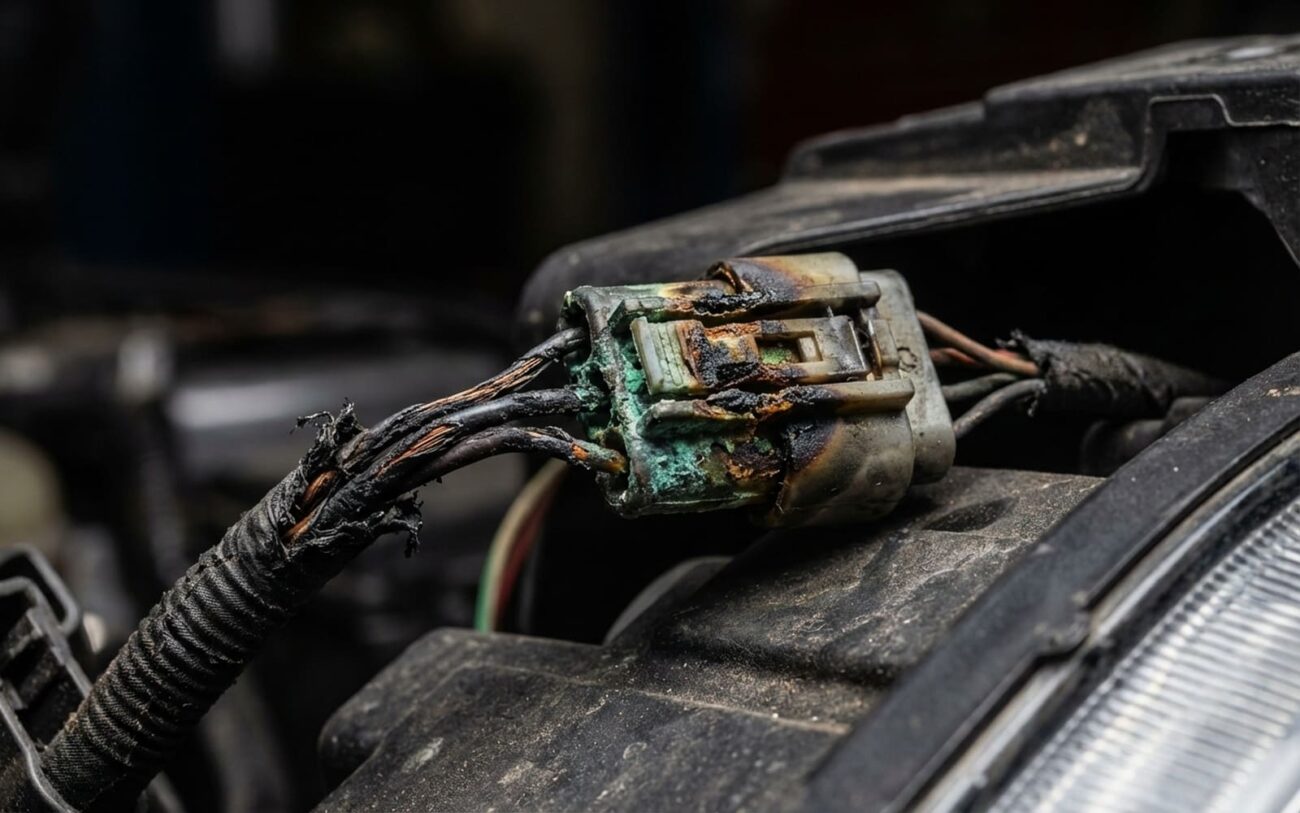
Moisture? Yeah. Especially on modules mounted behind the front bumper. I pulled one off a 2017 VW Passat last month. The connector was green. Not just corroded—green. Water got in, sat there, ate the traces. You wouldn’t know from the outside. But inside? Ruined.
And yes—firmware. These things run code. If a reprogramming fails mid-update, or a memory cell goes bad, the module won’t boot. It’ll act dead. No lights. No communication. But physically? It might be fine. Just forgot its job.
What I Do Next (And What You Should)
Check the connector first DIY-FEASIBLE
Open it and look inside Professional Only (Requires micro-soldering)
Replace it Non-Repairable → Replace
You have to program it. Every time. Whether it’s a GM, VW, or Toyota, the module needs to be initialized. You need a J2534 tool and OEM software. Skip this, and you’ll get a U-code or non-functional DRLs. I don’t care if the lights come on. If it’s not programmed, it’s not done.
And yeah—there’s a bypass. You can wire a relay to send 12V to the DRL circuit. But that’s [TEMPORARY / LAST-RESORT]. It kills all logic: no dimming, no turn signal override, no ambient light sensing. It might also fail inspection in Canada or states where DRLs are mandatory. Use it to test the circuit, not as a fix.
After the Fix: Don’t Hand It Back Yet
So the lights are on. Great. Now prove it’s fixed.
If you cleaned the connector, cycle the DRLs ten times. Automatic start, manual command via scan tool. Take it for a drive. Make sure they shut off at night. Any flicker? Delay? That’s not fixed.
If you replaced the module, you’ve got more work. Clear all codes. Drive through a full cycle. Check communication. Use the scan tool to verify brightness, turn signal interaction, and ambient light response. Measure output voltage and current draw. If you’re pulling more than spec, you’ve got a short—and you just fried a new module.
Walk around the car. Daylight. Low light. Make sure both sides match. If one DRL is dimmer, that’s a wiring issue or a bad ground. Don’t ignore it.
Is It Worth It? (The Real Talk)
| Repair | DIY Cost | Shop Cost | Success Rate | Risk |
|---|---|---|---|---|
| Connector Repair | $20 (cleaner, grease) | $100 | 95% | Corrosion returns if seal isn’t fixed. |
| Module Replacement | $200–$600 + $150 programming | $350–$950 | 98% | Bad programming can brick the BCM. |
| PCB Repair | N/A | $200–$400 | 60% | Other joints may fail soon. Not a long-term fix. |
PCB repair? I do it sometimes. But I don’t recommend it unless you’re desperate. A cracked joint today means others are fatigued. You fix one, two more go next month. It’s not reliable.
And if the repair costs more than 40% of the car’s value? Think hard. In Ontario, non-working DRLs fail safety. In Texas, maybe not. But safety aside—spending $800 to fix a $2,000 car? That’s a judgment call. I’ve walked customers through that math more than once.
Keep It From Happening Again
What I Do in My Shop
-
I check battery terminals and ground straps on every vehicle. Loose or corroded? That’s voltage ripple. It kills modules. Fix it before it kills something expensive.
-
I tell customers: check your DRLs when you start the car. If one’s dim or flickering, don’t wait. Bring it in. Early corrosion is fixable. Late-stage water damage isn’t.
-
After any front-end work—bumper off, headlight replaced, minor fender bender—I scan for codes and test the DRLs. A small impact can crack a module internally. You won’t see it. But it’ll fail in three months.
