Symptom First, Diagnosis Second
When the headlights don’t track with the steering—especially at low speed, like pulling into a driveway or navigating a parking lot—you’re not imagining it. That’s a failure in the adaptive front lighting system (AFS), and it’s more than just a convenience issue. I’ve seen drivers miss curbs, misjudge turns, even clip signs because their beam didn’t swing where they were going. Night driving becomes a guessing game. This isn’t cosmetic. It’s functional safety.
The most common symptom? The beam stays locked forward while the wheel turns. But here’s what most people miss: sound. I pop the hood, have the customer turn the wheel slowly with the lights on, and I listen. If I hear a faint click… click… click—or a low buzz coming from inside the headlight housing—that’s the motor trying to move. It’s getting power, but the output shaft isn’t turning. That tells me the control module is awake and talking. The problem is mechanical: likely a stripped plastic gear or a seized shaft.
And don’t ignore DTCs like B1515 or B1516. They point to an open or shorted circuit in the aiming motor. But here’s the trap: if the motor is mechanically seized and the system keeps commanding it, the driver circuit in the AFS module can fry. I’ve pulled apart modules on 2012–2016 Acuras where the MOSFETs were cooked from sustained overcurrent. What started as a $300 motor job turned into a $1,600 control unit replacement. That’s why early diagnosis matters. Don’t wait.
Is It the Motor? Or Something Else?
Before you crack open the headlight, rule out the easy stuff. I’ve seen techs replace motors only to realize the steering angle sensor (SAS) wasn’t calibrated after a battery disconnect. The system never got the signal to turn—so of course the headlight didn’t move. But the motor was fine.
The only way to know is with a real scan tool—something that talks to the AFS or body control module. Generic OBD2 scanners won’t cut it. You need bi-directional control. That means you can command the motor to move left and right manually, bypassing the steering input. If the motor responds, the issue is upstream: SAS, calibration, or wiring. If it doesn’t move—and you hear that telltale buzz—the fault is mechanical.
| Symptom | Points to Motor | Could Be External | Definitive Test |
|---|---|---|---|
| No movement during cornering. | Seized shaft, stripped gear, open winding. | Lost zero-point cal, bad SAS, BCM software glitch. |
Command motor via scan tool. If it moves, the problem is signal-related. If not, and you hear noise—the motor is the issue. |
| Clicking or buzzing from headlight. | Motor energized but output stuck—gear stripped or shaft seized. | Linkage binding, foreign object in mechanism. |
Disconnect linkage from motor. Re-test with scan tool. If motor spins freely, the bind is downstream. If it still clicks, the motor is shot. |
| DTC for motor circuit (open/short). | Failed windings, worn brushes, internal corrosion. | Chafed wiring, bad connector, failed driver in module. |
Disconnect motor, measure resistance. Infinite ohms = open winding. Near zero = short. 1–5 Ω is normal—look elsewhere. |
What Actually Fails in the Motor
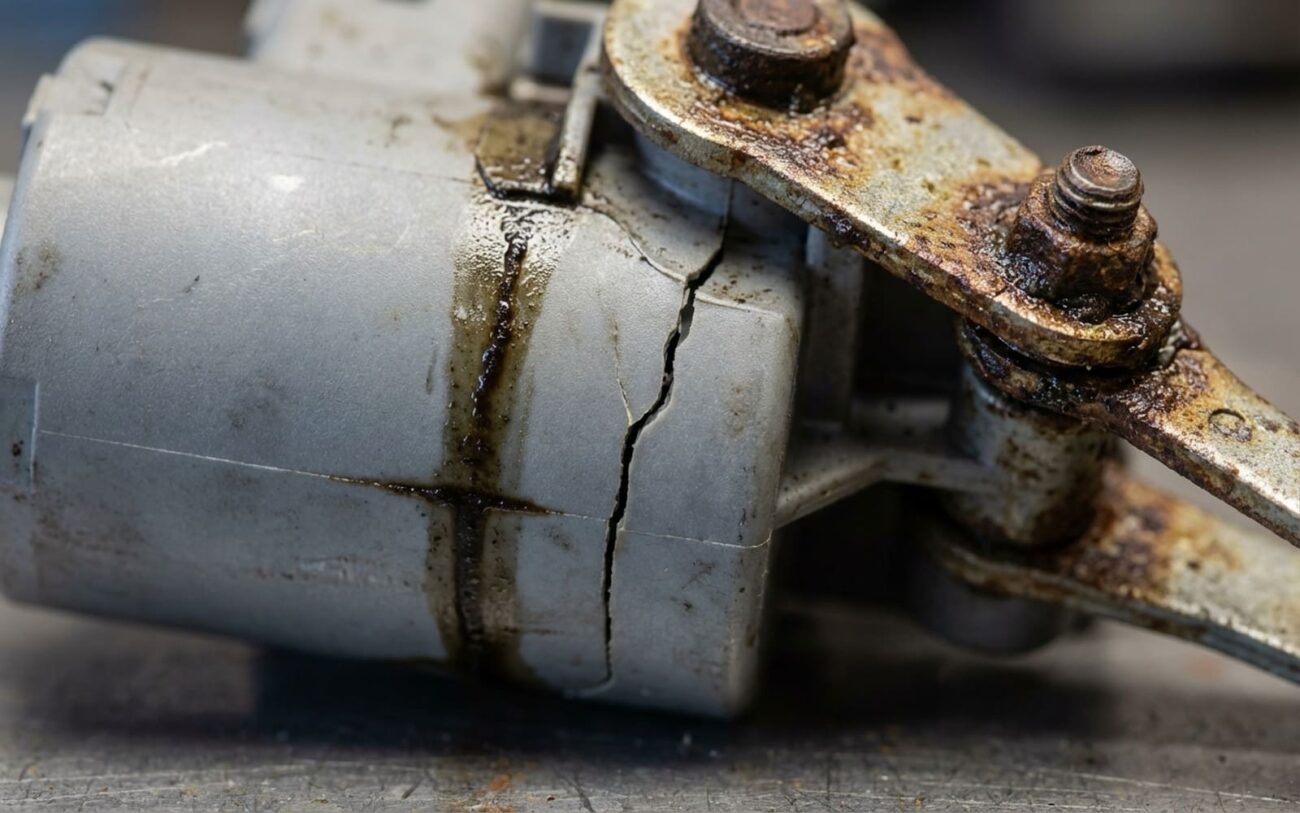
I’ve pulled apart dozens of these units. The #1 failure? Plastic gears. They’re molded, not machined, and they connect the motor to the reflector pivot. Every time the headlight hits its travel limit—especially if the driver turns the wheel hard at low speed—the gear takes a shock load. Do that enough, and teeth shear off. The motor spins, the gear flails, nothing moves.
Bearing seizure is next. The motor shaft rides on tiny bushings or ball bearings. If moisture gets in—usually from a cracked seal or clogged vent tube—rust forms. The shaft binds. Motor draws current, makes noise, but can’t turn. I see this a lot on coastal vehicles or ones that get washed weekly. Salt and water are brutal.
Electrical wear happens too. Carbon brushes in DC motors wear down over time. Once they’re too short, contact with the commutator breaks. Motor stops. Or worse: intermittent contact causes arcing, which degrades the commutator bars. I’ve seen motors where the copper segments were pitted and uneven—no amount of cleaning would fix that.
And don’t forget connector corrosion. On 2005–2010 Hondas and Acuras, the motor connector is exposed to splash water. I’ve found green crust inside pins, high resistance, voltage drop. Not a dead short, but enough to confuse the module. A simple clean and dielectric grease sometimes fixes it—no part replacement needed.
But—and this is important—don’t confuse motor failure with input issues. A bad SAS, lost zero-point cal, or faulty body height sensor won’t damage the motor. They just prevent the system from commanding it. Test the signal path before tearing into hardware.
How I Fix It (And When I Walk Away)
If it’s just the connector—corroded pins, damaged housing—it’s a solid DIY-FEASIBLE job. I use a proper crimp tool, OEM-matched waterproof connector kit, and heat-shrink with adhesive lining. Depin, splice, solder, seal. Done right, it lasts the life of the car.
If the motor is inside a sealed headlight—like on most Toyotas or Nissans—you’re looking at a “bake-off.” I heat the lens evenly with a heat gun (250–300°F), separate it carefully, replace the motor, then reseal with fresh butyl. Torque specs matter: 8 Nm (71 in-lb) on the mounting bolts, T20 Torx bit. Too tight and you crack the housing. Too loose and moisture gets in. This is Professional Only—not because it’s magic, but because one slip ruins the whole unit.
On BMWs, Mercedes, and some Audis? Forget it. The motor is welded into a non-serviceable module. No disassembly. No repair. Your only option is NON-REPAIRABLE → REPLACE UNIT. That means either the entire actuator or the full headlight. I always pull the VIN and check ETKA or OEM parts diagrams before ordering. And no, you can’t just jam the reflector by hand and call it good. Beam alignment will be off. You’ll blind oncoming traffic. That’s a liability.
Did It Actually Work?
Swapping parts isn’t the end. I test. Always.
First, I use the scan tool to command full left and right sweep. The motor should move smoothly, no stutter, no grinding. If it hesitates, something’s still binding.
Then I run the AFS zero-point calibration. This tells the module where center is. Without it, the system doesn’t know its reference point. The lights might twitch but won’t track. And if the calibration fails or throws a DTC, you’ve got a deeper issue—maybe a bad sensor or incomplete communication.
Finally, I do a live test. Level ground, engine running, turn lock-to-lock. I watch the beam on a wall. It should follow the steering input in real time. If it lags or jumps, something’s off. This whole process needs OEM-level tools: ISTA, VCDS, GDS2. Generic scanners won’t cut it.
Is It Worth Fixing?
Here’s the reality: AFS repairs get expensive fast. I run the numbers before I touch a wrench.
| Repair Type | DIY Cost | Shop Cost | Success Rate | Secondary Risk |
|---|---|---|---|---|
| Replace entire headlight assembly. | $800–$2000 | $1000–$2500 | 99% | Low—assuming correct cal and part. |
| Replace swivel motor (if serviceable). | $150–$400 | $500–$900 | 85% | Moisture intrusion if reseal fails. |
| Internal gear repair (kit available). | $50 | $300 | 60% | Fragments can jam mechanism. |
My rule of thumb: if the repair exceeds 40% of the car’s private-party value, it’s time to rethink. For a 2010 Lexus IS350 worth $6k, a $2,500 headlight replacement doesn’t pencil out. One option—where legal—is coding out the cornering function. A specialist can disable it via the BCM. You lose AFS, but keep functional headlights. Not ideal, but realistic.
How to Avoid This Mess
Prevention is cheap. I check headlight seals every oil change. Look for cracks, soft spots, or missing chunks of butyl. And inspect the vent tube—usually on the back. If it’s clogged with dirt or mud, pressure builds, seal blows, water gets in. I’ve seen motors rust out in two years on off-road trucks with blocked vents.
For early warning, do a 10-second test: at night, turn the wheel slowly with lights on. Watch the beam. If it stutters, flickers, or moves unevenly, something’s degrading. Could be the motor, could be the driver module—especially on LED systems. I wrote about that here.
Bottom line: adaptive headlights are precision systems. Treat them like suspension or brakes. Small issues become big ones fast. Catch it early. Test properly. Fix it right.
