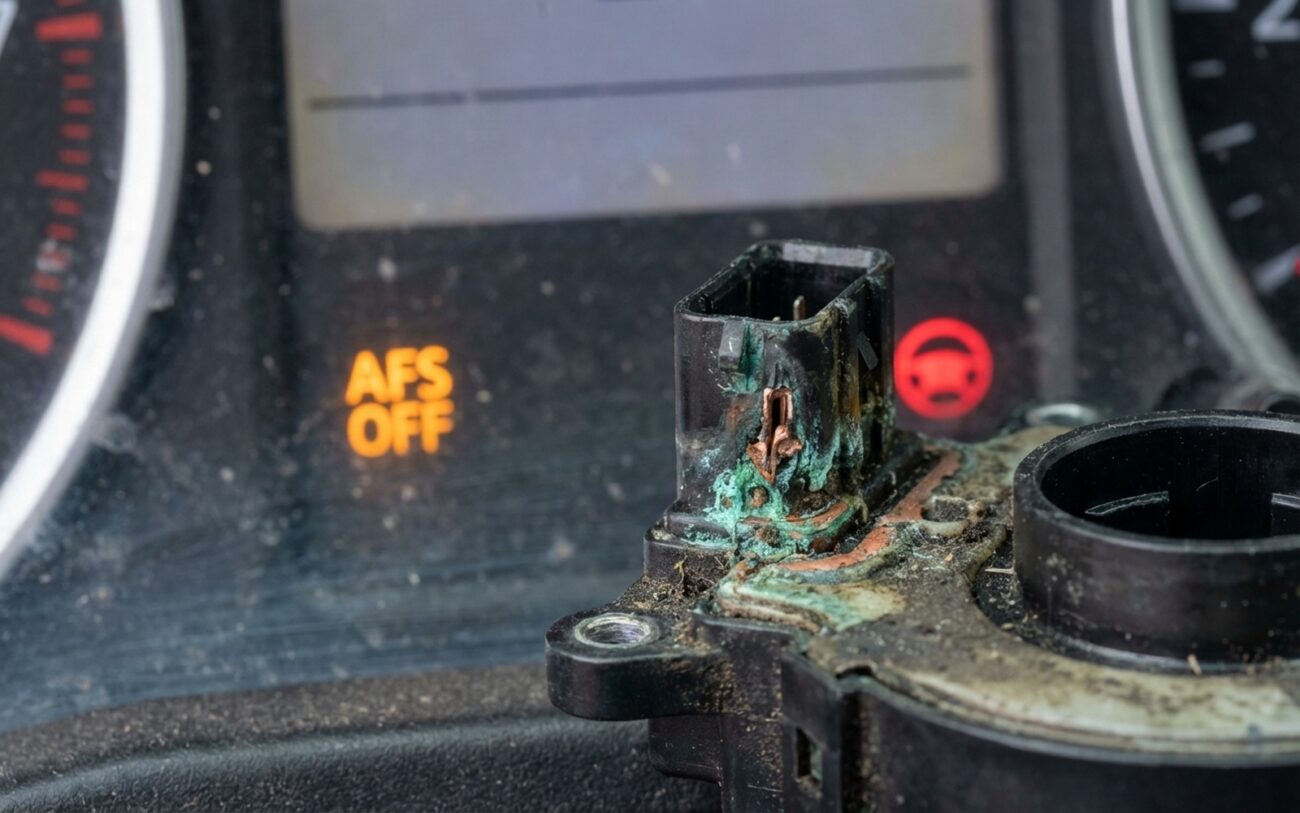
When the adaptive headlights quit, most shops go straight for the motors or control module. That’s wasted time and money. In my 25 years turning wrenches, I’ve seen exactly one failed headlight actuator cause a full AFS shutdown. The real culprit? Nine times out of ten, it’s the steering angle sensor—or more precisely, how it’s been treated.
What Actually Fails — And What Doesn’t
The steering angle sensor (SAS) is solid-state. No moving parts. It’s either working, dead, or confused. When it fails, the AFS system doesn’t “limp” — it kills itself. Same with ESC. That’s by design. No guesswork allowed when stability control or adaptive lighting is involved.
Here’s what I see:
- AFS warning light on — sometimes labeled “Adaptive Lights Inactive” or just a generic symbol.
- ESC or VSC light lit at the same time. That dual warning? Red flag. These systems share the SAS. If both are down, the sensor or its circuit is suspect.
- Headlights don’t sweep at startup. No pivot in corners. Feels like the car forgot how to steer.
But don’t assume hardware failure. On a 2018 Camry I worked last week, the owner replaced the battery, didn’t recalibrate the SAS, and spent $600 chasing “bad actuators.” The fix? A 10-minute relearn with Techstream. Done.
Diagnosis: Skip the Guesswork
Start with codes. But not just any scanner. You need bi-directional access — something that talks to the body control module, AFS unit, and ABS/ESC system. Generic OBD2 tools are useless here.
Look for:
- C1241, C1242 — common generic SAS faults.
- C1A15 — Toyota/Lexus favorite. Usually means signal invalid or calibration lost.
- Manufacturer-specific codes in the ABS or ESC modules. These often point back to SAS data corruption.
Then go live. Connect the scanner, center the wheel, and turn lock-to-lock. The SAS reading should ramp up smoothly — typically 0° at center, ±720° at full lock (varies by make). If it jumps, resets, or flatlines? Bad sensor or wiring.
But here’s the trap: a clean data stream doesn’t mean the sensor is good. It might just be “remembering” the wrong zero point. That’s why calibration matters — and why so many DIYers fail.
Root Causes: Why These Sensors Die
These units are sealed. No serviceable parts. When they fail, it’s usually one of four things:
- Contamination — moisture or dust gets past a cracked seal. Coats the optical disc. Seen it on off-road Jeeps with poor column sealing.
- Thermal stress — underhood heat cycles. Solder joints fatigue. I’ve pulled units apart and found cracked traces on the PCB.
- Electrical damage — jump-starting with reversed cables, alternator spikes, or hot-disconnecting the battery. That last one fries the EEPROM chip. Seen it on BMWs and Acuras more than I’d like.
- Physical shock — collision damage or someone yanking on the column during airbag work. The housing cracks. Game over.
But — and this is critical — 60% of “failed” sensors I pull test fine on the bench. The problem was calibration loss or wiring. On 2010–2012 Nissans? Yeah, those years are notorious. Poor sealing, bad solder. But on most cars, the sensor lasts the life of the vehicle unless abused.
Repair: Replacement and Calibration Are Non-Negotiable
Not a DIY Job
You’re working near the airbag clockspring. One wrong move, and you’re looking at a $500 repair for a severed spiral cable. Plus, you need OEM-level software. No way around it.
Replace It — No Shortcuts Professional Only
Installation Matters Professional Only
- Disconnect the battery. Wait 15 minutes. Airbag capacitors take time to drain.
- Remove column covers. Clockspring access varies — some cars need the intermediate shaft pulled.
- Unplug old sensor. Mount new one. Torque spec is usually 25 Nm + 90° turn (torque-to-yield). Don’t wing it.
Calibrate or Fail
Verify the Fix — Or It Didn’t Happen
Clear all codes from AFS, ESC, and BCM modules. Then check: did the calibration stick? Your scanner should confirm “Zero Point Learned” or equivalent.
Now, road test. Not a lap around the block. Drive for 10 minutes. Make gentle turns. Watch live SAS data. It should ramp up and return to zero smoothly. Any hesitation, jump, or offset? Something’s wrong.
If the lights come back:
- Don’t assume the sensor is bad. Could be a yaw rate sensor issue, wheel speed imbalance, or CAN bus glitch.
- No SAS code but AFS still dead? Look at the leveling system. Faulty body height sensor? Bad actuator motor? Check those before blaming the SAS again.
Cost vs. Value: When to Walk Away
DIY Replacement
Parts: $150–$400 (sensor only)
Labor & Tools: $50–$150 (scan tool rental/subscription)
Shop Repair (Domestic/Mid-Range)
Parts: $200–$450
Labor & Tools: $150–$250
Shop Repair (Luxury)
Parts: $300–$600
Labor & Tools: $250–$400 (complex calibration)
I’ve had customers come in with a new sensor installed, no calibration done, and ESC still off. They saved $200 on labor and now owe $400 to fix their mistake. Not worth it.
Real Talk
If the repair costs more than 30% of the car’s value, and it’s got other age-related issues, think hard. Driving without ESC or adaptive headlights cuts your safety margin — especially in rain or at night. That’s not just resale value. That’s you, your family, your liability.
Prevention: Don’t Abuse the System
How to Keep It Alive
-
Disconnect the battery before any steering column work. Wait 15 minutes. Prevents voltage spikes that fry the sensor’s memory.
-
Don’t yank the tilt wheel. That clockspring only lasts so many cycles. Treat it gently.
-
Replace weak batteries early. Voltage drops confuse modules. I’ve seen a failing battery trigger C1A15 on a Lexus three times in one week.
-
Check calibration after alignment or suspension work. If the toe changed, the system might need a relearn. Takes 5 minutes. Saves a headache later.
Bottom line: the SAS doesn’t wear out. It gets killed by bad habits. Respect the system, use the right tools, and it’ll outlive the car.
