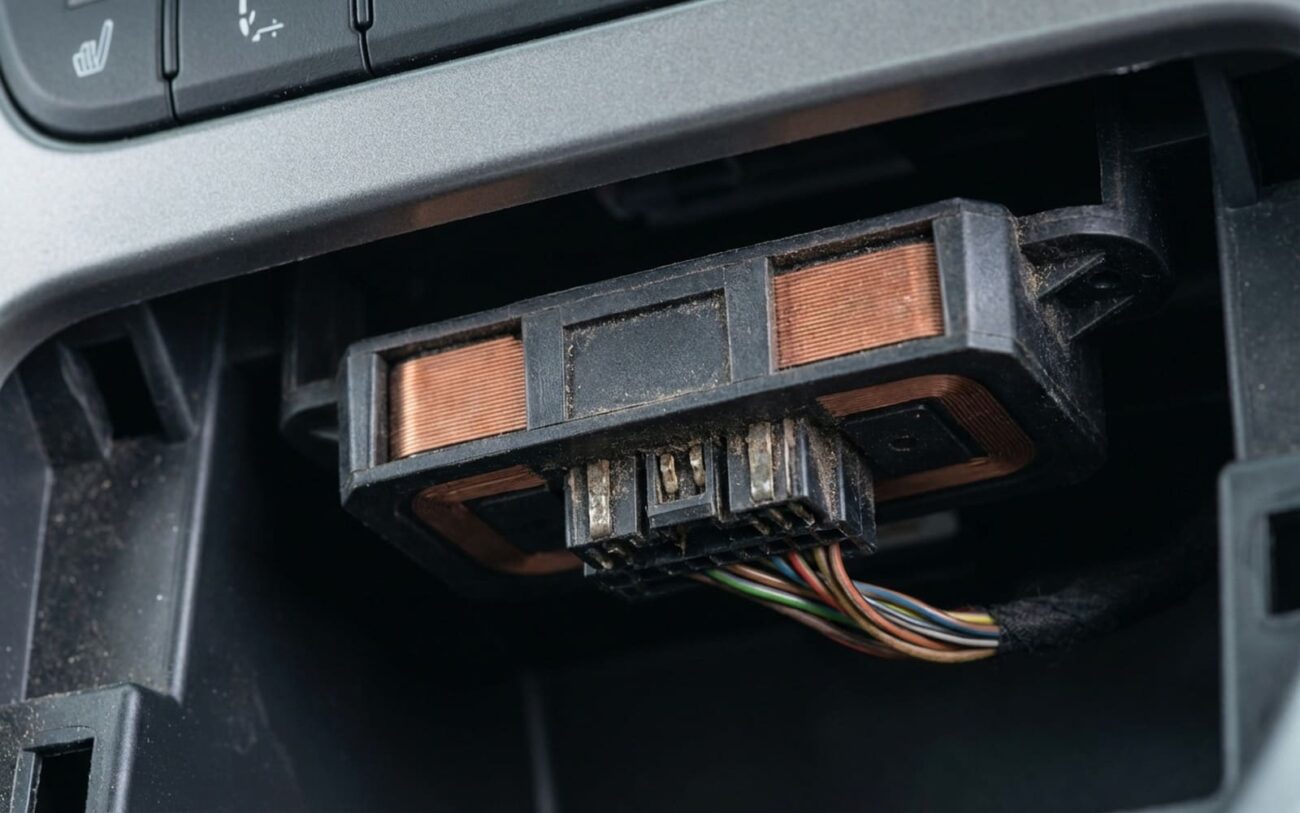
Alright, let’s talk about that dreaded “Key Not Detected” message. If you’ve ever stared at your dash, key fob in hand or pocket, wondering why your car won’t recognize it, you’re not alone. After 25 years in the shop, I can tell you that nine times out of ten, the problem isn’t the fob itself. We’re usually looking at a deeper issue within the car’s passive anti-theft system (PATS) – specifically, those hidden antenna coils or, in the worst cases, the Body Control Module (BCM) that runs the whole show.
Getting this diagnosis right saves you a ton of grief, time, and money. The key is paying close attention to when and where the detection fails. That’s your first big clue.
Diagnosing the ‘Key Not Detected’ Mystery
Before we dive into anything serious, let’s get the obvious out of the way: always, always, always check or replace your key fob battery first. A weak battery is the most common culprit for erratic behavior, and it’ll mimic antenna or BCM issues all day long. Use a fresh, high-quality CR2032—don’t cheap out here, because inconsistent output from a bargain battery can send you on a wild goose chase. If that doesn’t fix it, then we know the fault is on the vehicle side.
Proper diagnosis means having the right tools. You’ll need a capable scan tool (one with bidirectional controls is best), a good digital multimeter, and the wiring diagrams for your specific vehicle. Trust me, guessing will only cost you more in the long run.
| What You’re Seeing | Where I’d Look First | Common Misleads (Check These Too) | How I Confirm It |
|---|---|---|---|
| Key only detected in specific spots (e.g., right by the start button, but not in the console or trunk) | A failing passive antenna coil for that specific zone. | Weak key fob battery, or a faulty key fob itself. |
Use a bidirectional scan tool to run the “Antenna Diagnostic Test.” If a specific antenna circuit fails, that coil or its wiring is the problem. Always confirm with a known-good fob and a fresh battery.
|
| You’ve got a Diagnostic Trouble Code (DTC) for an antenna circuit e.g., B3031, “Antenna Circuit Short to Ground” |
Faulty antenna coil or a bad connection/wiring to it. | Damaged wiring harness, or poor contact at the BCM connector. |
Disconnect the BCM and measure resistance at its connector for the suspect antenna circuit. You should see 1–10 ohms. Infinite resistance means an open circuit (broken wire/coil); 0 ohms means a short. Then, if needed, check at the antenna end to pinpoint the exact break.
|
| No key detection, AND the BCM is unresponsive (no interior lights, no chimes, scan tool can’t communicate with it) | Internal BCM module failure. This is the big one. | Blown BCM fuse, a bad power relay, or a corroded ground connection. |
Check all BCM power and ground circuits with a multimeter at the connector. If you have solid voltage and a ground resistance under 0.5 ohms, but still no network communication, then the BCM itself is almost certainly toast.
|
Just like diagnosing a faulty outside temperature sensor, you can’t just guess. You’ve got to test the circuit. Voltage, resistance, and signal integrity—that’s what tells the real story.
Why These Parts Fail (My Experience)
Understanding why something broke helps confirm your diagnosis and, hopefully, prevents it from happening again.
Passive Antenna Coils are pretty simple, but they’re vulnerable. What I see most often is an internal break in that fine copper winding. This happens over time from constant vibration or thermal stress—especially in spots like the center console where temperatures really fluctuate. Since they’re sealed in plastic, you can’t really fix ’em; you just replace the whole assembly. I’ve also seen plenty of physical damage from interior work, like someone prying too hard on trim during a stereo install and cracking the antenna housing. And corrosion at the connectors? That’s a known issue on some models. I’ve worked on GM vehicles, for example, where the PEPS (Passive Entry Passive Start) antenna in the console would get moisture in its connector, leading to all sorts of intermittent key detection problems. It’s a specific antenna assembly failure, not a BCM issue.
BCM failures are a whole different beast and usually point to more serious environmental or electrical stress. Internally, components like voltage regulators just degrade over time from daily heating and cooling cycles. A big voltage spike from, say, a failing alternator, can also fry sensitive circuitry in a heartbeat. But the biggest culprit I see? Water. If a sunroof drain clogs up, or a door seal starts leaking, water can drip right into the BCM housing (which is often tucked away in a kick panel or under the dash). Once moisture gets on that circuit board, corrosion sets in, leading to shorts or open circuits. That’s usually the end of the BCM.
Important Distinction:
A separate RF receiver module (used in some systems) isn’t the same as a BCM. And while a dead 12V battery can cause all sorts of erratic behavior, it’s not a BCM fault—though it can sure make it look like one. It’s like how a low battery can trigger a false “check coolant” warning even with a full reservoir, as explained in coolant level sensor diagnosis.
Getting It Fixed: Your Repair Path
Once you’ve confirmed the fault, the repair path depends entirely on what’s broken.
Replacing a Passive Antenna Coil DIY-FEASIBLE
Replacing and Programming the BCM PROFESSIONAL-ONLY
Using the Backup Start Location TEMPORARY / LAST-RESORT
Post-Repair Validation (Don’t Skip This!)
Never just assume the repair worked—you’ve got to verify it thoroughly.
After replacing an antenna coil, I’ll test detection in every single zone: door handles, trunk, console, and the start button area. The key should be consistently recognized everywhere. Clear any stored DTCs and then monitor for their return over several ignition cycles. A professional scan tool should show normal antenna circuit status with no pending faults.
After a BCM replacement, validation is much broader. Every BCM-controlled function—lights, locks, windows, wipers, the instrument cluster—must operate normally. And, of course, the engine must start with all programmed keys. Use your scan tool to confirm network communication, check for any new error codes, and verify the module is properly configured. If any function is missing, it usually means a relearn or programming step was missed. Go back and check your work.
Cost, Risk, and Making the Right Call
Repair costs can vary wildly, so here’s a realistic breakdown based on what I see in the shop:
Antenna Coil Replacement
DIY parts usually run $50–$150. If you bring it to the shop, expect $200–$400, including diagnosis and labor. High success rate if you’ve diagnosed it correctly.
BCM Replacement & Programming
This is a professional-only service. That price includes the module itself and all the specialized programming. High success rate, but only with the right tools and expertise.
Look, I’m all for fixing cars, but you’ve got to be honest about your vehicle’s value. If the repair costs start creeping up past 40% of what your car is actually worth, it’s time to seriously evaluate if it makes economic sense. I’ve seen too many people pour good money after bad, only to face another major repair down the road.
Prevention & Monitoring
You can’t prevent every failure, but you can definitely reduce your risk.
My Advice to Keep You Going
-
Protect your car from water. Seriously. Regularly inspect your door, sunroof, and body seals. A little bit of moisture in the wrong place can kill a BCM faster than anything. And make sure your 12V battery and charging system are healthy to prevent those nasty voltage spikes.
-
Keep an eye out for inconsistent key detection. If it starts getting flaky in one zone, address it early. A partial failure is much easier and cheaper to fix than a complete immobilizer shutdown that leaves you stranded.
-
When your car’s in for regular service, ask them to do a quick scan for immobilizer or BCM codes. Proactive diagnostics can often catch issues before they become critical and leave you stuck on the side of the road.
