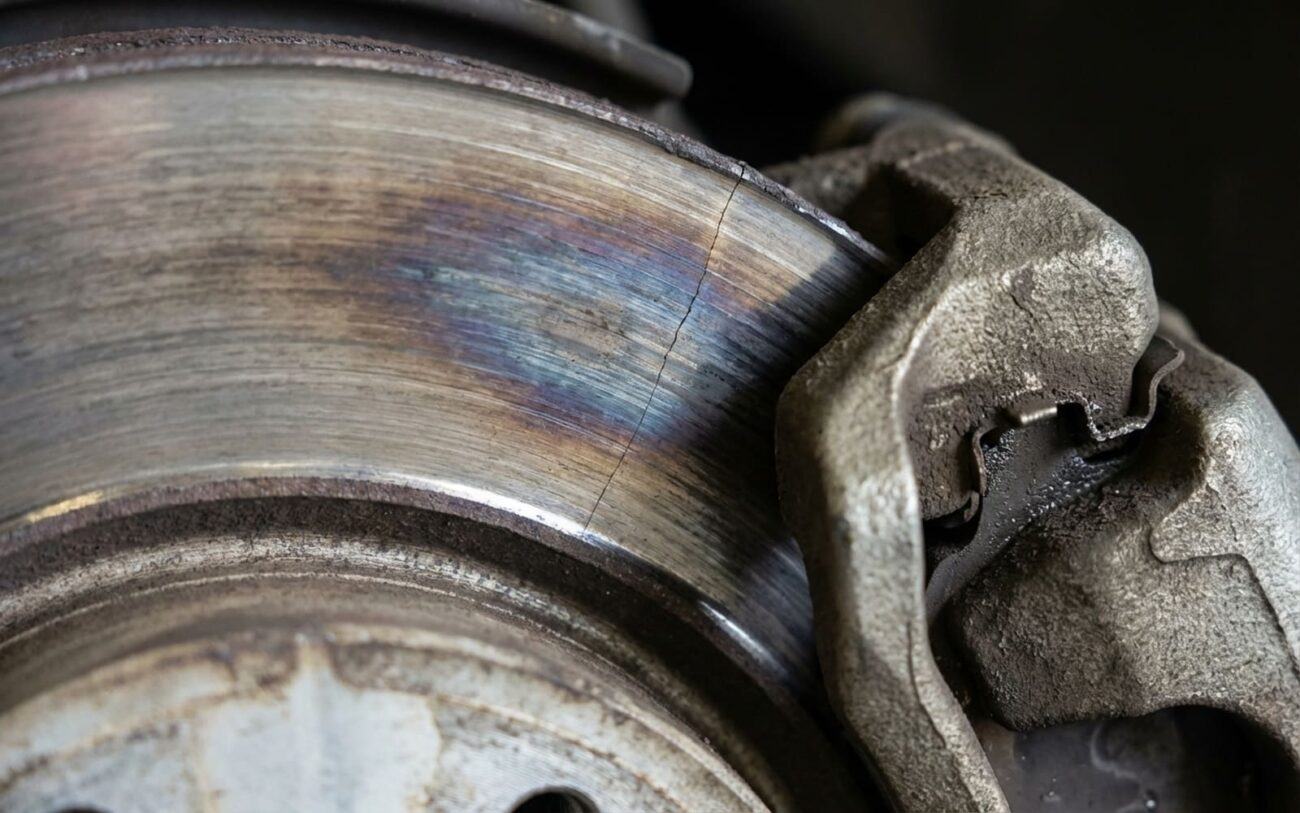
If you’re driving a hybrid or an EV and your friction brakes are acting up – I’m talking rotors turning blue, cracking, or pads getting glazed – and you know you haven’t been driving like a maniac, then you’ve got a serious problem. In my shop, when I see this kind of brake overheating under normal conditions, especially on an electrified vehicle, it almost always points to one thing: a failure in the regenerative braking system (RBS).
Symptom Check: Are Your Brakes Overworking?
Here’s the deal: the RBS is designed to do the heavy lifting when you slow down. It turns the electric motor into a generator, taking that kinetic energy and shoving it back into the battery. It’s smart, it saves fuel, and it saves your friction brakes. But when that system goes south, all that braking load gets dumped onto your traditional brake pads and rotors. And let me tell you, those components were never built to handle that kind of continuous heat. They’ll overheat, and they’ll do it fast.
So, how do you know if it’s regen, not just worn-out brakes? I look for a couple of clear electrical and behavioral clues:
- Energy Flow Display: Most hybrids and EVs have an energy flow display or a state of charge (SOC) indicator. Every time you lift off the accelerator or lightly tap the brake pedal, you should see energy flowing back into the battery. It might be a visual animation or a rising SOC. If you’re not seeing that, especially when your battery isn’t full, regen isn’t working. It’s that simple.
- Brake Pedal Feel: Modern blended braking systems are supposed to seamlessly combine regen and hydraulic braking. When regen drops out, the system tries to compensate, but it often doesn’t quite nail it. You’ll notice the pedal feels “off”—maybe more travel, or you need to push harder to get the same stopping power. It’s not in your head; it’s the system struggling to balance the two braking types.
And listen up: this isn’t just an annoyance. Overheated rotors transfer serious heat into your calipers, which can boil your brake fluid. Once that fluid vaporizes, you lose hydraulic pressure, and your pedal goes straight to the floor. You’re also risking warped rotors, damaged caliper seals, and pads that wear out in no time. This is a safety-critical failure. Don’t wait. Get it diagnosed immediately.
Differential Diagnosis: Isolate the Real Problem
Before we jump to conclusions about the regen system, we always have to rule out conventional brake faults. A seized caliper or a dragging brake hose can definitely cause a rotor to overheat, but the pattern is usually different. A regen failure typically affects both front rotors (or whichever axle is driven and handles most of the regen) pretty evenly. A mechanical drag issue, on the other hand, almost always shows up at just one wheel. That’s a key differentiator I use.
This table is a quick reference I keep in mind to help pinpoint the true source. Accurate diagnosis starts with a good scan tool and knowing what you’re really looking at.
| Symptom I See | Points to RBS Failure | Common Mechanical Mimics | My Go-To Test to Confirm |
|---|---|---|---|
| Excessively Hot Front Rotors (Both Sides) | RBS isn’t doing its job, forcing friction brakes to work overtime. | Stuck front caliper(s), restricted brake hose. |
Road test with a capable scan tool. Monitor “commanded regenerative torque” and “motor/generator current.” If the system asks for regen torque but the motor current stays near zero, regen isn’t happening. After the drive, use an infrared thermometer: hot friction brakes with a cool motor/inverter area confirms mechanical-only braking. |
| No Battery Charge Gain During Deceleration | HV battery contactors, Inverter, Motor/Generator, or DC-DC converter fault. | N/A — this is purely an electrical system symptom. |
Use an OBD2 scanner to watch “high-voltage battery current.” During deceleration, it should be negative (meaning charging). If it’s zero or positive, regen is dead. Always check for Diagnostic Trouble Codes (DTCs) in the hybrid control, powertrain, and brake modules. |
| Increased Brake Pedal Effort / “Spongy” Feel | Issue in the brake blending control (e.g., brake actuator, pedal simulator, or integration module). | Vacuum pump failure, faulty brake booster, low fluid, air in lines. |
Compare pedal feel with the ignition OFF versus in READY mode. Many EVs use electronic pedal feel. A big difference points to an electronic integration fault. Use a scan tool to monitor “brake pressure sensor” data and “regen request” PID during light stops. |
RBS Root Causes: What I See Most Often
Once I’ve definitively ruled out mechanical brake issues, I know the problem is in the regenerative system itself. Here’s what I’ve seen over my two decades in the shop:
The most frequent failures I encounter are in the inverter or motor controller. This is the brain that manages power flow between the motor and battery during regen. If it has an electrical failure or a software glitch, regen just stops. I’ve worked on plenty of Nissan Leafs, for example, where an inverter software problem caused intermittent or complete loss of regen. There are even service bulletins out there for certain model years on this very issue.
The high-voltage (HV) battery is another common culprit. Sure, if it’s fully charged, the Battery Management System (BMS) will disable regen to prevent overcharging – that’s normal. But if the battery is degraded, or has high internal resistance, it might reject regenerative current even when it’s only partially charged. I see this a lot in older EVs where the battery cooling system hasn’t been properly maintained.
Less common, but still possible, is physical damage to the motor or generator itself. Things like seized bearings, internal shorts, or a rotor imbalance can prevent it from generating power. The system is smart enough to detect these issues and will disable regen as a safety measure.
And don’t overlook the control logic and sensors. The vehicle’s brake control module or dynamic stability control unit is what blends regen and friction brakes. A corrupted software calibration or a faulty module can mess up that coordination. Similarly, bad input sensors – like a wheel speed sensor or accelerator pedal position sensor – can feed incorrect data to the computer. For instance, a misreading wheel speed sensor might make the ECU think a wheel is locking up, triggering an ABS intervention that shuts down regen.
Getting It Fixed: Repair Pathways
How you fix this really depends on what we find, and the skill level needed varies wildly.
Software & Firmware Update [PROFESSIONAL-ONLY]
Sensor Replacement [DIY-FEASIBLE]
Major HV Components [PROFESSIONAL-ONLY / DEALERSHIP]
Temporary Workarounds [NONE EXIST]
Post-Repair Validation: Prove It’s Fixed
Just fixing something isn’t enough; you have to prove it’s fixed right. For software or sensor repairs, your validation steps are pretty straightforward but absolutely essential:
- First, confirm with a scan tool that no relevant DTCs have returned and all hybrid and brake modules report normal status.
- Then, take it for a road test while logging data. You’re looking for negative HV battery current during deceleration, and it should match the commanded regenerative torque PID. This confirms energy is actually flowing back into the battery.
- After a moderate braking test, use an infrared thermometer to check rotor temperatures. They should be warm, not scorching hot. And if it’s a front-driven vehicle, you want even heat distribution across both front rotors, indicating balanced braking. If one rotor is still significantly hotter, you might need to revisit the mechanical side – maybe a caliper isn’t releasing fully.
For major HV component replacements—like an inverter or a battery—the validation is more involved. You’ll need to complete the OEM-specified drive cycle to ensure all systems recalibrate properly. Keep an eye on the regen display; it should respond normally when you lift off the accelerator. After a standard test drive, your rotor temperatures should be within 20% of ambient temperature, proving that the friction system isn’t carrying the full load anymore.
The tools I rely on for this: a capable hybrid-specific scan tool, an infrared thermometer, and if I can get to it, an HV current clamp meter to directly verify charging current. Don’t skip validation—it’s the only way you can truly ensure safety and performance.
Cost, Risk, and Making the Call
Let’s talk money, because these repairs can be substantial. The financial hit depends entirely on the component that failed, your local labor rates, and what the car is actually worth.
| Repair Type | DIY Cost (Parts Only) | Shop Cost (Parts & Labor) | My Observed Success Rate | Secondary Risk if Repair Fails |
|---|---|---|---|---|
| Software Update/Recalibration | $0 (if you own the tools/subscriptions) | $150–$400 | High | Minimal, assuming correct procedure. |
| Wheel Speed Sensor Replacement | $80–$200 (OEM part) | $250–$500 | High | ABS or traction control failure if installed/calibrated incorrectly. |
| Inverter Replacement | N/A | $2,500–$5,000+ | Medium-High | Severe HV system damage or safety hazard if done wrong. |
| HV Battery Replacement | N/A | $5,000–$20,000+ | High | Significant financial loss if repair exceeds vehicle value. |
When you’re staring down a major repair like an inverter or battery replacement, you have to ask yourself the hard question: is this car really worth it? My rule of thumb is this: if the repair cost is more than 40% of the vehicle’s current market value, and it’s out of warranty, you need to weigh that investment very carefully. Sometimes, especially with older EVs, letting it go and replacing the car makes more sense than sinking thousands into a repair. It’s not what anyone wants to hear, but it’s the practical truth.
Prevention & Proactive Monitoring
The best repair, in my book, is the one you never have to do. A lot of regenerative braking failures I’ve seen come from neglected maintenance—especially the high-voltage battery cooling system. If your vehicle has a dedicated coolant loop for the battery or inverter, you absolutely have to follow the manufacturer’s replacement interval to the letter. And only use the dielectric coolant specified by the OEM. Over time, degraded or contaminated coolant loses its thermal efficiency, leading to battery overheating, accelerated degradation, and eventually, the system disabling regen to protect itself.
Stay sharp and pay attention to early warning signs. Keep an eye on your energy recovery display. If you notice a gradual decline in how much energy you’re regaining during deceleration—even if no warning lights are on—it could mean a sensor is drifting or the battery is slowly losing capacity. For those who want to dig deeper, grab an OBD2 scanner that supports hybrid-specific PIDs. Track your regenerative current over time to establish a baseline. A sudden drop in that current during normal deceleration is a huge red flag, long before your rotors start glowing.
And finally, regularly scan for pending or “soft” DTCs in your hybrid and brake modules. Some faults won’t trigger a check engine light but can still degrade system performance. Catching them early can prevent a complete regen failure and all the expensive brake damage that comes with it.
