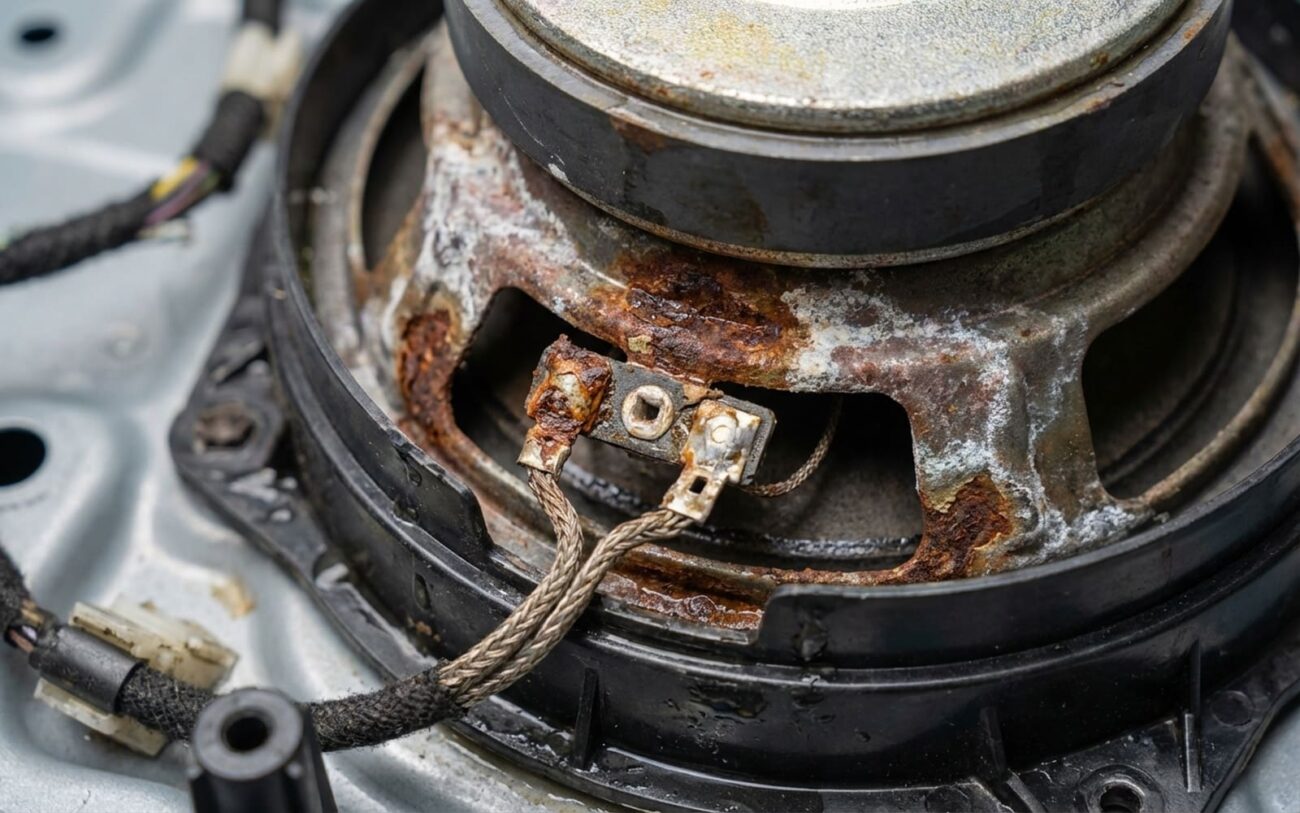
You’re Not Blowing Speakers — You’re Drowning Them
I’ve torn apart thousands of door panels in my career. And if there’s one thing I’ve learned, it’s this: when a door speaker dies, it’s rarely because it “just wore out.” More often than not, water got in. Not a flood — just enough moisture to start corrosion, and within months, that speaker is toast.
The symptoms are predictable. You’ll lose sound in one door — maybe only after rain, or a car wash, or even a humid morning. Sometimes it comes back when things dry out. Other times, it’s gone for good. You might hear crackling, distortion, or muffled tones that make you think the cone’s torn. But I’ve seen plenty of speakers with perfect cones and open circuits — all because the voice coil rusted through.
And here’s what people miss: that corrosion doesn’t just kill the speaker. It can fry the amp. A failing voice coil can short, pull too much current, and take out the amplifier channel driving it. Now you’re not replacing a $60 speaker — you’re rebuilding the head unit or swapping an amp. I’ve seen it turn a simple fix into a $1,000 repair. So don’t wait. If you’re seeing these signs, act fast.
Don’t Replace It — Test It First
I can’t tell you how many times I’ve had a customer show up with a new speaker in hand, only to find the old one was fine and the real issue was a broken wire in the door boot. Replacing parts without testing is gambling — and you usually lose.
Start simple. Pull the door panel. Look for obvious signs: white or green corrosion on the terminals, rust on the basket, damp foam surrounds. If the cone’s warped or the surround’s crumbling, you’re past the point of saving it. But if it looks okay, test it.
Grab a AA battery — yes, just a 1.5V AA. Touch the speaker leads to the terminals. You should hear a solid “pop” and see the cone move out. No pop? No movement? That’s an open voice coil. Speaker’s dead. If it clicks but sounds rough, you’ve got debris in the gap — rust flakes or moisture residue dragging the coil.
Now check resistance with a multimeter. A 4-ohm speaker should read between 3.6 and 4.4 ohms. Infinite? Open circuit. Way low? Shorted windings. Either way, it’s done.
What Actually Dies — And Why
Water doesn’t just sit in the door — it migrates. It follows gravity, condensation, and air movement. And the speaker? It’s at the lowest point, bolted to metal. Perfect setup for corrosion.
The voice coil is the first to go. It’s made of fine copper wire — 0.1mm thick in some cases. When moisture gets in, especially with road salt, it starts electrolytic corrosion. The wire thins, breaks, and you’ve got an open circuit. No current, no movement, no sound.
Next, the gap. Rust from the basket or magnet structure flakes off and gets into the narrow space where the voice coil moves. Now instead of floating freely, it drags or binds. That’s what causes distortion — you’re hearing metal-on-metal at 200 times per second.
And the soft parts? Factory speakers love paper cones and foam surrounds. Both absorb water like a sponge. Paper warps, delaminates, loses rigidity. Foam turns to mush. MDF cones — yeah, some OEMs still use wood-based material in a car door — swell and crack. I’ve pulled speakers where the cone literally fell apart in my hands.
And don’t blame the speaker. The real failure is upstream: a clogged drain plug, torn vapor barrier, or leaking window seal. Fix the speaker without fixing those, and you’re just buying time.
So What Do You Actually Do?
If it’s just dirty — surface mold, dust, light grime — clean it. Remove the speaker, wipe with a damp cloth (not wet), use a soft brush for debris. Let it dry 24 hours in a warm, dry spot. Don’t rush it. But this only works if the voice coil is intact and dry. If you’ve already heard crackling or lost sound, cleaning won’t save it.
If there’s corrosion — green or white powder, sticky residue, seized cone — forget it. You can’t reverse corrosion. No amount of contact cleaner or baking will bring back broken copper. Replace it.
And don’t skip the seal. This is where most DIYers fail. You install a new speaker, bolt it down, and think you’re done. But without a proper gasket, moisture gets right back in. Use a continuous bead of butyl rope or closed-cell foam tape between the basket and door metal. Not caulk. Not RTV. Not electrical tape. Butyl or foam — that’s what seals.
Torque the screws to 2.5–3.5 N·m (22–31 in-lbs) in a criss-cross pattern. Overtighten, and you warp the basket. Undertighten, and the seal fails. I’ve seen both.
And while you’re in there — check the vapor barrier. If it’s torn or peeling, reseal it with butyl tape. This plastic liner is the first line of defense. No vapor barrier? Water sprays in every time you roll the window down. Game over.
Did It Actually Work?
Don’t close the door and call it a day. Test it. Play a 50Hz tone — bass-heavy, makes the cone move. Then 1kHz (mid), then 10kHz (treble). Compare it to the other side. Should sound balanced, clean, no buzzing.
Now do the leak test. With the panel off, play a steady 40Hz tone. Watch the edge of the speaker. If the gasket flutters or you hear “chuffing” — that’s air escaping. Seal failed. Take it off, add more butyl, try again.
And check resistance. Should be within 10% of spec. If it’s way off, you’ve got a dud speaker or wrong impedance. A 2-ohm speaker on a 4-ohm system can overload the amp. Don’t assume “it fits” means “it’s safe.”
What’s It Gonna Cost?
Aftermarket pair: $50–$150. OEM: $150–$400+. Labor at a shop runs $200–$400 for aftermarket, more for OEM. But here’s my rule: if OEM speakers cost more than 20% of the car’s value, don’t do it. A 2012 Camry isn’t getting $600 in factory speakers — it’s not worth it.
And consider this: a pro diagnosis costs $100–$150. But it prevents $300 in wasted parts. I’d rather pay for an hour of labor than guess wrong and replace two speakers, only to find the amp was bad.
Stop It From Happening Again
Every year — mark it on your calendar — check the door drain plugs. They’re at the bottom of the door, usually three or four per side. Poke them with a stiff wire or blow them out with compressed air. Clogged? Water pools. Water pools? Corrosion follows. I see this weekly on 2015–2017 F-150s — Ford didn’t flare the ends enough, leaves collect, drains clog.
If you ever pull the panel, inspect the vapor barrier. Reseal any tears. And consider upgrading to aftermarket speakers with rubber surrounds and sealed baskets. They cost a bit more, but they last longer — especially in coastal or snowy climates.
And listen. Seriously. Every time you fill up, play a quick test track. If one side sounds weak or scratchy, pull the panel. Catch it early, and you save the amp. It’s like noticing TPMS says one tire’s low when the others are fine — could be a leak, could be a sensor. But you check it, because small things become big ones.
