When the Brain Gets Wet: Spotting a Water-Damaged ECU
After 25 years under the hood, I can tell you this much: when an engine computer (ECU) takes on water, it rarely just quits clean. You don’t often get a sudden, silent death. What I usually see is a slow, agonizing unraveling of the vehicle’s electrical nervous system. It starts with weird glitches, gets worse over time, and often ends with a complete communication breakdown.
I’ve pulled dozens of these water-logged ECUs from vehicles, especially after floods or even just persistent leaks. The damage isn’t always obvious from the outside, but the symptoms sure are confusing for drivers and even some seasoned techs.
Think of it like this: your car’s ECU is its brain. When that brain gets wet, it doesn’t always short out immediately. Instead, corrosion starts to eat away at the delicate circuits, causing all sorts of intermittent chaos before it finally gives up the ghost.
ECU DIAGNOSTIC
Status: NO RESPONSE
The biggest red flag I look for is no communication with the ECU when I plug in my scan tool. If it says “No Response” or “Module Not Found,” that’s serious. But hold on — don’t condemn the ECU just yet. You’ve got to rule out other stuff first: fuses, relays, wiring damage, and any issues with the CAN bus network. However, if I know the vehicle was submerged, or I find evidence of water intrusion (like a clogged cowl drain that’s been pouring water on the ECU), then that communication failure points pretty strongly to internal module damage.
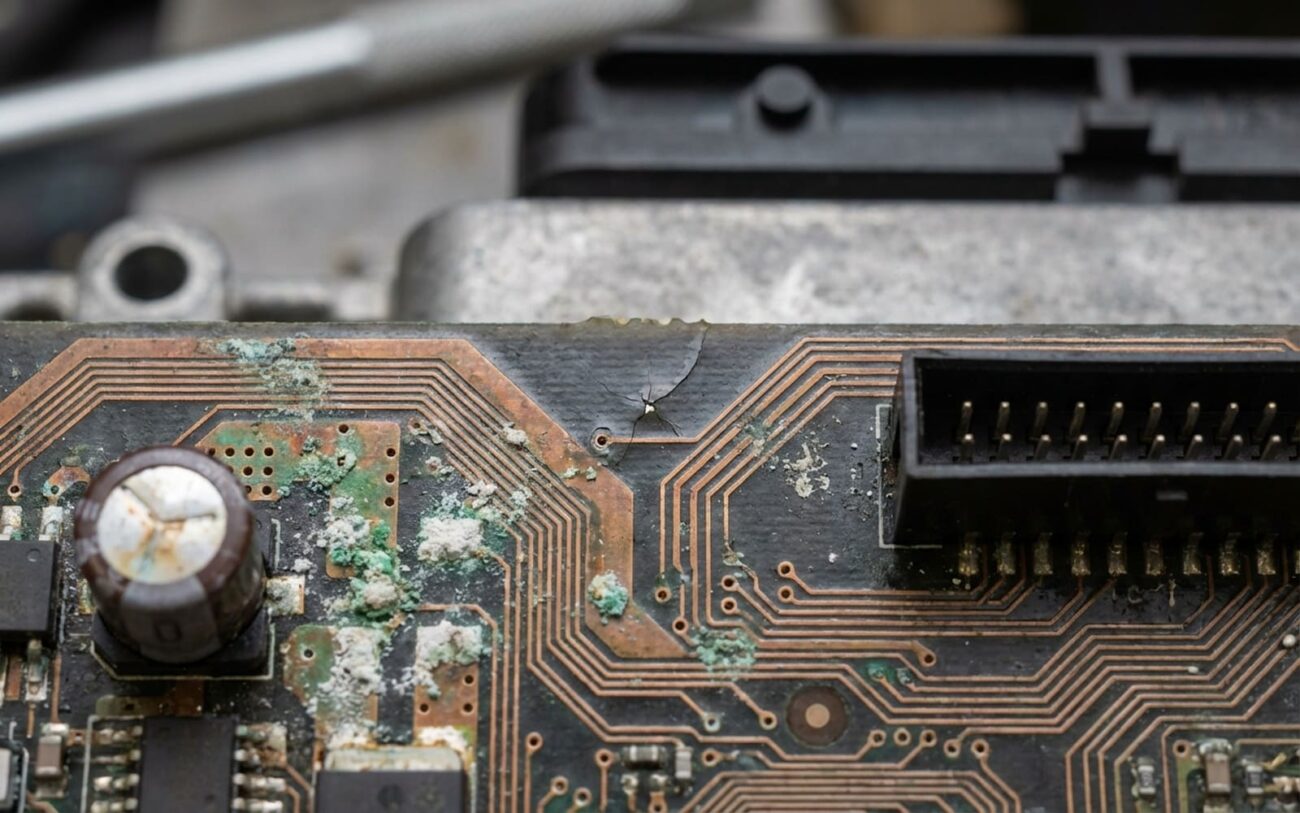
Another dead giveaway is visible corrosion on the ECU connector pins. These modules are often stuck in vulnerable spots—under the hood, under the dash, or even in a wheel well. Unplug the main connector and get a good look. You’re looking for white, powdery deposits or that greenish-blue crust around the pins. That’s electrolytic corrosion, and it’s a sure sign of moisture. In really bad cases, if I open the ECU housing (which I only do in a controlled environment, mind you), I’ll see that same corrosion eating away at the circuit board itself.
Then there are the bizarre electrical symptoms: multiple sensor codes popping up all at once. I’m talking P0121 (throttle position), P0340 (camshaft position), P0107 (MAP sensor)—a whole laundry list. And the kicker? Each sensor might test perfectly fine individually. Why? Because many sensors share a common 5-volt reference or ground supplied by the ECU. When corrosion attacks those internal circuits, it starves multiple sensors of power simultaneously. The result is a bunch of DTCs that send you on a wild goose chase, when the real culprit is the ECU itself.
I also see intermittent stalling, random misfires, crank-no-start conditions, or sudden limp mode activation. These often come from corroded driver circuits inside the ECU that control critical components like fuel injectors or ignition coils. I’ve had cars come in with a “crank no start” where the ECU simply isn’t sending injector pulse signals—even with good voltage at the harness and a perfectly functional crank sensor. That kind of failure almost always points back to internal PCB damage. And yes, while rare, a completely silent failure—no warning lights, no codes, just a dead ECU—is possible. That’s usually when a main power trace corrodes open, cutting off the microprocessor entirely. But in my experience, that’s the exception. Most water-damaged ECUs give you plenty of erratic behavior first. Ignoring those early signs is what turns a potentially simple cleaning job into a total loss.
Is It Really the ECU? Don’t Just Guess.
Before you condemn an ECU, you have to be methodical. I’ve seen too many techs jump straight to replacing the computer, only to find the problem was something else entirely. Many issues mimic ECU failure, especially after water exposure. Bad grounds, damaged wiring, blown fuses, or even a single faulty sensor can trigger similar symptoms. Swapping an ECU without proper diagnosis is a costly mistake—and often unnecessary.
The key is isolating the fault: Is it the module itself, the wiring harness, or something external? Here’s how I break down common symptoms, what else could cause them, and the definitive tests I use to pinpoint the real issue.
| Symptom I See | Likely ECU Failure (Water Damage) | Common External Mimics | My Definitive Test |
|---|---|---|---|
| No communication with ECU | Failed oscillator, damaged power regulation, or corroded CAN transceiver. | Blown ECU power fuse, failed EFI main relay, severed wiring, or poor ground. |
Check battery voltage at ECU connector pins. Verify CAN-H/L signals with a lab scope. |
| Multiple sensor circuit faults | Corrosion of shared 5V reference or sensor ground traces on the board. | Shorted sensor wiring harness, moisture in a connector block, or a single shorted sensor. |
Back-probe 5V ref pin at the ECU connector. If voltage returns when the ECU is disconnected, the short is likely in the harness or a sensor. |
| Engine runs erratically (stalling, misfires, no start) | Failed driver circuits for injectors or coils due to trace corrosion. | Faulty crank sensor, poor engine ground, damaged ignition switch, or a bad fuel pump. |
Use a noid light for injector pulse. Check coil trigger signals with a lab scope. Verify crank/cam sensor signals. |
A common mistake I see:
Too many techs assume a no-start with no spark is automatically a bad ECU. Don’t overlook the basics. A failed crank sensor, a loose ground strap, or even a bad ignition switch can look identical. Always test the inputs and power/grounds before assuming the processor is dead.
The Nitty-Gritty: How Water Kills an ECU
It’s not just pure H₂O that’s the problem; it’s the crud in it. The water that gets into your car—road salts, minerals, dirt—turns into a conductive electrolyte. When this stuff bridges exposed metal on a circuit board, like copper traces and solder joints, it kicks off galvanic corrosion. This electrochemical reaction literally eats away at those thin copper pathways, especially where different metals meet. Over time, these traces flake off or corrode completely open, breaking vital connections inside the ECU.
Another nasty issue is dendrite growth. As moisture cycles through evaporation and condensation, it leaves behind conductive mineral deposits. These deposits can grow like tiny metallic whiskers between closely spaced circuit traces or component leads, creating unintended shorts. These intermittent shorts can crash the microprocessor, corrupt memory, or blow internal protection diodes. The result? Random reboots, corrupted calibration data, or a complete module lockup that’ll drive you crazy trying to diagnose.
And don’t forget the connector pins. Even if the ECU housing itself seems sealed, moisture can wick up the wire insulation or sneak in through a degraded rubber boot. Corrosion here increases resistance, which the ECU often misinterprets as a faulty sensor signal. This is why you’ll sometimes see “circuit high” or “open circuit” codes even when the external wiring tests perfectly fine.
Here’s a critical point: the corrosion is the symptom, not the root cause. The real problem is almost always an external leak. I’m talking clogged cowl drains flooding the engine bay, torn firewall grommets, or failed door seals letting water into the cabin. I’ve pulled ECUs from Hondas and Toyotas mounted under front seats that were completely soaked from backed-up sunroof drains. If you replace the ECU without fixing that leak, you’re just signing up to do the same job again in six months, guaranteed.
What Can You Do? Repair Options & Realities
This Ain’t a DIY for Most
Internal PCB repair requires an ESD-safe workstation, specialized micro-soldering tools, and high-concentration isopropyl alcohol. If the microprocessor or memory chip is fried, repair simply isn’t practical or even possible.
External Pin Cleaning (Sometimes a DIY)
Professional Electronics Repair Specialist Only
Full ECU Replacement & Programming (Most Common for Severe Damage)
Validating the Fix: How I Know It’s Really Fixed
Just because the car starts doesn’t mean the problem is gone. Water-damaged ECUs are notorious for intermittent failures, so validation needs more than a quick test drive. If you only cleaned the connector pins, verification is straightforward: your scan tool should communicate without interruption, and all previously set DTCs should stay cleared after a drive cycle.
For a professionally repaired PCB, the standard is higher. The ECU should pass all built-in self-tests available through a factory-level scan tool. I’ll also put it through repeated key cycles—50 or more—without any glitches. With a full replacement, success means the module is properly programmed, all immobilizer handshakes are complete, and the vehicle can finish a full OEM drive cycle, including setting all emissions readiness monitors. If those monitors don’t set, it’s not truly fixed.
What’s This Going to Cost Me?
Pin Cleaning
DIY cost for materials vs. shop labor for diagnosis and cleaning.
PCB Repair
Professional cleaning, trace repair, and conformal coating by specialists.
Full Replacement
Includes new OEM part, professional programming, and labor.
The decision often comes down to the vehicle’s value. As a rule of thumb I use in my shop, if the repair cost exceeds 40% of the car’s current market value, it’s worth seriously reconsidering. Used or remanufactured modules can lower the cost, but they always come with risks—hidden mileage, programming conflicts, or previous unknown damage. I always advise caution there.
Don’t Let It Happen Again: Preventing Water Damage
My Maintenance Checklist
-
Keep cowl drains clear. This is huge. Blocked cowls allow rainwater to pool and seep into the HVAC housing, which then often floods the ECU.
-
Inspect body seals regularly. Door seals, firewall grommets, and sunroof drains degrade over time. They’re common culprits for letting water into the cabin.
-
Monitor for electrical gremlins after deep puddles or floods. A radio that resets, flickering dash lights, or even a weird window operation are early warning signs. Don’t ignore them.
-
Use dielectric grease on connectors during reassembly. It helps repel moisture and slows down electrolytic corrosion. It’s cheap insurance.
Pro Tip from the Shop Floor
If you’ve ever had a wet floor mat after heavy rain, address that leak immediately. In many modern vehicles, the ECU is mounted exactly where that water ends up. Prevention costs pennies; a new ECU costs thousands. Trust me on this one.
