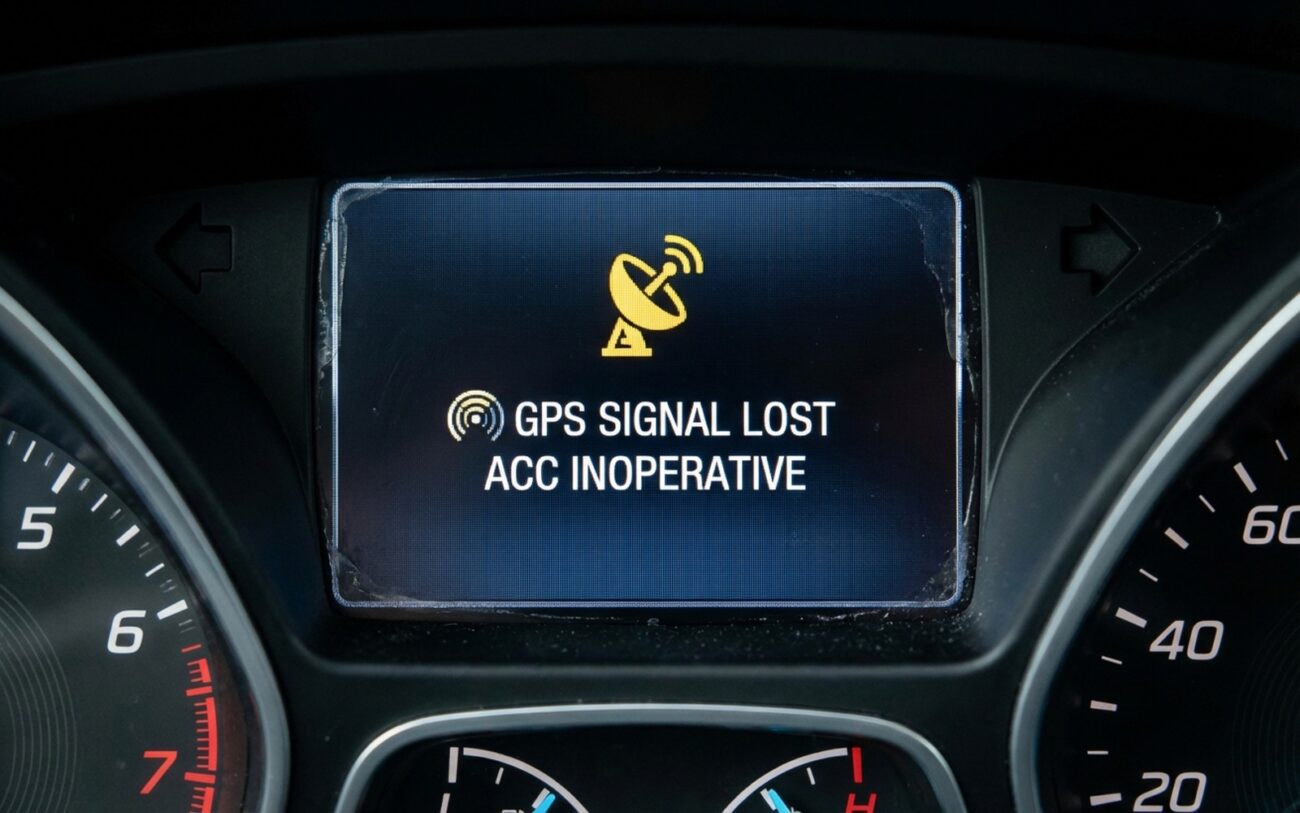
You’re driving down I-75 in your 2018 Ram 1500, adaptive cruise locked in, when suddenly—“ACC Unavailable” flashes on the dash. At the same time, the nav screen spins, stuck on “Searching for Satellites.” That’s not a glitch. That’s the GPS module failing. And I’ve seen it on FCA trucks, BMWs, even some Toyotas—same pattern, same result.
Modern adaptive cruise isn’t just radar watching the car ahead. On systems like Mercedes Distronic, BMW’s Professional package, or Ram’s Level 2 stuff, the car uses GPS and map data to predict what’s coming—curves, hills, speed limit changes. No GPS? No prediction. The system defaults to safe mode: ACC cuts out, or it stays on but only reacts to the car in front. You lose the “smart” part.
And here’s what most techs miss: if the GPS module dies, it doesn’t just kill navigation. It kills the road-reading brain of the whole ADAS suite. That means no proactive slowing for a 25 mph curve—even if the camera sees the sign, the system won’t act without GPS confirmation.
Don’t Replace It Yet — Diagnose Like a Pro
I’ve had customers come in with a “dead GPS module” diagnosis from a shop—after they’d already paid $800 for a replacement. Turns out? Blown fuse. Not the module. Happens all the time.
Before you spend a dime, check the basics. Power. Ground. Signal. It’s not sexy, but it’s how you avoid costly mistakes.
Start with the fuse. On FCA vehicles, the GPS module shares a circuit with the telematics and sometimes the radio. A blown #37 (usually 10A) in the IPM kills GPS and ACC at the same time. On BMWs, it’s often behind the glovebox—fuse 134 or 135, depending on model year. Multimeter it. Don’t just look at it.
Next, scan tool time. Pull live data. What’s the satellite count? Zero? Could be module, could be antenna. But if the module voltage is below 11.8V, don’t blame the hardware yet. Check battery health. Weak battery = unstable modules. Seen it on a 2016 Jeep Grand Cherokee—replaced the battery, GPS came back to life.
| Symptom | Likely in GPS Module | Common External Mimics | Definitive Test |
|---|---|---|---|
| ACC dead, GPS no signal | GNSS chip failure, power circuit | Blown fuse, battery sag, harness disconnect |
Check fuse with multimeter. Then scan tool: zero satellites + low module voltage = internal failure likely. But confirm battery is above 12.4V first. |
| ACC works, but no curve slowdown | Firmware glitch, map correlation fault | Outdated maps, missing license, radar misalignment |
Compare GPS coordinates on scan tool to phone GPS. Off by more than 50 feet? Hardware issue. Try a map update via dealer portal—could save you $600. |
| GPS drops in tunnels, then won’t come back | Cracked antenna trace, bad solder joints | Roof antenna damage, water in coax, EMI |
Use scope on antenna input pin at module. Clean signal? Then module isn’t processing it—points to internal fault. |
What’s Actually Failing Inside?
I’ve cracked open dozens of these modules. They’re not just antennas—they’re full signal processors. And they fail in predictable ways.
-
GNSS receiver chip: Takes the satellite signal and calculates position. Runs hot under the dash. After 5–7 years, thermal cycling kills it. Common on BMWs and Land Rovers.
-
Capacitors: Electrolytic caps on the power input dry out. You’ll see bulging tops or leakage. Causes intermittent resets. Replace them, and sometimes the module comes back.
-
Antenna trace: Some modules use a printed trace on the PCB as the antenna. Vibration cracks it. Seen it on Jeeps driven off-road. No signal, but the chip is fine.
-
Firmware corruption: Especially after a battery disconnect. The almanac data (satellite orbits) gets wiped. Module can’t acquire satellites fast enough, so the system flags it as failed.
How I Fix It — Based on What’s Wrong
Reflash the Module DIY-FEASIBLE
Replace the Module PROFESSIONAL-ONLY
Solder Repair SPECIALIZED
Battery Reset Trick LAST-RESORT
After the Fix — Validate It
You’re not done when the module’s in. Drive it. At least 15 miles. Let it lock onto satellites, load map data, relearn its position.
Pull live data again. Satellite count? Should be 8+. Position accuracy? Under 10 feet. ACC should now slow for curves. If it doesn’t, check radar alignment. A misaligned radar can block GPS data integration—even if the module’s working.
Firmware Reprogramming
DIY: $100–$200 (software access)
Shop: $150–$250
Success Rate: 95% if software issue
Risk: Bricking if power drops
Module Replacement (OEM)
DIY: $400–$800 (part)
Shop: $600–$1,200 (parts + labor + programming)
Success Rate: Near 100%
Risk: VIN programming failure
Solder Repair
Not DIY
Shop: $200–$400
Success Rate: ~70%
Risk: Other components failing later
And if the repair costs more than 30% of the car’s value? I tell the customer: live without the map-based features. Basic ACC still works on radar. You’ll follow traffic fine. Just don’t expect the car to slow for a curve it can’t see coming.
Prevention — Because You’ll Thank Me Later
-
Keep the battery healthy. Below 12.4V? Charge it before any software work. Voltage drops during reflashes are the #1 cause of “sudden” GPS failure.
-
Watch startup time. If nav takes 2+ minutes to get GPS lock, that’s not normal. Usually means capacitors are failing. Replace the module before it dies completely.
-
Update maps regularly. Outdated maps won’t kill the module, but they’ll make diagnostics harder. And yes, some systems disable predictive ACC if map data is too old.
And one last thing: when you change the battery, use a memory saver. $30 tool. Saves you hours of reinitialization, module syncing, and surprise “ADAS unavailable” messages.
