You walk up to your car, grab the driver’s door handle, and nothing happens. No unlock, no welcome lighting, no mirror fold. But hit the fob button? All doors respond fine. That’s not a dead battery or a blown fuse—it’s a dead giveaway the passive entry system on that door is down. I’ve seen this on everything from Toyotas to Teslas, and more often than not, it’s the handle assembly itself. Let me walk you through how I diagnose and fix this in my shop.
First: Confirm It’s Passive Entry — Not Remote RF
Before you pull a single trim panel, verify what’s actually broken. If pressing the fob button locks and unlocks all doors, your key fob, RF receiver, and body control module (BCM) are working. That’s huge. It means the problem is isolated to the passive entry system on one door—specifically, the low-frequency (LF) antenna and capacitive touch sensor built into the handle.
I can’t tell you how many shops skip this and throw parts at it. But here’s the rule: if remote functions work, the fault is downstream of the BCM. That narrows it to three things: the door handle electronics, the door harness, or the LIN bus communication to that module. And 80% of the time? It’s the handle.
Symptoms That Point to the Handle
Here’s what I look for when the customer says, “Only one side won’t unlock when I touch it.”
Passive entry fails on one door — but remote works.
That’s classic. The LF antenna inside the handle isn’t picking up the key fob’s signal. Could be a broken coil, failed capacitive sensor, or corroded circuit board. On 2018+ Camrys and Highlanders, I see this every few weeks—especially in coastal areas where salt and moisture eat the seals.
No welcome lighting or mirror unfold on that side.
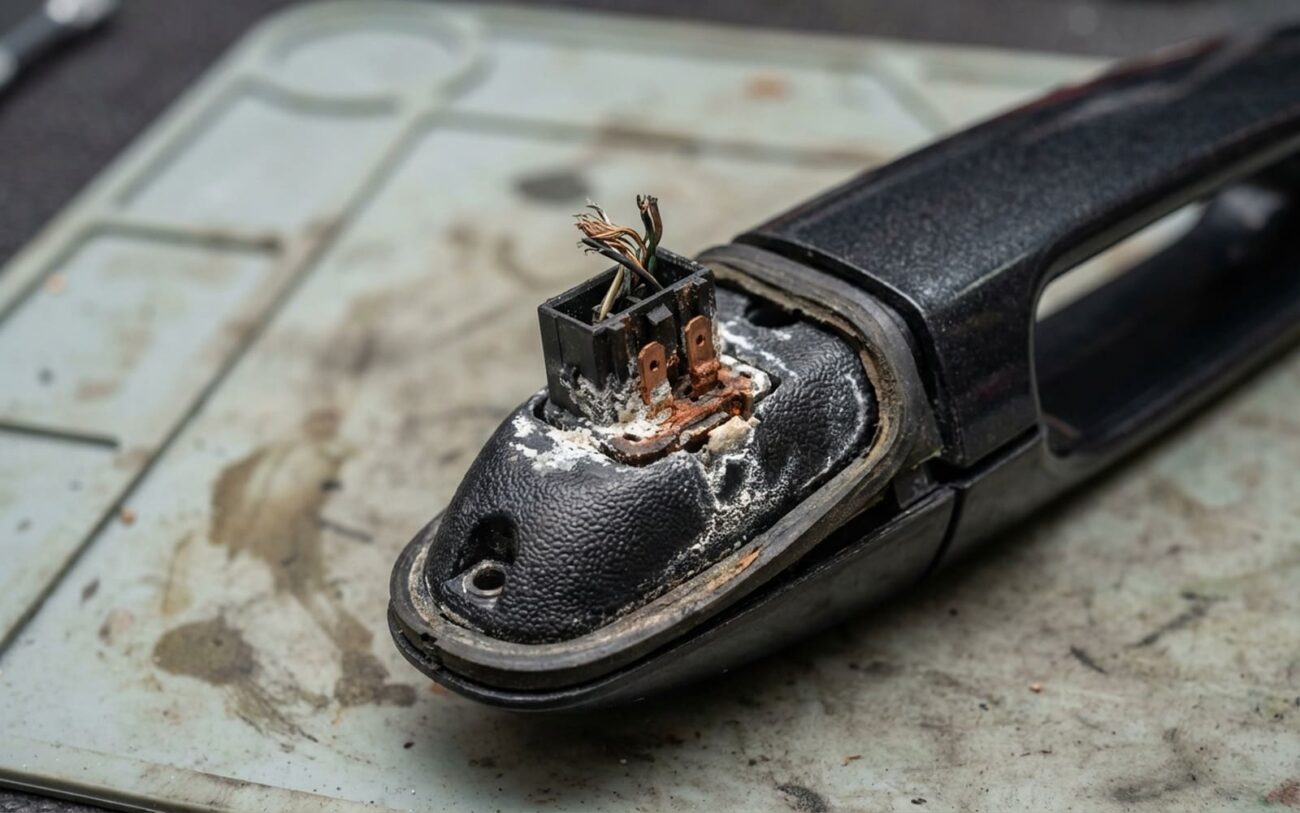
That’s a red flag. Those features are tied to the same module. If they’re out too, it’s not just the antenna—it’s the whole handle’s internal circuitry. I’ve pulled apart dozens, and half show white corrosion on the PCB near the antenna feed. Moisture got in, and it’s toast.
Intermittent operation — works when warm, fails when cold, or only after wiggling.
That screams cracked solder joint or broken trace. Thermal cycling from daily use expands and contracts the board until something gives. I’ve seen it on Fords, Hondas, you name it. Wiggle the handle while watching live data on a scan tool—if the LIN signal drops, it’s inside the handle.
How I Diagnose It — No Guessing
I don’t replace handles on hunches. Here’s my actual workflow:
Step 1: Scan for DTCs.
Plug in an OEM-level tool—something that can read body control and door module codes. Look for U-codes related to LIN bus communication or “LF Antenna No Signal” on the affected door. If it’s throwing a code for that door only, you’re on the right track.
Step 2: Run the antenna test.
Most modern vehicles have a built-in diagnostic for the passive entry antennas. Run it. If the system shows “No Activation” or “Signal Strength: 0” for the driver’s side, the antenna isn’t talking. That’s not a wiring issue—it’s the handle.
Step 3: Power and ground check.
Unplug the handle connector. Test for 12V and ground at the harness side. If you’ve got both, the supply is good. No power? Then trace back to the fuse and ground at the door jamb. But if power’s there and the handle still doesn’t work, it’s the assembly.
Step 4: Swap test (if possible).
On symmetric vehicles (like most sedans), I’ll swap the driver’s and passenger’s handles. If the problem moves to the other side, it’s confirmed. This is the gold standard. I’ve used it on Accords, Explorers, you name it.
Why Handles Fail — And It’s Not Random
These aren’t fragile parts, but they’re not invincible. The LF antenna is either a thin wire coil or a printed trace on a small PCB, both embedded in plastic. Over time, the handle flexes with use—especially in cold weather—and that stress cracks solder joints.
But the real killer? Moisture. There’s a rubber gasket inside the handle that seals the electronics. When that dries out or cracks, water gets in. I’ve seen it pool on the board after a heavy rain. Corrosion follows, and once that happens, the antenna or sensor fails.
GM and Toyota both had TSBs on this in the late 2010s. Some models—like the 2016-2019 RAV4—were notorious for it. The fix was an updated handle with better sealing. But even now, the design hasn’t changed much. If you live near the coast or deal with winter roads, this is a wear item—like wiper blades.
Can You Repair It? Honestly? No.
I’ve tried. So have a few guys I know. You can crack open the handle, clean the board, reseal it—but it’s a long shot. The gasket is glued in place, and once it’s disturbed, it’s hard to reseal properly. Plus, if there’s corrosion, you’re not fixing that with contact cleaner.
And forget replacing just the antenna or sensor. They’re not sold separately. No aftermarket kits. No repair boards. The only real fix is a new OEM or OEM-equivalent handle assembly.
After install, you’ve got to initialize it. Most vehicles require a “learn” procedure via scan tool so the BCM recognizes the new hardware. Skipping this? The system might not enable passive entry. I’ve had customers come back pissed because they didn’t realize this step was needed. Don’t be that guy.
How I Know It’s Fixed
I don’t just touch the handle once and call it good. I walk around the car, approach from different angles, test lock and unlock. The welcome lighting should fire, mirrors should unfold, and the door should unlock on touch.
Then I plug in the scan tool again:
- Clear any old codes.
- Check for new DTCs—especially U-codes or “Antenna Not Responding.”
- Run the built-in LF antenna diagnostic. Signal strength should be normal, and activation should register.
If all that passes, it’s done. If not, something’s still off—maybe a bad connection or failed initialization.
Cost vs. Reality: Is It Worth Fixing?
Let’s be real. A new handle runs $150–$400. Labor’s another $150–$300. So you’re looking at $300–$700 total. If your car’s worth $5,000, that’s 6–14% of its value. Is it worth it?
Here’s my take: if you’re keeping the car and want full function, yes. If you’re selling soon, yes. But if it’s an older daily driver and you don’t care about convenience, just use the fob button. I’ve done it on my own trucks. It’s not ideal, but it’s not unsafe.
Pro tip: Always check for TSBs before buying parts. Some manufacturers have updated handles with better seals. And if your car’s under warranty—or CPO—this might be covered. I’ve saved customers hundreds just by checking.
How to Make It Last Longer
Moisture is the enemy. So avoid high-pressure sprayers aimed at the handle seam—common in automatic car washes. That force can degrade the internal gasket over time.
And never yank a frozen handle. I’ve seen guys rip the whole mechanism apart because they didn’t wait for it to thaw. Use de-icer or warm water first.
For prevention, test passive entry on all doors monthly. If one starts acting up, treat it like an early warning. And when you replace a handle, consider a light coat of dielectric grease on the internal gasket (if OEM specs allow it). It won’t fix a bad seal, but it can help it last longer.
