You’re cruising down the highway, everything’s smooth, and then BAM! The cruise control just drops out. No warning, no fade, just gone. I’ve seen this scenario play out hundreds, maybe thousands, of times over my 25+ years turning wrenches. And here’s the straight goods: almost every single time, it comes down to the Powertrain Control Module (PCM) or the dedicated cruise control module losing a reliable speed signal. When that happens, the system does exactly what it’s designed to do: it shuts down to keep you safe.
Modern vehicles rely on incredibly accurate speed data to maintain a set speed. If that signal gets wonky, disappears, or just doesn’t make sense, the system disengages. You’ll see that “CRUISE” light vanish from your dash, and depending on what you drive, you might get a chime or a message like “Cruise Control Unavailable.” The PCM usually logs a Diagnostic Trouble Code (DTC) — think P0500 (Vehicle Speed Sensor “A” Malfunction) or a wheel speed sensor code from the ABS module. These codes are your starting point, but don’t just assume the sensor is dead. That’s where proper diagnosis comes in.
How I Pinpoint the Problem
Replacing parts without really knowing what’s going on is a surefire way to empty your wallet and waste your time. Trust me, I’ve seen it too many times. The symptoms can overlap, but the root causes are often very different. Here’s how I narrow it down in the shop, based on what else is (or isn’t) happening with your vehicle.
Scenario 1: Cruise Quits, Speedometer Goes Haywire
If your cruise control drops out and your speedometer starts acting up – flickering, dropping to zero, or just being generally erratic – that’s a strong indicator that you’re dealing with a shared signal source. Usually, that’s the Vehicle Speed Sensor (VSS) located on the transmission. This sensor feeds speed data to both your instrument cluster and the PCM.
Now, it might be the VSS itself – an internal electronic failure, maybe a hall-effect sensor or magnetic pickup that’s just given up. But don’t rule out external factors that mimic a bad sensor. I’ve found damaged tone rings (the reluctor wheel) on the transmission output shaft, corroded connectors at the sensor or even back at the PCM, or wiring that’s chafed and shorting out near the transmission. On older vehicles, sometimes the gear inside the transmission that drives the VSS can strip.
My Diagnostic Approach: First, I hook up a good bi-directional scan tool and monitor live vehicle speed data while driving. If I see erratic readings or the speed drops to zero while the wheels are clearly turning, that confirms a signal issue. Then, I’ll visually inspect the sensor and its wiring. If I suspect the tone ring, a borescope can sometimes give you a peek without tearing things apart. For a definitive sensor test, an oscilloscope is key. It lets me see the actual waveform coming from the sensor. A clean, consistent square wave (for active sensors) or AC sine wave (for passive) means the sensor is likely okay; anything noisy or missing points to the sensor or its immediate circuit.
Scenario 2: Cruise Quits, ABS or Traction Control Light Comes On
This is a pretty clear indicator. If your cruise control dies and you suddenly have the ABS (Anti-lock Braking System) or ESC (Electronic Stability Control) warning light glaring at you, you’re almost certainly looking at a Wheel Speed Sensor (WSS) problem. Modern vehicles rely heavily on data from these ABS wheel sensors for vehicle speed input, especially at lower speeds or when the transmission VSS isn’t the primary source.
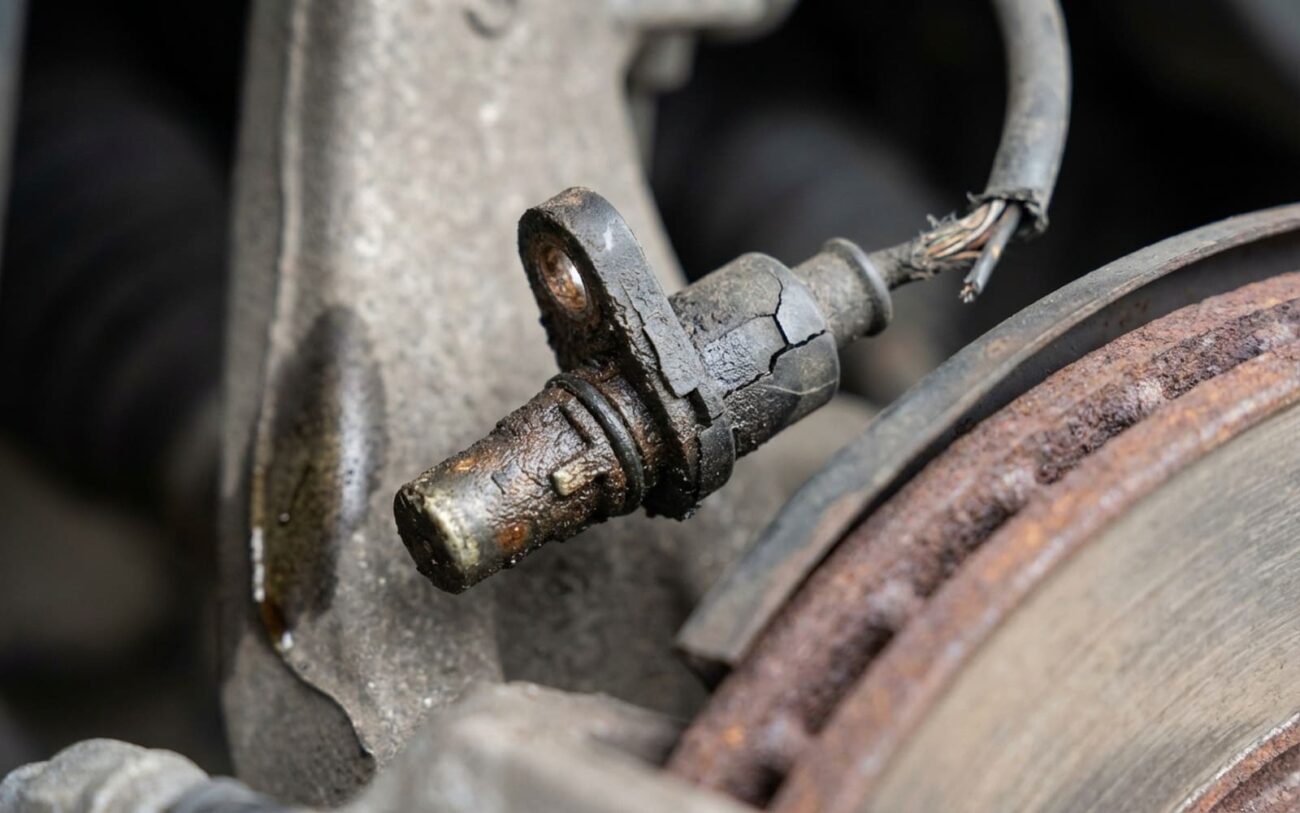
A faulty WSS isn’t just about losing cruise; it disables critical safety systems like ABS and stability control. Ignoring that light is a big mistake – you’re compromising your ability to stop safely in an emergency. The sensor itself could have an internal electronic or magnetic failure. But again, look for the external mimics: I’ve seen severed or pinched wiring, excessive air gaps caused by worn wheel bearings (which can move the tone ring too far from the sensor), corroded tone rings, or just plain old debris buildup on the sensor tip.
My Diagnostic Approach: You absolutely need a scan tool with ABS module access for this. I’ll monitor all four wheel speeds in real-time while driving. If one wheel shows a missing, erratic, or significantly different reading compared to the others, you’ve found your culprit. For older, passive sensors, I’ll check the resistance (typically 800–2500 ohms, but always check specs). For active sensors, I’ll verify the reference voltage going to the sensor and then use an oscilloscope to check the signal output – it should be a clean, consistent digital pulse train. On a 2015-2017 F-150, for example, I’ve seen rear WSS wiring get pinched by the leaf spring during suspension travel, causing intermittent ABS lights and cruise dropout.
Scenario 3: Cruise Quits, No Other Symptoms or Warning Lights
This one can be trickier, because it’s less likely to be a direct speed sensor failure. If your speedometer is fine, no ABS lights, and nothing else seems amiss, you might be dealing with an intermittent signal loss due to a poor connection somewhere, or even an issue within the cruise control module itself. This is where you start looking at other inputs the cruise system uses.
Common culprits I’ve run into here include a faulty brake pedal position switch (sometimes called a stop light switch) that sticks or fails to fully release its signal, or a defective clutch switch on manual transmission vehicles. A worn cruise control switch on the steering wheel, a damaged clock spring (the ribbon cable inside the steering column), or even a glitch in the CAN bus communication network can cause this. I once spent a frustrating hour on a Mercedes where it was just a tiny bit of corrosion on the brake light switch terminals.
My Diagnostic Approach: Again, the scan tool is your best friend. I’ll go into live data and monitor the brake and clutch switch status. You’re looking for the “brake applied” status when your foot is clearly off the pedal, or vice-versa. I’ll also check the cruise control switch circuit continuity with a multimeter. Some advanced scan tools can even command the cruise control function directly, which helps verify module communication. If all those inputs look good, then you start digging into wiring harnesses for intermittent opens or shorts, especially where they flex or pass through firewalls.
Why Do These Sensors Actually Quit?
When I say a sensor is “bad,” I mean the guts of the thing have failed – not the wiring leading to it, not the connector, but the sealed electronics or magnetic components inside. It’s important to understand this distinction, because a lot of folks replace sensors when the real problem is just a frayed wire.
Older, passive magnetic wheel speed sensors are pretty simple. They use a coil of wire wrapped around a magnet to generate an AC signal as a metal tone ring passes by. Over years of vibration and constant heating and cooling cycles, that fine wire in the coil can break. The magnet itself can weaken or even crack. They’re robust for what they are, but nothing lasts forever.
Modern vehicles mostly use active hall-effect sensors. These are more sophisticated, using a semiconductor chip to detect changes in a magnetic field and output a precise digital signal. While they’re incredibly accurate, they’re also more sensitive. The integrated circuit inside can fail from prolonged exposure to high heat – I see this a lot on rear sensors, especially if they’re close to brake drums or calipers that run hot. Moisture intrusion is another huge killer. If the sensor’s seal gives out, road splash, or even a pressure washer, can introduce water. That leads to internal corrosion, which road salt just accelerates. I’ve pulled sensors that looked perfectly fine on the outside but were a rusty mess inside. And sometimes, a single hard hit from road debris is all it takes to crack the housing just enough to kill the signal.
Important Note: There have been documented reliability issues and service bulletins from manufacturers about moisture getting into wheel speed sensor connectors and wicking its way into the sensor body itself, causing intermittent ABS and traction control faults. But remember: a damaged tone ring, frayed wiring, or a corroded connector is not a “sensor failure.” Those are separate issues that just happen to cause the same symptoms. Always, and I mean always, inspect the entire circuit – the sensor, its wiring, the connector, and the tone ring – before you condemn the sensor itself. Otherwise, you’re just throwing parts at a symptom.
Getting It Fixed: DIY or Pro?
Once you’ve done your diagnosis and you’re confident you know what’s bad, you’ve got a couple of paths to take. Some of these jobs are perfectly within reach for a competent DIYer, while others are strictly for the pros.
DIY-Friendly: Accessible VSS or External Wheel Speed Sensors
Replacing a transmission-mounted VSS or a front wheel speed sensor on a MacPherson strut setup is usually pretty straightforward. These are often held in with a single bolt and are fairly easy to reach with basic hand tools. You’ll typically need a socket (common sizes are 8mm, 10mm, or a T25 Torx), the OEM-specified replacement sensor (I always recommend OEM or a high-quality aftermarket brand here), some electrical contact cleaner, and dielectric grease.
The process is usually: unbolt the old, clean the mounting surface thoroughly, clean the electrical connector, apply a dab of dielectric grease to the new sensor’s connector to keep moisture out, and then bolt the new one in. Make sure you torque that sensor properly! Over-tightening can crack the housing or distort the magnetic gap, causing another failure. Check your service manual, but typical torque is around 7–10 Nm (62–88 inch-pounds). If you’re comfortable working safely under your car, this is a solid DIY job.
Professional-Only: Integrated Wheel Speed Sensors and Hub Assemblies
Now, this is where things get serious. On a lot of modern vehicles, especially many GMs, Fords, and some imports, the rear wheel speed sensor isn’t a separate, bolt-on part. It’s built right into the wheel bearing or hub assembly. Replacing it means you’re replacing the whole hub.
This job requires specialized tools: a hydraulic press (or a heavy-duty hub puller kit), large sockets (like a 32mm for the axle nut), and critically, a torque wrench capable of 200+ ft-lbs. That axle nut is often a one-time-use part and needs to be torqued to incredibly specific specs, sometimes something like “210 Nm plus an additional 90 degrees of rotation.” Get that wrong, and you risk premature bearing failure, damaging the CV axle, or even a wheel coming loose down the road. Plus, you often need a front-end alignment afterward, especially if it’s a front hub. If you’re not a certified technician with the right equipment and experience, leave this one to the shop. It’s not worth the risk.
No Repair, Only Replace: Internal Sensor Failure
Let’s be clear: once diagnostics confirm a sensor has failed internally, it’s a sealed unit. There’s no field service for these things. You can’t clean out the internals, you can’t solder a broken wire inside the housing. There’s no “repair.” If it’s dead, replacement is the only option. Don’t waste your time trying to fix something that isn’t designed to be fixed.
Temporary Fix / Diagnostic Step: Cleaning Debris
Sometimes, especially on front wheel sensors, brake dust and tiny metal shavings from the rotor can build up on the sensor tip. This gunk can block or distort the magnetic signal. You can carefully clean it off with some brake cleaner and a brush. If your cruise control starts working again, fantastic! But understand this: it’s often a temporary fix. If the underlying issue is constant contamination, it’ll happen again. And if the sensor was already internally failed, cleaning won’t do a thing. Use this as a diagnostic step to rule out simple interference, not as a permanent repair.
How I Know the Job’s Done Right
Don’t just bolt on the new part and assume you’re good to go. You absolutely need to validate the repair properly. Skipping this step is how you end up with repeat visits to the shop, or worse, a false sense of security.
First, clear all stored DTCs from both the PCM and the ABS modules using a capable scan tool. Then, you need to take the vehicle for a decent road test – I usually go for 5–10 minutes at speeds above 25 mph. After the drive, re-scan for codes. If nothing comes back, that’s a very good sign.
Functionally, you should be able to set and maintain cruise control on a flat stretch of road without any unexpected dropouts. For an extra check on speedometer accuracy, I’ll often use a GPS speed app on my phone. They should match within 1–2 mph; if there’s a big discrepancy, you might still have a signal issue or even a cluster problem.
For wheel speed sensors, the definitive test is watching live data from the ABS module. Drive at a steady 30 mph and observe all four wheel speed readings. They should be consistent, within 1–2 mph of each other, with no sudden drops, spikes, or flatlining. If one sensor is reading zero or jumping erratically, you still have a problem. A bi-directional scan tool that can talk to the ABS module is non-negotiable for this final verification. Without it, you’re just guessing, and that’s not how we do things in my shop.
What’s This Going to Cost You? (And Why Diagnosis Pays)
Let’s talk money, because that’s always a factor. Understanding the potential costs helps you decide whether to tackle it yourself, or if it’s time to bring it to a professional. These are rough estimates based on what I see in the field:
- Accessible VSS Replacement (DIY): You’re usually looking at $30–$100 for the part. If you bring it to a shop, expect $150–$300 for parts and labor. If the diagnosis was spot-on, the success rate is high, around 95%. The risk if you get it wrong? Minimal – the symptom just persists, no major safety issues beyond wasted effort.
- Integrated Wheel Bearing/Hub with WSS Replacement (DIY): Parts alone can be $150–$400, and you’ll likely need an alignment afterward. A shop will charge $400–$800 for parts and labor. With proper installation, the success rate is about 98%. The secondary risks here are significant: improper torque or press-fit can damage the new bearing, ABS wiring, or even the CV axle. And a severely under-torqued axle nut could lead to wheel separation. That’s a huge safety concern.
Here’s the reality check: if you’re working on an older car – say, 10+ years old and maybe worth a few grand – and you’re facing a complex electrical diagnosis, just throwing parts at it is a losing strategy. I’ve seen customers spend $1,200 chasing an intermittent cruise issue, only to find out it was a $15 brake switch. My advice? Paying a qualified shop for an hour of diagnostic time, using their expensive scan tools and oscilloscopes, is almost always cheaper than guessing wrong. That right diagnosis pays for itself, every single time.
Keeping It From Happening Again
Prevention really starts with awareness and a little proactive maintenance. When you’re doing routine brake service, take an extra 30 seconds to visually inspect the wheel speed sensor and its wiring. Look for cracked boots, damaged cables, or any metal debris stuck to the sensor tip. Clean it if needed. A little attention here can prevent a frustrating cruise failure down the road.
Pay attention to any early warning signs. Does the cruise only cut out when you hit a bump? Does the ABS light flicker momentarily? Those are huge red flags pointing to an intermittent connection or a sensor that’s on its way out. Address them early, before you’re stranded or, worse, dealing with a critical safety system outage.
And when you’re doing related work – like replacing a CV axle or a hub – be extra careful with the tone ring. Don’t beat on it with a hammer, and make sure to clean any metal debris from the area before you put everything back together. A scratched or dented tone ring will give a bad signal no matter how good your new sensor is.
Ultimately, all these vehicle systems are interconnected. Just like a faulty outside temperature sensor can throw off your climate control, a failing speed sensor doesn’t just affect cruise control. It can disrupt your ABS, traction control, and stability systems. Treat these components with the respect they deserve – they’re not just about convenience; they’re a vital part of your vehicle’s safety network.
