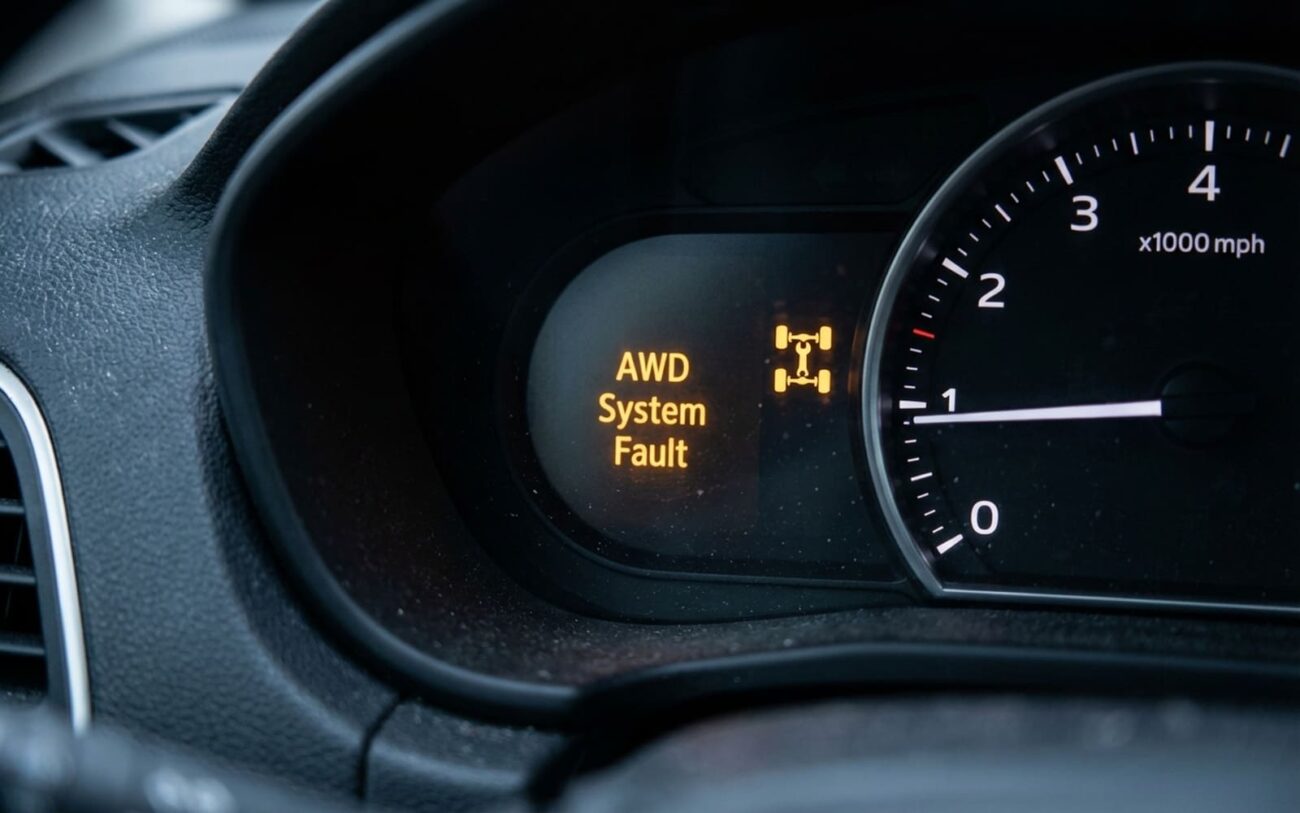
Alright, let’s talk about that all-wheel drive warning light on your dash. If it’s on, especially if you’ve also felt the car ‘binding’ or ‘grabbing’ during tight turns, or just acting funny when you hit the gas, don’t ignore it. That light means the AWD system has seen a fault and, more often than not, it’s shut itself down to protect itself. And trust me, you want it to protect itself.
What the Light Means & How I Diagnose It
When that AWD light comes on, it usually points to a fault in the system. In my experience, one of the most common culprits is a faulty center differential torque sensor. This sensor tells the AWD control module how much power is being transferred between the front and rear axles. If that signal is missing, erratic, or just plain implausible, the system defaults to “safe mode” to prevent damage, which means the AWD light comes on, and sometimes traction control or stability systems will kick in too.
So, the light’s on. What’s next? First thing I do is hook up the scan tool. Those diagnostic trouble codes (DTCs) are your first real clue, but they’re just a starting point. You’ll often see generic codes like P1890, or manufacturer-specific ones like Subaru’s C1142 or Audi’s 01379. These usually point right to a torque sensor circuit issue. But—and this is critical—the code itself doesn’t mean the sensor is bad. It just means the AWD control module isn’t getting a signal it likes. That could be the sensor, sure, but it could also be a corroded connector, damaged wiring, a power supply problem, or even a glitch in the module itself. You can’t just throw parts at it.
If the car’s binding or grabbing during slow, tight turns, that’s another big symptom. This happens when the AWD system thinks it needs to lock up the center differential, even at low speeds, which it absolutely shouldn’t do. A bad sensor can trick the system into doing this, sending a false ‘high torque’ signal. But don’t forget other culprits: mismatched tire sizes (yes, this is a huge one for AWD!), binding CV joints, or even a stuck clutch control solenoid can cause the same feel.
My Go-To Diagnostic Tests:
-
Live Data Scan: Get the vehicle on a lift. With the wheels off the ground, I use a capable scan tool to look at live torque sensor data. At idle, it should read close to zero (0-20 Nm, depending on the vehicle). Then, I’ll gently apply a little throttle. That value should rise smoothly. If it’s erratic, stuck, or just plain zero when it shouldn’t be, that’s a strong indicator.
-
Electrical Checks: I’ll also check voltage and ground at the sensor connector itself. A simple multimeter can tell you if the sensor is getting power and a good ground.
-
Tire Circumference: If you’re feeling binding, I’m also going to measure all four tires’ circumference—even a small difference can cause severe binding on some systems. This is a common oversight.
-
Bi-directional Control: If my scan tool allows, I’ll try to command 0% clutch engagement to the center differential. If the binding goes away, it helps isolate whether the sensor is lying, or if there’s a mechanical or hydraulic issue with the clutch pack or solenoid.
What Actually Fails in These Sensors?
When it is the sensor itself, what’s actually going on inside? Most modern torque sensors use a Hall-effect design. Think of it as a little magnet and a semiconductor chip that work together to measure how much the driveline is twisting. Over time, all the heat cycles, vibrations, and electrical stress just wear these things out.
What I typically see failing:
-
Weakened Magnets: The internal magnet loses its strength, so the sensor sends a weaker signal than it should. The computer sees this ‘implausible’ signal and throws a code.
-
Integrated Circuit Failure: The tiny electronics inside the sensor can just quit. Voltage spikes (I’ve seen this after bad jump-starts or alternator issues) or just plain old age can kill them, resulting in no signal at all.
-
Mechanical Wear: Some sensors have moving parts, like a torsion bar. These can wear out, leading to erratic or jumpy readings, especially when you’re trying to accelerate smoothly.
Manufacturer Pattern Alert:
I’ve seen patterns, too. For instance, Subaru released a service bulletin for 2005–2009 Legacy and Outback models addressing DTC C1142 and AWD warning lights, specifically citing the transfer clutch torque sensor as a known failure point. Similar issues have been observed in certain Audi Quattro, BMW xDrive, and Haldex-based AWD systems.
But let me be clear: a bad sensor is one thing. Don’t confuse it with a worn-out clutch pack or a bad solenoid. If the clutch pack is already burned or glazed from prolonged lockup, replacing the sensor won’t fix that. The sensor just reports what it sees. A stuck clutch control solenoid is a hydraulic problem, completely separate from the sensor itself.
Repair Options: What You’re Up Against
[DIY-FEASIBLE] Skilled DIYers
-
You’ll likely need to drain some gear oil, especially if it’s a ‘wet’ area.
-
Disconnect the electrical connector.
-
Remove the mounting bolts and carefully extract the old sensor.
-
Install the new sensor with its fresh seal, and make sure you torque it to spec (I’ve seen them range from 15-25 ft-lbs, but always check your service manual for the exact number).
-
Refill the fluid with the correct type—don’t skimp here (SAE 75W-90 GL-5 is common, but verify!).
-
Finally, you must perform the system calibration with your scan tool. Skipping this means the AWD system won’t know how to interpret the new sensor’s readings, and the light will likely come right back on.
[PROFESSIONAL-ONLY]
If that sensor is buried deep inside the differential or requires taking the transfer case apart, this is absolutely not a DIY job. We’re talking about removing the transmission, splitting the differential housing, and dealing with precision components like bearings and gear backlash. This isn’t just bolting on a part; it’s intricate work. Get any of those measurements or torques wrong, and you’ll end up with noise, vibrations, or a complete drivetrain failure down the road. Trust me, I’ve had to fix enough of those ‘DIY gone wrong’ jobs.
[NON-REPAIRABLE → REPLACE ASSEMBLY]
[TEMPORARY / LAST-RESORT]
Verifying the Repair: Don’t Skip This
Okay, new sensor’s in, fluid’s topped off, and the light’s off. You’re done, right? Not so fast. Just because the light’s out doesn’t mean the job’s done. You absolutely have to verify that the repair actually fixed the issue and that the AWD system is working correctly.
My standard procedure is a functional road test. I’ll drive it for at least 10 miles, hitting all the common scenarios: straight-line acceleration, coasting, and multiple full-lock, low-speed turns in both directions. The AWD warning light must stay off, and there shouldn’t be any binding, grabbing, or hesitation during those tight maneuvers.
Even better, I’ll keep the scan tool hooked up and monitor live data. I’m looking for a plausible torque sensor reading at idle (usually 0-20 Nm, depending on the vehicle). I want to see that value increase smoothly when I apply throttle. And if my scan tool allows it, I’ll command clutch engagement and watch for a corresponding rise in reported torque. This confirms the entire feedback loop is intact: the module sends a command, the actuator responds, and the sensor reports back accurately.
Costs, Risks, and Making the Smart Choice
Now, let’s talk about the money side of things. This is where you have to make a smart choice, because the costs can vary wildly depending on what’s actually failed and how long it’s been ignored.
| Repair Type | DIY Cost (Parts Only) | Shop Cost (Parts & Labor) | Repair Success Rate | Secondary Risks |
|---|---|---|---|---|
| External Sensor Replacement | $150 – $400 | $500 – $900 | High (>95%) | Fluid leaks; skipped calibration may prevent system operation |
| Internal Sensor Replacement | $200 – $500 | $1,500 – $3,000 | Medium (~80%) | Incorrect gear backlash or bearing preload leading to rapid failure |
| Assembly Replacement | $2,000 – $3,500 | $3,500 – $5,000 | Very High (>98%) | Low; most reman units come with a warranty |
Expert Rule of Thumb
Here’s my rule of thumb: If the repair cost starts creeping past 50% of your vehicle’s current market value, you need to think long and hard. I’ve had customers spend $4,000 on a differential fix for a car that was only worth $6,000—only to have the transmission fail six months later. You gotta be realistic about the car’s overall health and what you’re willing to put into it.
Prevention and Early Detection
Prevention is always better than a cure, especially with AWD systems. Torque sensor failures don’t usually just happen overnight. Most are sped up by poor maintenance or ignoring those subtle early warning signs.
The absolute best prevention? Follow your manufacturer’s recommended service intervals for transfer case and differential fluid. That fluid isn’t just for lubrication; it cools those internal components and carries away wear particles. And always, always use the exact fluid specified in your owner’s manual. Don’t cheap out with generic gear oil, even if the viscosity matches. OEM fluids are specifically formulated for the friction characteristics of your clutch pack and the sensor’s environment. Using the wrong stuff can void warranties and absolutely shorten component life.
For Early Detection:
-
Get yourself an OBD2 scanner that can read manufacturer-specific codes. Check for ‘pending’ codes in the AWD or transmission module. Sometimes a code will pop up there before the dash light even comes on.
-
Pay attention to how your car feels. The first sign of a torque sensor starting to drift is often subtle: a slight hesitation in AWD engagement, or a faint shudder under acceleration that you just can’t quite place.
-
During routine maintenance, take a quick look at the sensor’s connector. Look for corrosion, bent pins, or any damage to the wiring harness, especially if you live where they use road salt.
