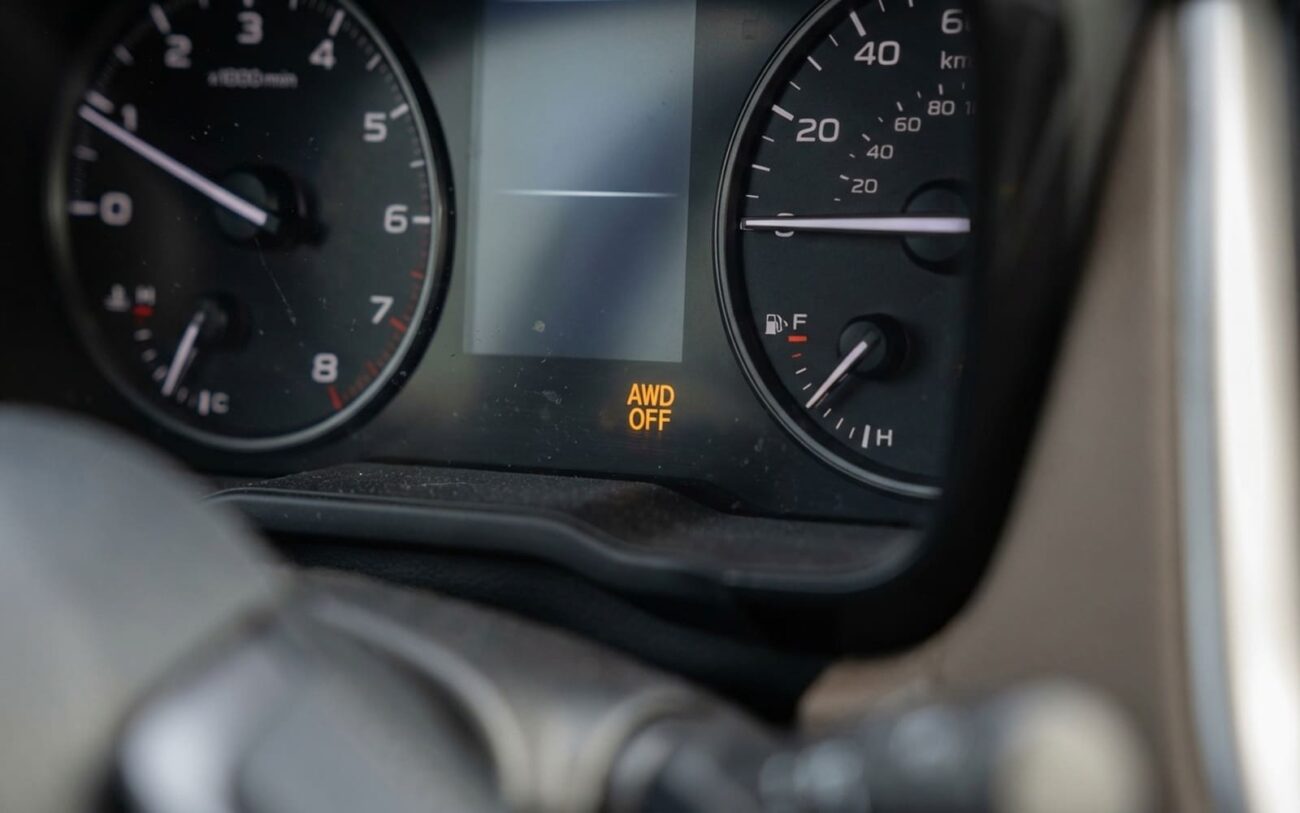
Alright, let’s talk about that dreaded ‘AWD OFF’ light on your Subaru Outback. When I see one roll into my shop, the first thing I tell the owner is this: it’s not a suggestion, it’s a hard fault. Your all-wheel-drive system is completely disabled. The car’s computer, specifically the Transmission Control Module (TCM), has thrown up its hands and said, “Nope, we’re not doing AWD today.” It’s a protective measure, but it leaves you driving a front-wheel-drive car that was never designed to be one.
This isn’t just a minor inconvenience. It fundamentally changes how your Outback handles, especially under acceleration or on slick surfaces. You might feel a lot more torque steer – that tugging on the steering wheel – or hear the front tires chirp as they struggle for grip. All that power that used to be distributed to the rear is now being handled solely by the front differential and the CVT. That extra stress can, and often does, lead to premature wear on the CVT chain, front differential gears, or axle shafts. I’ve seen folks drive for months with this light on, ignoring it, only to come back with a $2,500+ repair bill for a completely shot CVT.
The TCM is the brain here. It manages the CVT and the center differential that sends power to the rear wheels. A lot of the time, when this light comes on and stays on without any other warning lights (like a check engine light, ABS light, or AT TEMP warning), it points straight back to an internal TCM problem. We’re talking about issues with its circuitry, power supply, or even corrupted software. That’s what makes it tricky: the car seems to run fine otherwise, but your AWD is completely offline.
Diagnosing the AWD OFF Light: My Approach
Now, before you jump to conclusions and start pricing out a new TCM, you’ve got to do your homework. The TCM doesn’t operate in a vacuum; it talks to the ABS module, the Vehicle Dynamics Control (VDC) module, and the engine computer (ECM) over the CAN bus network. A fault in any of these systems can make the TCM shut down the AWD as a safety measure. That’s why your basic, cheap OBD2 scanner from the parts store isn’t going to cut it here. You need a professional-grade scan tool – something that can access all the modules and read manufacturer-specific codes, not just generic P-codes.
Here’s how I typically break it down in the shop:
| Symptom | Likely Internal TCM Fault | Common External Causes (Mimics) | My Definitive Test to Confirm |
|---|---|---|---|
| AWD OFF light ON, no other lights | Internal TCM processor failure, power supply issue, or corrupted firmware | Faulty wheel speed sensor, ABS module glitch, CAN bus communication error, transfer clutch solenoid failure (external to TCM) |
First, I use an OEM-level scan tool (like Subaru SSM) to pull all codes from all modules. Look for TCM-specific DTCs (P2762, P2763 are common). Crucially, I check for U-codes (communication errors) in other modules. Then, I perform an active command test on the transfer clutch solenoid and monitor its feedback current. Finally, I verify TCM power and ground circuits with a multimeter. |
My first move is always to grab the Subaru SSM (or my equivalent J2534 tool) and scan every module. If I see a TCM code like P2762 (Transfer Clutch Solenoid Circuit Low) or P2763 (High), that’s a pretty strong hint that the TCM itself is seeing an issue within its own circuit or the solenoid it controls. But I don’t stop there. I check the ABS and VDC modules. If they’re throwing codes—say, for a bad wheel speed sensor or a yaw rate sensor—then the AWD shut-off might just be a system-wide response to a stability control problem, not an actual TCM failure. And U-codes? Those are network communication errors, and they tell me the problem might be in the wiring or another module entirely, not necessarily isolated to the TCM.
The most revealing test, for my money, is the active command of the transfer clutch solenoid. With the scan tool, I’ll command a 50% duty cycle to that solenoid. If the TCM shows that it’s sending the command but the feedback current stays at zero, or doesn’t change as expected, that tells me the internal driver circuit in the TCM is probably dead. That’s a classic internal TCM failure. If the current does change as expected, then the TCM is electrically working, and the problem is likely external: a bad solenoid itself, a wiring fault to the solenoid, or even mechanical wear in the clutch pack. And don’t forget the basics: I always check power and ground at the TCM connector with a multimeter. A blown fuse or a corroded ground can perfectly mimic a failed TCM, and that’s a five-dollar fix versus a thousand-dollar replacement. Trust me, I’ve seen it happen.
Why TCMs Fail: The Inside Story
When the TCM itself is the culprit, it’s almost always due to internal electronic issues. These modules are sealed, not really designed to be serviced, so the failures happen on the circuit board. What I’ve seen most often are heat-related problems: voltage regulators and capacitors degrading over time from constant thermal cycling. You get cracked solder joints, especially under larger components like power transistors, and those create intermittent connections that eventually fail completely. These are the silent killers; the car might run fine when cold, but the AWD OFF light pops on after a 20-minute drive once the transmission heats up.
Another common cause is internal software corruption. A voltage spike (maybe from a failing alternator), an improper jump-start, or even disconnecting the battery under load can scramble the TCM’s firmware. The module might still boot up, but it can’t communicate properly or simply refuses to engage the clutch pack. Subaru knows this pattern well. There are documented service bulletins for certain model years—particularly 2015–2019 Outbacks with the TR690 CVT—where a P2762 code and the AWD OFF/VDC/OFF lights are directly traced back to these TCM faults. These aren’t just rare, isolated incidents; they’re known failure modes that I’ve dealt with repeatedly.
Subaru AWD OFF Light Fix: Your Options
Once you’ve definitively confirmed the TCM is the root cause, your repair path is pretty clear. There’s no quick fix or temporary workaround; the AWD system stays off until the issue is properly resolved.
Software Reflash & Calibration Professional Only
TCM Hardware Replacement Professional Only: Replace/Remanufacture
Wiring Harness & Connector Inspection DIY-Feasible with Caution
Validating the Repair: Did It Really Work?
Just clearing the code isn’t enough. You need to confirm that the AWD system is fully functional. If you did a reflash, the success criteria are straightforward: the AWD OFF light stays off, no codes return after a few drive cycles, and all your active tests (like commanding the solenoid) respond normally in the scan tool. If it passes all that, you’re probably good.
If you replaced the TCM, the bar is a bit higher. You absolutely must verify that the VIN programming and the clutch learning procedures completed successfully. The scan tool will confirm this. Then, it’s time for a real-world test. Find a safe, low-traction surface—gravel, wet grass, or a snowy parking lot works great. Accelerate gently from a stop. You should feel the car pull evenly, with no excessive front-wheel spin. If the front tires break loose but the car struggles to move, or you hear grinding, then torque isn’t reaching the rear wheels. That means the learning procedure failed, or there’s still a fault somewhere. You’ll need that scan tool and a safe place to test to be truly sure it’s fixed right.
Subaru AWD OFF Light Repair Cost: What to Expect
Repair costs can vary wildly, depending on what actually failed and who does the work. Here’s a realistic breakdown based on what I see in my shop:
| Repair Type | DIY Cost | Shop Cost | Success Rate | Secondary Risk if Failed |
|---|---|---|---|---|
| TCM Reprogramming | $0 (if you already own the tools) + ~$50 for 72-hour software access | $150 – $300 | High (if firmware corruption was the only issue, and done correctly) | Low; if it doesn’t work, you move on to hardware diagnosis. But a bad flash can brick the module. |
| TCM Replacement (New OEM) | $600 – $1,000 (part cost) + tool access for programming | $1,100 – $1,700 (parts & labor) | Very High (if diagnosis was 100% correct and programming is done right) | Moderate; the biggest risk is misdiagnosis—you could be replacing a good module if the problem was actually wiring or another component. |
| TCM Connector Repair | Under $50 (cleaner, dielectric grease, basic electrical tools) | $100 – $200 (for diagnosis and repair) | High (if corrosion or pin damage was the actual cause) | None; if it doesn’t work, you simply proceed to deeper diagnosis. |
This is where the rubber meets the road, financially. If the repair cost starts creeping up past 60% of your vehicle’s private-party value (check KBB or NADA), you really need to consider if the investment makes sense. Putting $1,700 into a $3,000 car is a tough pill to swallow—though sometimes it’s justified if the rest of the vehicle is in excellent condition and you plan to keep it for years. But if you’re already facing other aging components (suspension, timing belt due, etc.), it’s a clear sign to weigh your options carefully. Don’t throw good money after bad.
Preventing AWD System Malfunctions and TCM Failure
The TCM doesn’t have a scheduled maintenance interval, but you can definitely protect it. The biggest threat I’ve seen is electrical instability. A failing alternator or a weak battery can cause voltage spikes or drops that really stress the TCM’s internal regulators and can corrupt its firmware. So, keep your charging system healthy: test the alternator output regularly (it should be in the 13.5–14.5V range) and replace your battery every 4–5 years, even if it seems okay. I can’t tell you how many “mystery” TCM failures I’ve traced back to a 7-year-old battery that finally gave out.
