Look, after 25 years turning wrenches, I can tell you that an ABS module failure is one of those problems that can really throw a curveball. It’s not just about a light on the dash; it’s about your safety systems going haywire. And what I’ve seen time and again is it gets misdiagnosed. Folks chase wheel speed sensors or wiring, only to find the real culprit was the brain of the system all along. Let’s talk about what it actually feels like when one of these units starts to die, and more importantly, how I pinpoint the problem in my shop.
The Warning Signs: What You’ll Feel and See
When an ABS module starts to fail, it’s rarely subtle. This unit is the central nervous system for a whole host of safety features: anti-lock braking, electronic stability control (ESP, ESC, VSC – whatever your manufacturer calls it), traction control, and even cruise control. So, when it falters, you don’t just get one warning light; you get a whole Christmas tree on your dashboard. The most telling sign I see is the ABS, ESP/ESC, and cruise control disabled messages all popping up at the same time. That’s not a coincidence. It’s the vehicle’s network telling you it’s lost reliable communication with the ABS control unit, so it’s shutting down everything that depends on that data.
Beyond the lights, you might experience some really unsettling “phantom interventions.” I’ve had customers describe the ABS kicking in during a perfectly smooth stop on dry pavement, or the stability control suddenly braking a single wheel during a gentle turn. These aren’t random glitches; they’re the system reacting to corrupted or missing wheel speed data, or sometimes even internal sensor failures within the module itself.
In more severe cases, the module can fail completely. When that happens, you’re looking at a loss of power brake assist because the hydraulic pump isn’t responding, a rock-hard brake pedal, and a dashboard lit up like a warning panel in an air traffic control tower. It’s a serious situation.
How I Diagnose a Failing ABS Module
Before I even think about condemning an expensive ABS module, I always rule out the simpler, less expensive failures first. A single bad wheel speed sensor, a corroded connector, a damaged tone ring, or even a wiring fault can mimic the exact same symptoms. The key here is systematic diagnosis using the right tools. You can’t just guess.
Scenario 1: Multiple Warning Lights (ABS, ESP, Cruise)
This is the classic “Christmas tree” scenario. When all these lights come on together, it usually points to an internal processor failure, corrupted software, or a failed power regulation circuit within the ABS module itself. But don’t jump to conclusions. I’ve seen this exact symptom caused by something as simple as a faulty wheel speed sensor, a damaged wiring harness, or a poor ground connection to the module.
My definitive test here is to use a bi-directional scan tool. I’ll run active sensor tests to see if I can command each wheel speed sensor and get a proper reading. Then, I’ll check power and ground at the module connector, making sure to do it under load. A multimeter might show 12 volts, but if there’s resistance in the circuit, that voltage can drop to nothing when the module tries to pull current. That’s why “under load” testing is critical.
Scenario 2: Unwanted ABS or ESP Activation
This is where the car feels like it’s braking itself unexpectedly. It’s often due to a failed internal solenoid driver or a faulty integrated yaw/acceleration sensor within the module. However, I’ve also tracked this down to a cracked tone ring (the toothed wheel the sensor reads) or an excessively worn wheel bearing that’s affecting the sensor gap. The system gets bad data and thinks it needs to intervene.
To confirm, I pull out my oscilloscope. I’ll capture the AC waveform from each wheel speed sensor. If I see clean, consistent sine waves, I can pretty much rule out the sensors and tone rings. If the signal is erratic or dropping out, then I know where to focus my attention, usually on the sensor, its wiring, or the tone ring.
Scenario 3: No Communication with the Module
This is a big one. If your scan tool can’t even talk to the ABS module, you’re looking at a serious issue. It could be an internal CAN bus transceiver failure or a total power supply collapse within the module. But again, don’t overlook the basics: a blown fuse, damaged CAN bus wiring, or even a faulty gateway module elsewhere in the vehicle can cause this.
My go-to here is probing the CAN High and CAN Low lines with the oscilloscope. I’m looking for a clear, clean data signal. If the rest of the vehicle’s network is alive and communicating, but the ABS module is silent on the CAN bus, then it’s dead. Period. That’s a pretty definitive sign the module itself has failed internally.
What Actually Fails Inside the ABS Module
The ABS module isn’t just a simple relay box; it’s a sophisticated computer. We’re talking microprocessors, power drivers, and communication chips, all sealed up in an aluminum housing. When these units fail, it’s almost always due to electronic issues, not hydraulic ones. The most common failure I’ve encountered is cracked solder joints on the circuit board.
Think about it: that unit sits in the engine bay, getting baked by engine heat, then cooling off, day after day, year after year. This constant thermal cycling causes the solder under large chips to develop tiny microfractures. Eventually, these cracks break the electrical connection, and the module stops working correctly.
My Experience with Corrosion & Software:
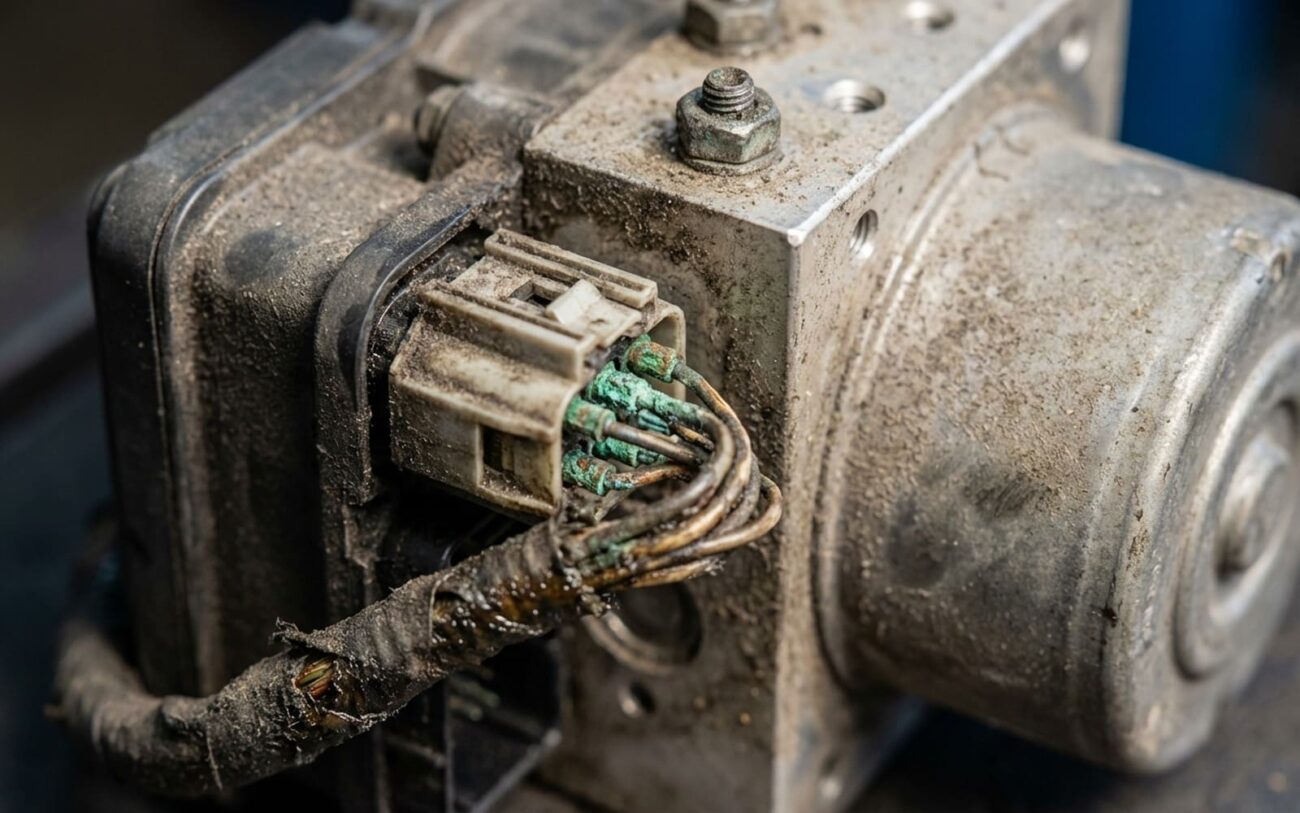
I’ve pulled apart dozens of failed modules over the years, and I can tell you, internal corrosion is far more common than most people realize. If the internal sealant degrades, even a tiny bit of moisture can creep in and start wreaking havoc on the delicate electronics. Additionally, I’ve seen voltage spikes – often from a failing alternator or an improper jump-start – literally scramble the module’s memory, causing boot failures or intermittent communication issues. It’s like a computer getting a power surge.
Repair Options: From Rebuild to Full Replacement
Professional Territory Only (Mostly)
While some control unit swaps are DIY-feasible, most modern ABS repairs require OEM software for “virginizing” (resetting to factory state) and reprogramming. And a word of caution: a power drop during programming can permanently brick the module. I’ve seen it happen, and it’s an expensive mistake.
Removable Control Unit Swap DIY Feasible
Specialist Board Repair Professional Only
Integrated Assembly Replacement
Verifying the Repair: Don’t Skip This Step
My Post-Repair Validation Checklist
-
Static Test: With the scan tool, I’ll run active tests to cycle each ABS solenoid. You should hear distinct clicks. I’ll also run the pump motor for about 5 seconds. This confirms the internal components are responding to commands.
-
Dynamic Test: I always do a controlled stop on a low-traction surface – gravel or wet pavement works well. The goal is to trigger the ABS, feeling that characteristic pedal pulsing without any wheel lockup. This confirms the system is actively modulating brake pressure.
-
System Check: Since cruise control often ties into the ABS module, I’ll take the vehicle on the highway and verify that cruise control sets, holds, and cancels smoothly. If it’s still acting up, there might be residual communication issues.
Cost Breakdown and When to Walk Away
Costs can vary widely depending on the type of repair and your vehicle. Here’s a general idea of what I see:
Module Rebuild
This is for the parts only, sending your existing board to a specialist. It has a high success rate for solder issues, and it’s often the most economical route if your module is a good candidate.
Removable Unit Swap
This includes the cost of a remanufactured electronic-only unit and the labor to swap it out. It’s a good middle-ground option for vehicles where this design is possible.
Full Assembly
This is for a complete hydraulic and electronic unit replacement. It’s necessary for integrated, sealed designs and is usually the most expensive option due to parts cost and the added labor for bleeding the brake system.
As for when to walk away? If you’re looking at a full assembly replacement on an older, high-mileage vehicle that’s already got other issues, that $2,000-$3,000 repair bill might be better spent as a down payment on a newer, safer car. I always tell my customers to weigh the repair cost against the vehicle’s overall value and remaining lifespan.
A Quick Prevention Tip:
Maintain a stable electrical system. A failing alternator sending voltage spikes through the CAN bus is a prime cause of module corruption. Also, avoid careless jump-starts – those voltage surges can fry sensitive electronics. And during your oil changes, take a minute to inspect the ABS module connectors for any green corrosion. A little dielectric grease can go a long way in preventing future headaches.
