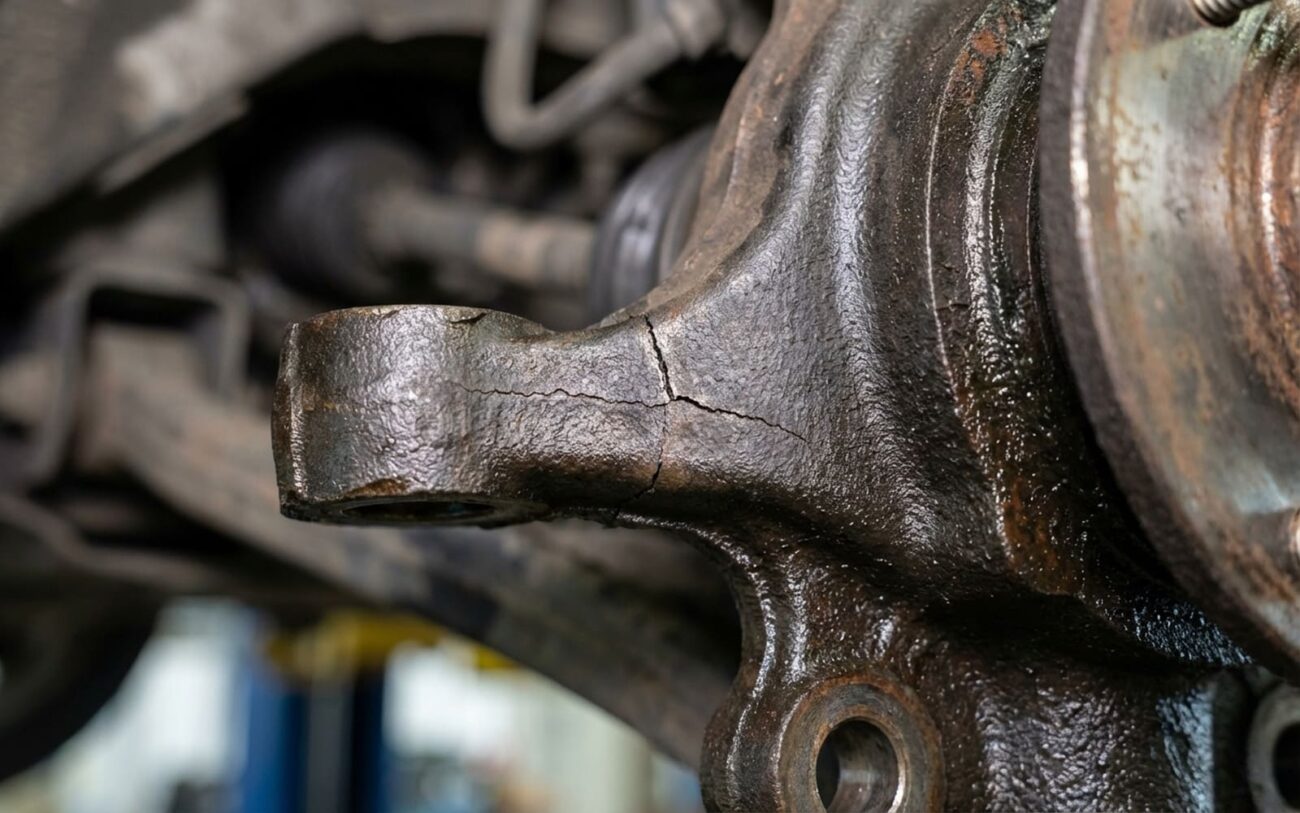
Now, with that out of the way, let’s talk about what a cracked steering knuckle actually feels and sounds like. Most of the time, when a customer comes in complaining about a front-end vibration, it’s something simple: unbalanced tires, a bent rim, or maybe a worn wheel bearing. But every so often, it’s something far more serious, and that’s when a cracked steering knuckle needs to be at the top of your list.
What You’ll Feel and Hear
The most common symptom I see is a vibration through the steering wheel or the whole front end. It usually starts building up around 65-75 mph. Now, that sounds like a tire balance issue, right? And often it is. But here’s the kicker: if that shake changes when you’re under load (like accelerating or going uphill) or during gentle turns, that’s a big red flag for something more structural. A steering knuckle is the central hub of your front suspension—it holds the wheel bearing, the brake assembly, and connects to your control arm, strut, and steering linkage. When it cracks, even a tiny bit, it compromises that structural integrity. That can introduce runout in the wheel mounting surface, and even a few thousandths of an inch of deviation can set up harmonic vibrations that get pretty intense at highway speeds.
Listen closely, too. A rhythmic clicking or popping noise, especially from the front corner during low-speed turns (think pulling into a parking spot), is another serious warning. This sound comes from micro-movements at fracture points where things should be absolutely rigid. Sure, a failing CV joint or a worn wheel bearing can make similar noises, but the context matters. If that noise lines up with wheel rotation and doesn’t change with engine load, then the knuckle or the hub area is highly suspect.
And then there’s the alignment. If you’ve been to an alignment shop and they tell you they just can’t bring the camber or caster into spec—especially if you’re also seeing unusual tire wear, like the inner or outer shoulder scrubbing off—you’re likely dealing with a distorted component. A bent or cracked knuckle shifts the entire mounting geometry. At that point, adjustments are impossible because the foundation itself is compromised. Don’t ignore that warning. I’ve seen too many people keep driving, hoping it’ll go away, only to face a sudden, catastrophic failure down the road.
Diagnosing the Problem: My Approach
Look, I’ll be honest: most vibrations at highway speeds aren’t from a cracked knuckle. It’s usually something more common, like unbalanced tires, a bent rim, or a failing wheel bearing. My job, and yours, is to eliminate those common culprits first before we start chasing the rare, serious stuff. Diagnosis isn’t guesswork; it’s a methodical process. Here’s how I break it down in the shop to figure out if it’s really the knuckle or something else entirely.
Highway-Speed Vibration
If you’re feeling that vibration, especially one that changes under load or in turns, a cracked knuckle could be causing hub face runout or structural flex that alters the resonance. But don’t jump to conclusions. Common mimics include unbalanced tires, a bent rim (which I see a lot more often than cracked knuckles, honestly), an out-of-round tire, or even a worn CV axle. To really nail this down, I’ll put the vehicle on a lift, remove the wheel, and use a dial indicator to measure the hub face runout. If I see anything over 0.005 inches (about the thickness of a human hair, but it makes a huge difference), that’s a strong indicator of distortion in the knuckle itself.
Clicking or Popping During Turns
That rhythmic click or pop at low speeds, particularly when turning, can point to a crack near a ball joint bore or the steering arm, allowing movement where there shouldn’t be any. However, this is also a classic symptom of a worn outer CV joint, a loose wheel bearing, or a damaged tie rod end. My go-to test here is to lift the vehicle, grab the wheel at 12 and 6 o’clock, and check for play. Then, I’ll use a pry bar to put some leverage on the ball joint. If I see any movement within the knuckle bore itself, or hear that distinct click under load, that’s a strong sign the knuckle is compromised.
Uncorrectable Alignment Issues
When an alignment shop throws their hands up because they can’t get the camber or caster into spec, that’s a huge red flag. A cracked or bent knuckle directly alters the mounting geometry for the strut, control arm, or tie rod. Of course, a bent control arm, a damaged strut, or even frame misalignment (especially after an accident) can cause similar problems. The definitive test here is a full 4-wheel alignment. Pay close attention to the printout. If you’re seeing more than a 1-2 degree deviation in mounting angles side-to-side, even after trying to adjust, then you’ve likely got structural damage to the knuckle. It’s just not going to hold spec.
Why These Heavy-Duty Parts Fail
It’s a fair question: how does a heavy-duty, forged or cast component like a steering knuckle actually fail? I mean, these things are designed to take a beating—cornering loads, braking forces, constant road impacts. But even the toughest parts have their limits and specific failure modes. From what I’ve seen over the years, the root causes usually boil down to four main things: manufacturing defects, impact trauma, long-term fatigue, and a silent killer we often overlook: corrosion.
Manufacturing Defects
Sometimes, it’s just bad luck. A tiny void, an inclusion, or an imperfection in the original casting or forging can act as a stress riser. Think of it like a microscopic weak spot. Over time, with all those repeated load cycles from driving, that weak spot can propagate into a full-blown crack. I typically see these cracks start near high-stress zones, like around the ball joint bore or the strut mounting ears. And yes, I’ve seen this on vehicles with otherwise low mileage and no history of any kind of impact damage. It’s just a material flaw finally giving way.
Impact Trauma
This is, by far, the most common trigger I deal with. Hitting a deep pothole at speed, riding up hard on a curb, or even a seemingly minor collision can deliver a shock load that just exceeds the knuckle’s yield strength. Unlike a bent tie rod, which is a relatively straightforward replacement, a cracked knuckle compromises the entire steering and suspension interface. It’s the foundation, and when the foundation cracks, everything else is off. In my experience, I definitely see more impact-related failures than anything else.
Corrosion: The Silent Killer
If you live in a snow-belt region where they use road salt, you know what I’m talking about. Road salt is incredibly corrosive, and it absolutely eats away at knuckle surfaces. This isn’t just surface rust that looks bad; it’s structural degradation. Once that wall thickness is compromised, even normal driving loads can cause cracking. It’s a slow, insidious process. If you’re in an area where salt is used, I strongly recommend getting your knuckles (and other suspension components) inspected annually. A good wash of the undercarriage after winter isn’t a bad idea either.
Long-Term Fatigue
Even without a defect or a major impact, metal just gets tired over time. After hundreds of thousands of flex cycles—all those bumps, turns, and stops—a crack can initiate. These fatigue cracks usually start at internal casting corners and grow slowly. Now, I won’t give you any fake TSB numbers, but it’s true that certain vehicle models, particularly some compact SUVs and front-wheel-drive platforms, have shown a higher-than-normal rate of knuckle cracking in the field. Sometimes it’s a design issue, sometimes it’s the metallurgy, but it’s something I’m always aware of when I see those specific vehicles come in.
The Only Safe Repair: Replacement
This is a Safety-Critical Component
Let me be absolutely clear: if your steering knuckle is cracked or bent, the only safe, long-term repair is full replacement. Period. The manufacturer doesn’t authorize repairs for this part, and for very good reason. Don’t let anyone tell you otherwise.
Why Replacement is Non-Negotiable
For any crack in a load-bearing area—whether it’s the ball joint bore, the strut mount, the steering arm, or the hub face—replacement is the only way to go. You simply cannot “straighten” forged or cast steel without compromising its structural integrity. Once it’s bent or cracked, the internal grain structure is damaged, and it will never be as strong as it was originally. Trying to fix it is like trying to mend a broken bone with duct tape; it just won’t hold up under the dynamic loads it’s designed for.
The repair itself requires precision and the right tools: a ball joint separator, a good torque wrench (and knowing how to use it), and the correct axle socket for your vehicle. I always recommend using high-quality OEM parts or reputable aftermarket brands like Moog or Mevotech. This isn’t the place to cheap out.
Why Welding is a Dangerous Gamble
I get asked about welding all the time. My answer is always the same: don’t do it. Welding cast or forged steel fundamentally changes the grain structure of the metal. You create what’s called a “heat-affected zone” (HAZ) around the weld, and that area becomes brittle. Even if the weld itself looks perfect, you’re leaving behind residual stress in the material. On a component that’s subjected to constant dynamic loads, that weld can fail suddenly and without warning. If someone attempts a weld as a “get-home” measure, treat it exactly like that: drive extremely slowly and replace the knuckle immediately. It’s not a permanent fix, and it’s certainly not a safe one.
Torque Specs: Don’t Guess, Don’t Skip
This is absolutely critical during reassembly. Over-tightening can crush a ball joint, strip threads, or even distort the new knuckle. Under-tightening means components will loosen up, leading to play, noise, and eventual failure. These aren’t just suggestions; they’re engineered values. For example, a typical hub nut might require something like 185 ft-lbs, sometimes even with an additional 90-degree turn. A lower ball joint nut could be around 70 ft-lbs, and strut-to-knuckle bolts often sit near 55 ft-lbs. But these are just examples. You must follow your vehicle’s specific service manual. Don’t guess, and don’t rely on “good enough” tightening. Your life, and the lives of others, depend on it.
Making Sure the Job is Done Right
Just bolting on the new knuckle isn’t the end of the job. You’ve got to validate the repair. Before you even think about mounting that wheel, grab your dial indicator. You need to check the hub face runout. I’m looking for less than 0.003 inches (that’s 0.076 mm) of runout. Any more than that, and I guarantee you’ll feel a vibration, even with perfectly balanced tires. It means something isn’t seated right, or the new part itself has an issue (yes, it happens, even with new parts).
My Post-Installation Checklist
Once everything is reassembled, I always bounce the suspension a few times. This helps seat all the bushings and ball joints properly. Listen for any weird clicks, creaks, or binding. Next, you absolutely need a professional 4-wheel alignment. Camber, caster, and toe must be within factory specifications—no exceptions. Finally, and this is where you confirm your work, take the vehicle for a thorough road test, including highway speeds. You’re looking to confirm that the original shake, pull, or noise is completely gone. If it’s not, you’ve got more digging to do.
What This is Going to Cost, and When to Walk Away
Let’s be blunt: this isn’t a cheap fix. You need to go into this with realistic expectations. The total cost will include the new parts, the labor to install them, and that mandatory alignment. Here’s a general idea of what you’re looking at, and why some “solutions” just aren’t worth it.
The Numbers
- DIY Parts Only: If you’re doing the work yourself, you’re still looking at anywhere from $150 to $400 for the knuckle, a new hub bearing (which I always recommend replacing at the same time), fasteners, and that crucial professional alignment.
- Professional Shop Replacement: This is where most people end up. Expect to pay between $750 and $1,500. That covers quality parts, the shop’s labor rates, and the alignment. It’s a significant chunk of change, but it’s for a safety-critical repair.
- Attempted Weld Repair: I’ve already told you why this is a terrible idea, but if someone tries to quote you $200 to $500 for a weld, just walk away. The success rate is abysmal—I’d put it at less than 10% for a long-term, safe repair. The secondary risk? Sudden fracture, wheel separation, and a total loss of control. It’s just not worth the gamble.
When to Cut Your Losses
Here’s a rule of thumb I’ve used in my shop for decades: if the total cost of this repair (or any major repair, for that matter) starts to exceed 40% of your vehicle’s private-party value, you really need to reconsider the investment. Factor in the car’s overall condition—how are the tires, brakes, engine, transmission? If it’s a rust bucket with other major issues, throwing $1000+ at a knuckle might be pouring money into a losing battle. Safety is non-negotiable, absolutely. But so is financial practicality. Sometimes, the smartest repair is buying a different car.
Prevention and Early Detection
The best defense against a cracked knuckle is awareness and proactive maintenance. After any hard impact—a deep pothole, a curb strike, even a minor fender bender—get that front suspension inspected. Don’t wait for symptoms to show up. A quick visual check by someone who knows what they’re looking for can save you from a dangerous and expensive failure down the road.
My Maintenance Best Practices
- Regular Inspections: During every routine service (oil changes, tire rotations), have your technician use a good flashlight to examine the ball joint housing and strut mounts on the knuckle. Look for any hairline cracks, fresh rust trails (which can indicate a new crack), or unusual discoloration.
- Quality Parts Matter: If you’re replacing other suspension components, stick with known, quality brands like Moog, Mevotech, or OEM for critical joints. Proper fit and material integrity are key to ensuring everything seats correctly and doesn’t put undue stress on the knuckle.
- Wash the Undercarriage: If you live in a region with corrosive conditions (hello, road salt!), regularly washing your vehicle’s undercarriage can significantly slow down rust progression on structural components like the knuckle. It’s a small effort that can make a big difference over the long haul.
Catching a problem early—before that crack grows into a catastrophic failure or the geometry shifts beyond repair—is always going to save you money and keep you safer. Stay proactive. Your steering knuckle is literally holding your wheel on. Treat it with the respect and attention that safety-critical part deserves.
