Park Assist cuts out mid-maneuver? That’s not a glitch — it’s the system doing its job by failing safe. But when it keeps happening, you’ve got a real problem. I’ve torn into hundreds of these systems across Fords, BMWs, Audis, and Teslas. Most techs jump straight to sensor replacement. Bad move. You’ll burn time and money if you don’t diagnose it right.
What the System Is Telling You
When Park Assist aborts, it’s not random. It sees something it can’t reconcile. The chime, the “System Unavailable” message — that’s the Parking Aid Control Module (PACM) saying, “I don’t trust my inputs anymore.”
I’ve seen this on a 2018 Explorer where the system would abort every time it reached the final swing into a parallel spot. Owner thought it was a software issue. Turned out the rear left ultrasonic sensor was cracked — not visible from the outside, but dead as a doornail when tested. The system lost confidence at that exact moment because it expected input and got nothing.
False positives are just as telling. If your display shows a red block in one corner when there’s nothing there, don’t assume the sensor is junk. Could be dirt, could be wiring, could be a reflection off a license plate bracket. But if it’s consistent — same spot, every time — you’ve got a target.
First: Eliminate the Obvious
Before you touch a scan tool, do this:
Walk around the car. Look at every sensor. Are they painted over? Covered in wax? I’ve had customers bring in cars where the entire bumper was just detailed — thick wax layer — and the ultrasonics couldn’t “see” a thing. Clean them with mild soap and a microfiber cloth. No polish, no degreaser. Then test.
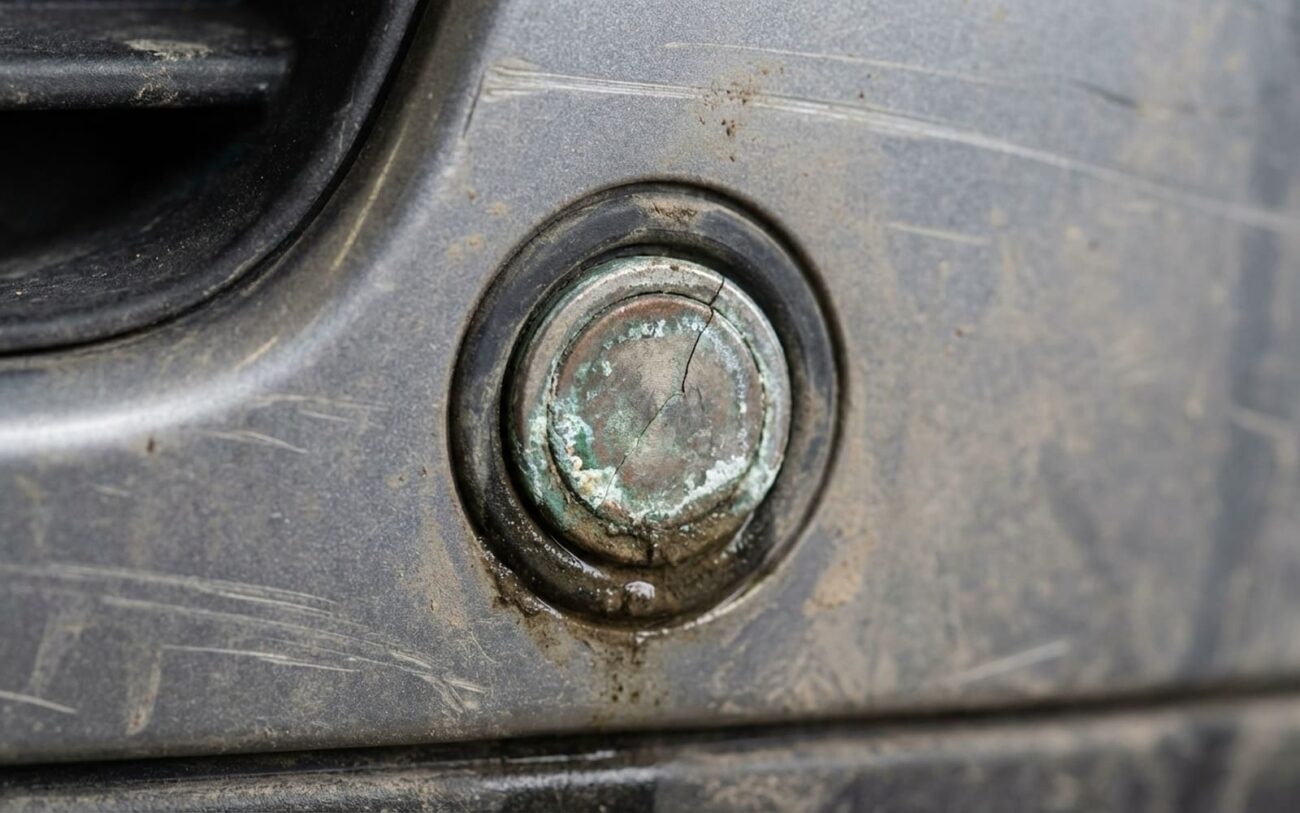
Check for physical damage. A rock chip might not crack the bumper, but it can fracture the sensor’s internal piezoelectric crystal. You won’t see it without pulling it. But if the face is cracked or milky, it’s done.
And yes — bumper stickers matter. I had a Prius once where the owner stuck a logo right over the center rear sensor. System thought there was a wall behind it 24/7. (Yes, this matters.)
Now, Diagnose Like a Pro
Here’s how I do it in my shop. No guesswork.
First, scan the PACM. Not the engine module. Not the ABS. The Parking Aid Control Module. Generic OBD2 tools won’t touch this. You need a bidirectional-capable scanner — ThinkScan Pro, Autel, or factory-level software. If you don’t have one, stop now. You’re flying blind.
Look for DTCs. But don’t just read them — interpret them.
Code U0235? That’s a communication loss with a specific sensor. Could be the sensor, could be the wire, could be a bad ground. I once chased a “dead” rear sensor for two hours only to find the harness ground was corroded under the rear bumper liner. Fixed it with a wire brush and a new ring terminal. Sensor worked fine.
Performance codes — like “Signal Plausibility” — are trickier. Often these mean the sensor is aging. The piezoelectric crystal isn’t sending or receiving at the right frequency anymore. But before you replace it, verify the part number. I’ve seen guys install a front sensor in the rear because it “looked the same.” Wrong frequency. System threw codes immediately.
What Actually Fails Inside the Sensor
Ultrasonic sensors? Three main failure points.
One: piezoelectric crystal degradation. It’s a ceramic disc that vibrates at 40–50 kHz. Over years, thermal cycling cracks it. Signal weakens. System thinks there’s no echo — so it assumes an obstruction. I’ve measured outputs on a scope: good sensor shows a clean sine wave, bad one is jagged or missing peaks.
Two: moisture ingress. The urethane seal fails. Water gets in. Corrosion eats the PCB. I’ve pulled sensors that looked fine outside — but inside, the board was green with corrosion. Happens more on trucks that get pressure-washed weekly.
Three: physical damage. Not just from rocks — sometimes during bumper repairs. A tech reattaches the bumper and the sensor housing is slightly twisted. It’s seated, but the field is aimed 10 degrees off. System gets inconsistent returns and disables.
Radar sensors fail differently. The MMIC (Monolithic Microwave Integrated Circuit) is sensitive. ESD during handling can kill it. Voltage spikes from jump-starts, too. And the dielectric lens? If it develops micro-bubbles from UV exposure, the beam distorts. You’ll get phantom cross-traffic alerts. Not fixable. Replace.
Fix It Right — Or Don’t Bother
If it’s just dirt or misalignment: clean it, reseat it, torque to 1–2 Nm. That’s it. Over-tighten and you’ll crack the bumper. I keep a small torque wrench just for this.
If the sensor is cracked, waterlogged, or electrically dead: replace it. But here’s the catch — if it’s behind the bumper, and you’ve never removed one before, don’t wing it. Plastic tabs break easy. You’ll need a trim tool set. And the retaining clip? They almost always snap. Buy a new one.
OEM part only. Aftermarket sensors often don’t match frequency or CAN protocol. I tried a $60 “OEM-equivalent” on a 2019 A6. System wouldn’t calibrate. Threw a U0423. Wasted two hours.
And yes — calibration is mandatory. Even for ultrasonics. Most systems require a “relearn” via scan tool. Drive above 20 mph after replacement to wake up the network. Then run the initialization routine. No shortcuts.
Did It Work? Prove It.
Replacement isn’t the end. It’s the beginning of validation.
First: clear codes. Then cycle the ignition. Then drive above 20 mph. This resets the network. Then scan again. Any pending codes? Problem’s still there.
Second: live data test. Key on, hand in front of each sensor. Watch the readings. They should ramp up and down smoothly. If one jumps or freezes, it’s not talking right.
Third: real-world test. Do three parallel park attempts. Two perpendicular. System should complete every one. Don’t stop at one success. I’ve seen intermittent faults that only show up on the third cycle.
No scan tool with bidirectional control? You can’t do this job. Period. You’re just swapping parts.
Is It Worth Fixing?
Let’s talk money.
Single sensor: $75–$250 for the part. DIY labor: low. But if you don’t have the scan tool, shop cost jumps to $400–$500. That’s not just labor — it’s calibration software and time.
Full set? $1,500 easy. And if the real problem was a bad ground or a failing PACM, you just wasted a grand.
I tell customers this: if the car’s worth less than $8,000 and Park Assist is just a convenience, consider disabling it. Some vehicles let you turn it off in the menu. Others need a module reflash. But it’s cheaper than throwing parts at it.
And yeah — check your EV battery warranty. Some manufacturers cover ADAS modules under high-voltage system coverage. I’ve seen dealers eat $800 repairs because it was tied to a covered control unit.
Keep It Working
Prevention’s easier than repair.
Wash smart. No high-pressure sprays directly on sensors. I’ve seen seals blow from a pressure washer held six inches away. Just rinse.
No metallic paint, no thick coatings. Even some ceramic coatings can dampen the signal. If you wrap your bumper, leave the sensors exposed.
And test monthly. Back into your driveway, watch the display. Pass your hand in front of each sensor. If one zone doesn’t respond, pull it now. Early failure means a $100 fix. Wait until it kills Park Assist mid-maneuver in traffic? That’s a safety risk — and a much bigger bill.
