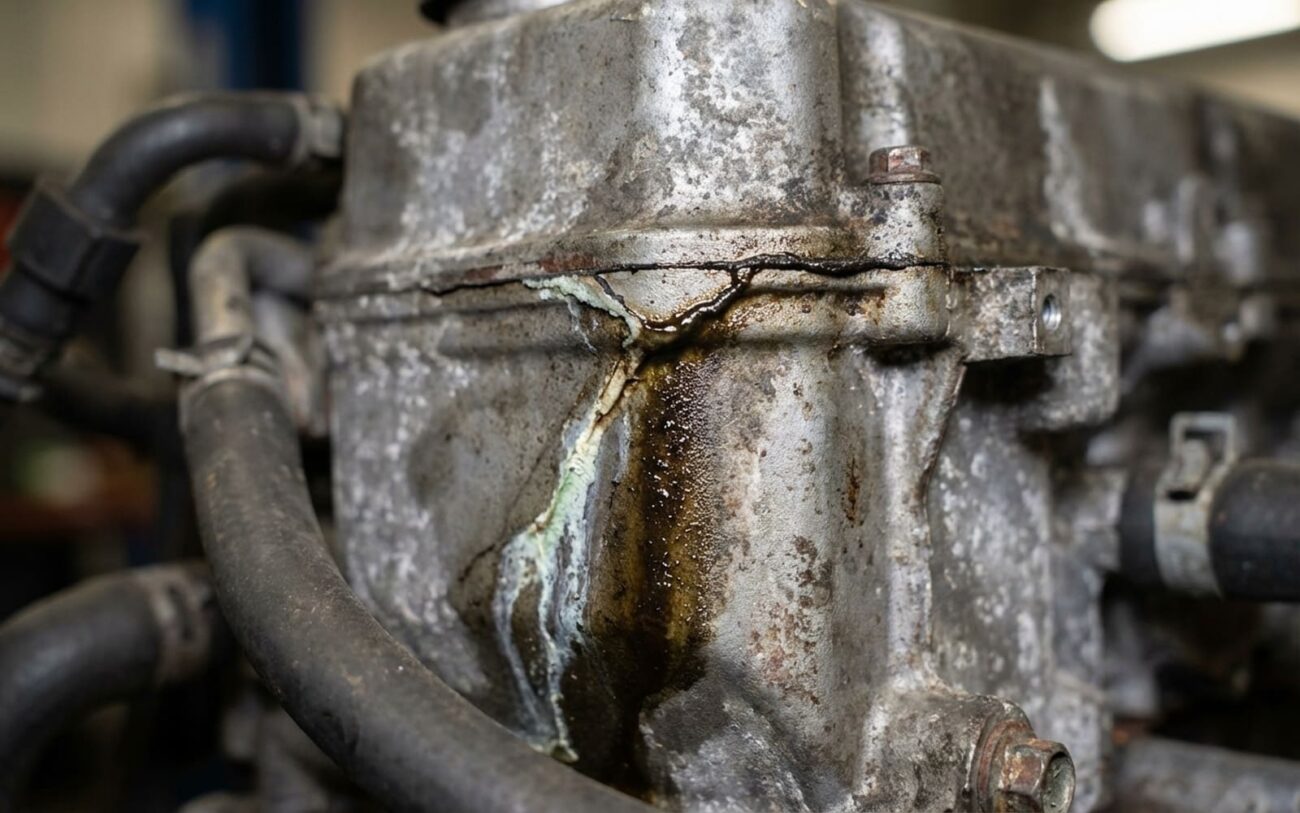
Look, when folks come in with a drip or a low coolant light, the first thing they usually say is, “My block’s cracked, isn’t it?” And yeah, a cracked block is about the worst news you can get in this business. But in my 25+ years spinning wrenches, I can tell you this: it’s almost never the block itself. The engine block is the foundation, sure, but it’s cast tough. Most leaks come from the components bolted to it—gaskets, seals, freeze plugs—not the metal of the block. That said, when the block does fail, it’s a serious problem, and knowing how to tell the difference can save you a ton of grief and wasted money.
Think of the engine block like the foundation of your house. If the foundation cracks, the whole structure is compromised. You don’t just patch a leaky window; you’ve got a much bigger problem on your hands.
How I Pinpoint a Block Problem (and Rule Out Everything Else)
You can’t just guess at a leak source. That’s how you end up throwing parts at a problem and draining your wallet. You need a methodical approach. Visual inspection is your starting point, but it won’t always cut it; many leaks are hidden, or they migrate, making the actual origin tough to trace. This is where pressure tests, chemical checks, and isolation procedures become essential.
Here’s the deal: if you see fluid seeping from a flat, non-machined surface of the block—like the side of a cylinder wall, or an area away from any gasket lines, bolt holes, or mounting surfaces—that’s a major red flag. That kind of leak suggests the metal itself has failed due to a crack or casting porosity. It’s not just a seal gone bad; it’s structural. Let’s break down what I look for:
1. External Coolant Weep on the Block Side
If you’ve got coolant weeping from a smooth, vertical side of the engine block, especially where there are no hoses or freeze plugs, that immediately makes me think “casting porosity” or a “thermal crack in the cylinder wall.” But before I jump to that, I’m checking the easy stuff: heater hoses, hose clamps, and especially the freeze plugs. I’ve seen plenty of rusted-through freeze plugs that look like a block leak. To confirm, I’ll clean the area thoroughly, add UV dye to the coolant, and hit it with a cooling system pressure tester. I’ll pump it up to spec (usually 15-18 psi) and let it sit for at least 30 minutes, then check with a UV light. A borescope can be really handy here, too, to get a good look in tight spots.
2. Oil Seepage from the Lower Block
If oil is seeping from the lower block, particularly near the main bearing webs, that can point to internal oil gallery porosity or a crack. Again, I’m ruling out the obvious first: oil pan gasket, rear main seal, front main seal, oil filter housing gasket, and any oil sensor O-rings. These are far more common. If all those are good and I still see seepage from the main block casting, then I’m looking at a deeper issue. Sometimes, a UV dye in the oil can help pinpoint this, but it’s often a sign of something that’s only going to get worse.
3. Oil in Coolant (Brown Sludge)
This is a classic sign of internal fluid mixing. My first suspects are always the oil cooler (if equipped), a transmission cooler leak (especially on vehicles with an integrated cooler in the radiator), or a head gasket breach. A block casting issue is possible, but less common. I’ll isolate and pressure test the oil cooler first. Then, I’ll do a combustion gas test on the coolant. If I’m getting exhaust gases in the coolant, it’s usually a head gasket or a cracked cylinder head. Only after ruling out those common culprits do I start thinking about an internal block crack between an oil gallery and a coolant passage.
4. Coolant in Oil (“Milkshake Oil”)
Now, this is serious. When you pull the dipstick or the oil fill cap and see a milky, frothy mixture, that’s coolant in the oil. My prime suspects are a head gasket failure, a cracked cylinder head, or a failed oil cooler. A cracked block is definitely on the table, but I must rule out those other sources first. A cracked cylinder head can mimic a cracked block almost perfectly. I’ll pressure test the cooling system with the oil cap off, watching for bubbles in the oil. A leak-down test can also help pinpoint which cylinder, and sometimes even which area, is compromised.
5. Coolant Loss with White Exhaust Smoke
If you’re losing coolant and seeing thick white exhaust smoke that smells like coolant, you’ve got an internal combustion leak. This is often a blown head gasket or a cracked cylinder head. A block crack is possible, but I’m going to do a combustion leak test (often called a “block test”) to confirm exhaust gases in the coolant. I’ll also do a leak-down test to identify the cylinder. If all signs point away from the head gasket and cylinder head, then, and only then, do I consider the block itself compromised.
The goal, always, is to eliminate the likely causes first. Start with external components: hoses, gaskets, seals. If you’re losing coolant with no visible external leak, you might be dealing with an internal combustion leak. We cover that in detail, but only after ruling out all accessible parts should you consider the block itself compromised.
Why Did This Block Fail? Understanding the Root Cause
Understanding why a block failed isn’t just curiosity; it’s critical for ensuring any repair actually lasts. Some failures are isolated incidents; others point to deeper issues that will just repeat if you don’t address them.
Yeah, manufacturing defects happen. A sand inclusion or a core shift during casting can leave a weak spot in the metal. Some engine families or specific model years have known issues with casting porosity, especially around high-stress areas like the main bearing webs. We see service bulletins for these kinds of flaws sometimes, but honestly, they’re relatively rare in the grand scheme of things.
Far more common is thermomechanical fatigue, which is a fancy way of saying repeated or severe overheating. Aluminum expands faster than cast iron, and rapid heating or cooling puts immense stress on the metal. Over time, this can create cracks between cylinder bores or from a cylinder into the coolant jacket. A single hard overheat—like running with a failed water pump or a blown hose—can be enough to do it. I’ve seen blocks crack from overheating that looked perfectly fine externally but failed instantly under a pressure test.
Corrosion is another big factor, especially in aluminum blocks. Using the wrong coolant type—or worse, mixing incompatible formulas—can kick off electrolytic corrosion. This literally eats away at the metal from the inside, often starting in coolant passages near the cylinder liners. For example, some Hondas and Acuras absolutely require specific phosphate-free coolants; using the wrong type accelerates internal damage. And in heavy-duty diesel engines with wet liners, cavitation erosion—caused by tiny collapsing bubbles in the coolant—can wear down the liner seating area over time, leading to leaks.
Then there’s impact damage. This is the catastrophic stuff: a thrown connecting rod, a spun bearing, or a broken crankshaft can literally punch a hole through the block wall. These are almost never repairable in any practical sense. But remember this: a blown head gasket is not a block failure. Neither is a leaky valve cover gasket or an oil pan seal. Those are maintenance items, plain and simple. Don’t confuse a failed seal with a failed block—they’re worlds apart in cost and complexity.
Your Repair Options: From a Quick Patch to a New Engine
Professional Territory Only
Internal failures—like a crack between an oil gallery and a coolant passage—are a different animal entirely. There’s no reliable way to repair these. You can’t weld inside a coolant jacket, and sealants won’t hold under pressure. In these cases, the only real, lasting solution is to replace the block or the entire engine.
Freeze Plug Replacement
External Patching & Welding Pro Recommended
Full Block or Engine Replacement
As for temporary fixes: cooling system sealants (like GM’s Cooling System Supplement, which is actually pretty good for minor seeps) can sometimes stop a small external leak long enough to get the vehicle to a shop. But use them with extreme caution. They can clog heater cores, radiator tubes, and thermostat housings, especially the cheaper ones. Never, ever use any sealant in the oil system—that will cause catastrophic damage faster than you can say “new engine.”
How to Know If the Fix Actually Worked (Don’t Skip This!)
After any repair, you must test it. Assuming it worked without verification is how comebacks happen, and that costs everyone time and money. Here’s my process:
- For an external epoxy or welded repair: Perform a pressure test on the affected system to the OEM specification. Hold that pressure for at least 30 minutes, sometimes longer. Any drop in pressure means the repair failed, period. After the pressure test, I’ll inspect the area again with a borescope and UV light (if dye was used) to check for any micro-seepage.
- For freeze plug replacements: Refill the coolant, then run the engine through at least three full thermal cycles—that’s cold start to full operating temperature, then a full cool-down. Check for seepage after each cycle. A properly installed plug should show no signs of leakage. I’ll often put a piece of clean cardboard under the area overnight, too, just to be sure.
- For internal repairs or after a block replacement: Validation is even more critical here. Run a combustion leak test on the coolant. A good result shows hydrocarbon levels below 0.1%. Also, take an oil sample and have it analyzed for coolant contamination. Even trace amounts can indicate a lingering issue or a misdiagnosis. This step is absolutely essential if you’ve replaced the block due to an internal leak; misdiagnosis is the most expensive mistake you can make.
The Cold, Hard Costs and the Big Decision
Let’s be blunt: block repairs can get expensive, fast. Here’s a rough idea of what you’re looking at, but remember, prices vary wildly by vehicle, region, and shop.
| Repair Type | DIY Cost (Parts Only) | Shop Cost (Parts & Labor) | Success Rate (My Experience) | Secondary Risk |
|---|---|---|---|---|
| External Epoxy Patch | $50 | $300 – $500 | 60% (for minor seeps) | Sudden coolant loss, overheating, engine damage |
| Freeze Plug Replacement | $30 | $200 – $400 | 95% | Slow seepage, repeated loss if not done right |
| Block Welding (Machine Shop) | N/A | $800 – $2,500+ (plus R&I labor) | 70-80% (highly dependent on crack) | Warping, re-cracking, internal damage |
| Block Replacement (Long Block) | N/A | $6,000 – $12,000+ | 100% (if installed correctly) | Installation error, parts quality |
| Temporary Sealant | $25 | $100 – $200 | 30% (for short term) | Cooling system blockage, overheating |
The 60% Rule:
This is a rule of thumb I’ve used for years. If the professional repair cost (including parts and labor) exceeds 60% of the vehicle’s current private-party value, it’s usually smarter to consider engine replacement or even replacing the vehicle entirely. For internal block failures, repair isn’t viable—only replacement is, and that often pushes you past this threshold.
How to Prevent This and Catch It Early
Most block failures are preventable, believe it or not. Consistent, proper maintenance and early detection are your absolute best defense. Here’s what I tell all my customers:
My Maintenance Checklist
-
Use the correct coolant. Seriously, this is huge. For aluminum blocks, the wrong chemistry leads to internal corrosion and cavitation. Never mix different types; flush and fill at the OEM recommended intervals.
-
Address overheating immediately. A single severe overheat can cause thermal stress cracks that might not show up for months. If that temperature gauge spikes, shut down the engine. Don’t try to limp it home.
-
Check for milky residue on the dipstick and oil cap during every oil change. This is an early, critical sign of internal coolant mixing. Don’t ignore it.
-
Perform an annual cooling system pressure test. This simple test can catch slow leaks before they become catastrophic structural failures or leave you stranded.
-
Pop the hood regularly. Every few months, just take a flashlight and inspect clean, dry areas of the block, especially around freeze plugs and casting seams. Catching a small weep early can save you from a full engine replacement down the road.
