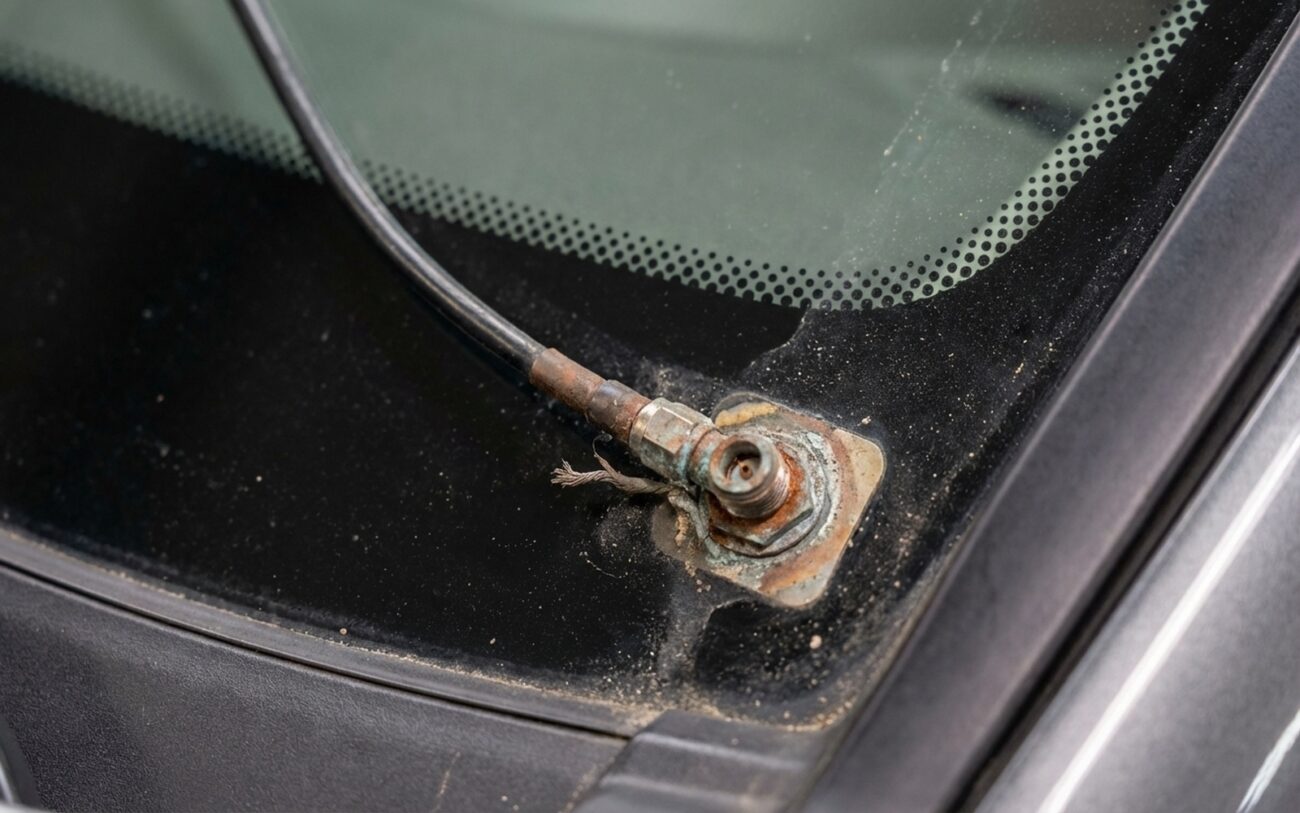
You had perfect radio reception. Then came the new windshield. Now you’ve got static, missing stations, or dead satellite—same day, same job. That’s not a coincidence. I’ve been in the bay for 27 years, and this? This is textbook. The antenna’s in the glass. You replaced the glass. Something got broken in the process. Let’s stop guessing and start diagnosing.
What You’re Hearing (And What It Means)
If AM/FM is dead—just static on every station—your in-glass antenna grid is likely severed. These aren’t wires; they’re conductive ceramic traces baked into the windshield, running from the top center down to a busbar at the edge. Break that path, and the signal stops cold. It’s not the radio failing. It’s like cutting the coax on a rooftop antenna. No signal in, no sound out.
Weak reception—stations cutting in and out, more noise than music—points to a partial break or high resistance. Could be a hairline crack in the grid, corrosion on the busbar, or a connector starting to lift. I’ve seen this misdiagnosed as a bad amplifier. But if the radio was fine before the glass job, don’t go chasing modules. Start at the source.
Satellite radio (SiriusXM) out but AM/FM still working? That’s a separate circuit. Most modern windshields have a dedicated patch antenna embedded near the top—usually tied to a blue Fakra connector. Damage that tiny trace or its feed line, and satellite dies while AM/FM keeps running. Easy to miss if the tech doesn’t know where it is.
Bottom line:
your radio tuner is fine. This isn’t a software glitch or internal failure. You’re not hurting the car by driving it, but you’ve lost a function that should work—and it’s almost certainly tied to the windshield replacement.
Diagnosis: Find the Break, Don’t Guess
You don’t need a scan tool to start. You need a multimeter. And the factory wiring diagram. Pull it. Every vehicle has specific resistance specs for the antenna circuit—usually between 1 and 6 ohms. Anything outside that range means trouble.
| Symptom | Most Likely Cause | Common False Traps | How to Confirm |
|---|---|---|---|
| Complete AM/FM loss | Grid or busbar physically broken | Disconnected coax at radio or amp |
Measure resistance at the windshield connector. Open loop (OL)? Grid’s dead. If resistance is good, move downstream—check the cable and connectors. |
| Weak AM/FM signal | Partial grid damage or corroded busbar | Pinched coax or bad amp ground |
Test resistance end-to-end on the grid. Higher than spec? You’ve got a weak link. Use a signal meter at the radio input to confirm actual signal drop. |
| Satellite (SDARS) only down | Damaged patch antenna or embedded feed line | Disconnected Fakra (blue) connector or bad tuner |
Inspect the Fakra plug. Check continuity from the pin to the patch contact. No continuity? Broken trace or bad connection. |
Seventy percent of the cases I see come back to the busbar or connector—either scraped off during install or drowned in urethane. And no, that’s not normal. It’s preventable.
Why It Breaks: The Real Culprits
Blades and busbars don’t mix. I’ve seen techs use metal cutting tools right through the antenna zone. One slip—just a nick—and the busbar’s gone. On 2018–2022 Ram trucks, that strip runs right along the edge. Cut it, and AM/FM’s dead. Doesn’t matter how clean the rest of the install looks.
Thermal stress is another silent killer. Heat the glass too fast during removal, or install it in direct sun without acclimating, and you can crack the laminate. Even a hairline fracture through the grid kills continuity. And you won’t see it from inside the cabin.
Then there’s adhesive. Urethane creeping into the connector cavity? Yeah, that’s a known issue on Chryslers and several German models. There are actual service bulletins warning about it. If the connector’s half-filled with cured glue, the pins can’t make contact. I’ve pulled plugs coated in black goo—no wonder the signal’s dead.
How to Fix It (Without Throwing Parts at It)
Clean and Reseat the Connector
(DIY-Friendly)
Busbar Repair with Conductive Epoxy
Professional Repair
Replace the Windshield
(Only Real Fix for Internal Grid Damage)
Temporary: External Glass-Mount Antenna
Did It Work? Test Like a Pro
Don’t just turn the radio on. Verify.
First, check resistance again. Should be 1–6 ohms. Higher? Still got resistance in the circuit. Signal’ll be weak.
Then road test. Hit areas with weak signals. Cycle through AM and FM. If your infotainment shows signal strength, use it. Even better, pull live data from the radio module with a scan tool—look at dBµV. That’s the real number.
And if you replaced the glass? Test satellite. Check for wind noise. Look for water leaks. A bad seal today can mean a rattle or leak in six months.
To Prevent This Next Time
-
Tell the tech: “This car has an in-glass antenna.”
-
Insist on nylon cutting tools near the top edge.
-
Make them keep urethane out of the connector cavity.
-
Test AM, FM, and satellite before they pack up.
Cost vs. Value: What’s Worth It?
| Repair Type | DIY Cost | Shop Cost | Success Rate | Secondary Risk |
|---|---|---|---|---|
| Connector Clean/Reseat | < $20 | $100–$200 | High (>90%) | Minimal—just don’t break the trim |
| Busbar Repair (Silver Epoxy) | $50 | $300–$500 | Low-Moderate (~50%) | Can fail over time; may be visible |
| Aftermarket Windshield | N/A | $400–$800 | High (>95%) | Poor install could cause leaks or noise |
| OEM Windshield | N/A | $1,000–$2,000+ | Very High (>98%) | High cost; may not make sense on older cars |
My rule: if an OEM windshield costs more than 30% of your car’s value, and you don’t need satellite or premium audio, live with it or use an external antenna. For newer or luxury vehicles? OEM replacement is worth every penny.
One More Thing
If your daytime running lights won’t turn on after a windshield job? Same story. Rain sensors, light sensors, even some adaptive cruise systems—they’re all tied to that glass now. Damage in one spot can kill multiple functions. Always test everything before you drive away.
