Airbag Deployed? Why Your Steering Wheel Buttons Are Dead (And What to Do)
Alright, so your airbag went off. Maybe it was a fender bender, maybe a sudden stop. Now you’ve got no cruise control, no volume, no phone buttons, and maybe even a horn that’s gone silent. Plus, that airbag warning light is glaring at you. I’ve seen this scenario play out countless times in my 25+ years in the shop, and let me tell you: those dead controls aren’t some random electrical glitch. They’re a direct clue, pointing to the heart of your vehicle’s Supplemental Restraint System (SRS).
What you’re dealing with is a designed failure in a system built to save your life. The good news is, it’s usually a predictable problem with a clear path to repair. Let’s dig into what actually happened, how to figure out what’s truly broken, and what your options are for getting things back to normal.
The Culprit: Your Clock Spring’s Sacrifice
When a frontal collision triggers the driver’s airbag, a lot happens in milliseconds. Many modern vehicles use a pyrotechnic steering wheel pretensioner or a forceful deployment mechanism that rapidly retracts or rotates the steering wheel. This movement is far more violent than any turn you’d make while driving — sometimes spinning the wheel several full rotations in an instant.
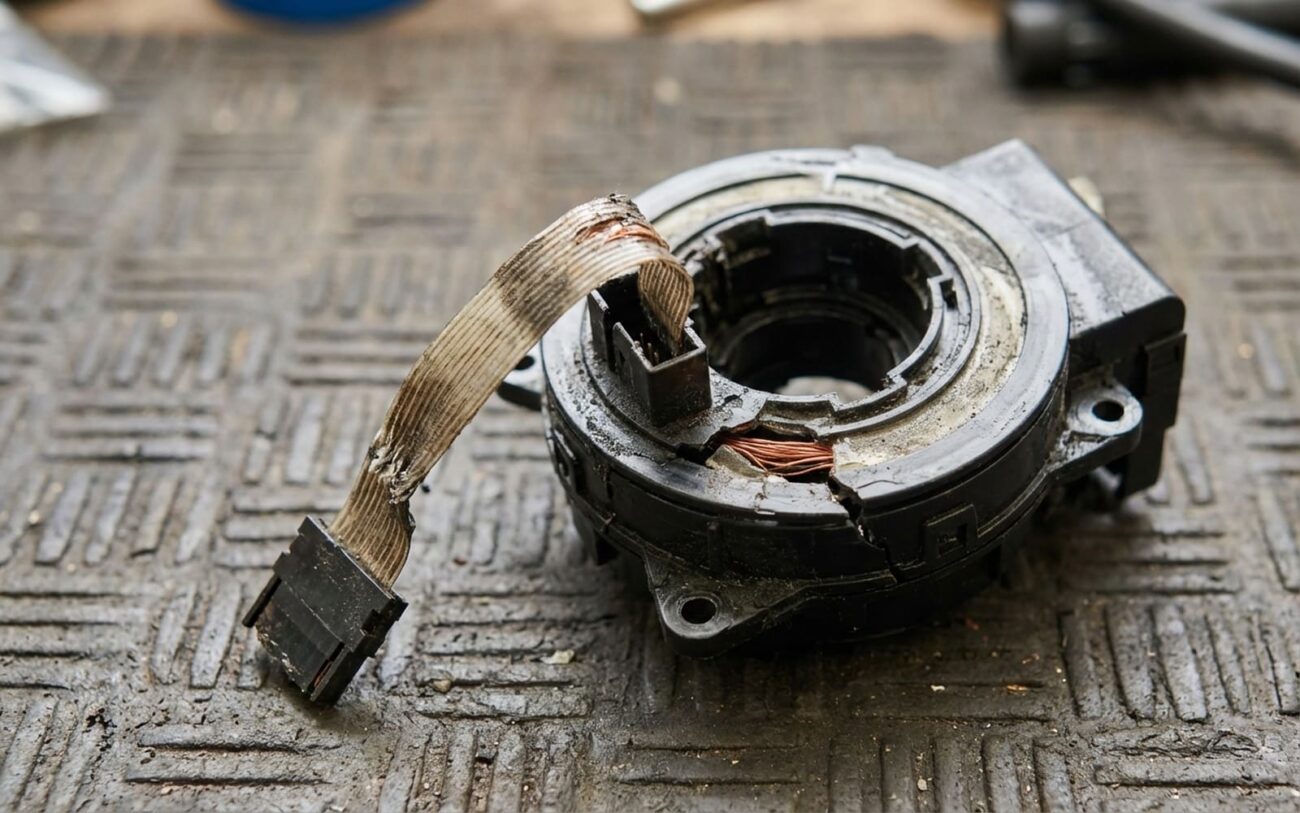
Behind your steering wheel, nestled in the column, is a component called the clock spring (sometimes called a spiral cable). This isn’t a spring at all, really. It’s a coiled ribbon cable that keeps electrical contact between the stationary steering column and your rotating steering wheel. It carries all the crucial signals: for the airbag itself, the horn, your audio and cruise controls, and often the steering angle sensor for stability control.
That violent, post-deployment rotation often exceeds the clock spring’s mechanical limits. The delicate copper traces inside that ribbon cable stretch, tear, or completely sever. This isn’t a flaw in manufacturing; it’s by design. The SRS is engineered to ensure full airbag deployment without electrical interference, even if it means destroying the clock spring in the process. Think of it as a fuse for the steering column’s electrical connections during a crash — it sacrifices itself to ensure the airbag fires correctly.
Diagnosing the Damage: Clock Spring or SRS Module?
While the clock spring is almost always the primary suspect after an airbag deployment, there’s another player: the SRS control module itself. After any deployment, the module logs crash data and can enter a “crash-locked” state. When this happens, it often disables certain functions and keeps the airbag light on until it’s reset or replaced. But here’s the critical distinction:
-
If all your steering wheel controls (including the horn) are dead, and the airbag light is on, it’s a very strong indicator of a physically severed clock spring. The module might be crash-locked too, but the physical break is what kills all those functions instantly.
-
If the module is crash-locked but the clock spring is intact, you might still have partial or intermittent control function, or just the airbag light on with no other symptoms. This is less common after a deployment that kills everything on the wheel.
The vehicle’s computer, specifically the SRS module, will usually log a “Crash Data Logged” event. And if you run a scan tool, you’ll likely see a Diagnostic Trouble Code (DTC) indicating an “Open Circuit” for the driver’s airbag or related steering wheel components. This “open circuit” is your smoking gun for a torn clock spring ribbon.
The Repair: Replacing the Clock Spring (Professional Territory)
If testing confirms the clock spring is damaged, replacement is mandatory. Manufacturers often have service bulletins stating that the clock spring must be replaced after any airbag deployment. This isn’t optional; it’s a safety requirement to ensure the airbag system is fully functional again. And frankly, this is a job I consider professional-only. It’s not necessarily mechanically complex, but the safety risks and the precision required for proper installation are too high for a DIY attempt. There are no safe shortcuts here.
Why This Is a Pro Job:
Beyond the obvious safety risks of accidental airbag deployment, the clock spring needs to be installed perfectly centered. If it’s off even slightly, the first time you make a full turn, you’ll destroy the new ribbon cable. It’s a costly mistake and a safety hazard.
Here’s the general sequence of how this repair is performed:
Disable the SRS System
Remove the Airbag and Steering Wheel
Replace and Center the Clock Spring
Reinstall and Torque
Re-enable and Initialize SRS
As for the SRS module itself: if codes indicate it’s crash-locked, your options depend on the vehicle. Some modules can be reset using advanced diagnostic software; others are one-time-use and must be replaced. This step should always happen after all physical repairs, like the clock spring replacement, are complete.
Confirming a Successful Repair
Post-Repair Validation
-
Functional Test: Start the vehicle and turn the steering wheel lock-to-lock a few times. Then, verify all steering wheel controls (volume, cruise, horn, phone, etc.) work as they should, at various steering angles.
-
Warning Light Check: The airbag warning light should illuminate briefly at startup, then turn off after 3–5 seconds. If it stays on or flashes, there’s still a problem.
-
Scan Tool Verification: Perform another full system scan with a professional tool. Confirm there are no active or pending SRS DTCs, and that the module reports a “Ready” or “OK” status.
What This Repair Will Cost You
Clock Spring Replacement
This range typically includes parts and labor at a reputable shop. The part itself can be $75–$300, but as I said, the labor and expertise are crucial.
SRS Module Work
This varies wildly. A simple software reset might be $150-$300. But if the module needs replacement, a new OEM unit can easily run $500-$1000+, plus programming.
Overall SRS Restoration
If you’re looking at a new clock spring, a new SRS module, and potentially other crash-related repairs, the total cost can quickly exceed 70% of your vehicle’s value. At that point, your insurance company will likely declare it a total loss.
Can You Prevent This?
In a crash, no, you can’t prevent the clock spring from breaking — it’s designed to sacrifice itself. However, clock springs can also fail from long-term wear. To minimize that risk, avoid “dry steering” (turning the wheel while stationary) and don’t hold the wheel at full lock for extended periods. If you ever notice intermittent steering wheel controls or a flickering airbag light before a crash, get it scanned immediately. Catching a wear-related failure early can prevent bigger headaches.
