Alright, let’s talk about the Subaru FB25 engine and its appetite for oil. If you’re here, you’ve probably noticed your dipstick showing low a little too often. Believe me, you’re not alone. In my 25+ years turning wrenches, I’ve seen plenty of these engines come through the shop with the same complaint. It’s a known issue, especially as these Subarus rack up the miles. But before you panic and start pricing new engines, let’s break down what’s happening and how we figure out what to do about it.
Spotting the Signs: What Your Subaru is Telling You
The first thing I tell folks is to pay attention to the basics. The most reliable indicator of an oil consumption problem is, well, consistent oil loss. If you’re pouring in more than a quart of oil every 3,000 to 4,000 miles, that’s a big red flag in my book. The industry generally considers anything more than a quart every 1,200 miles to be “excessive.” Subaru itself has historically allowed up to a quart per 1,200 miles under warranty, but honestly, if your engine is doing that, something’s definitely wrong and it’s time to investigate.
Here’s how I recommend you track it: Check your oil level over two or three oil change intervals. Always do it on level ground, with the engine cold and off for at least 10 minutes. Consistency is key here; otherwise, you’re just guessing. Keep a little log—miles driven, oil added. It gives us a clear picture.
Then there’s the smoke. Blue-tinged exhaust smoke is an unmistakable clue that oil is burning in the combustion chamber. You might see a puff of bluish-gray smoke on a cold start, or maybe when you’re engine braking down a hill, or even under hard acceleration. White vapor is usually just condensation, and black smoke points to a rich fuel mixture. But blue? That’s oil. Don’t ignore it, because it can lead to bigger problems down the road.
And speaking of bigger problems: if oil starts fouling your spark plugs, you’ll get misfires. That means a flashing check engine light, loss of power, and, worst of all, you’re cooking your catalytic converter. I’ve seen too many customers turn a $2,000 engine repair into a $4,000+ headache because they kept driving with misfires. Catch it early, act fast.
Initial Diagnosis: Rule Out the Easy Stuff First
Just because you’re losing oil doesn’t automatically mean your engine is toast. Before we start talking about tearing into the engine, we always rule out the simpler stuff. External leaks are the first suspects. A leaking valve cover gasket, a failing oil cooler o-ring, or even a front or rear crankshaft seal can lose a quart just as fast as internal burning. The good news? These usually leave a puddle or at least some drips on your garage floor or undercarriage. So, a good visual inspection, maybe with a UV dye in the oil, is always step one.
Another common culprit that gets overlooked is the PCV (Positive Crankcase Ventilation) system. A stuck or clogged PCV valve isn’t an internal engine failure, but it can absolutely mimic one. If crankcase pressure builds up, it can force oil past seals and into the intake manifold, where it gets burned. It’s a simple $20 part and a 10-minute fix—always check it before assuming the worst. I’ve seen it save a lot of money.
Digging Deeper: Pinpointing the Internal Culprit
Once we’ve ruled out external leaks and a bad PCV valve, we know the oil is disappearing internally. The trick now is figuring out where it’s going. The timing and pattern of that blue smoke really help narrow it down. Here’s how I approach it in the shop, based on what I typically see with high-mileage FB25 engines.
| Symptom | Most Likely Internal Source in FB25 | Common External or System Mimics | Best Diagnostic Test to Confirm |
|---|---|---|---|
| High oil consumption with blue smoke on cold start | Stuck or coked oil control rings due to low-tension design and carbon buildup | Valve cover gasket, oil cooler seal, front/rear crankshaft seal leaks |
A leak-down test is my go-to. If you hear hissing from the oil filler cap, that points to ring or cylinder wall leakage. A borescope inspection through the spark plug hole can also reveal vertical scoring on the cylinder walls or heavy carbon deposits on the piston crowns or ring lands. |
| Blue smoke during deceleration or engine braking | Hardened or worn valve stem seals allowing oil to seep down valve guides | PCV system blockage (e.g., clogged hose or stuck valve increasing crankcase pressure) |
First, I’d remove the intake manifold and inspect with a borescope. Pooled oil on top of the intake valves is a dead giveaway for valve stem seal failure. Also, perform a PCV system flow test to confirm proper vacuum draw and rule out crankcase over-pressurization. |
| Oil loss without visible smoke or leaks | Porous cylinder block casting (rare) allowing oil to migrate into coolant | External gasket leaks (oil pan, rear main seal), internal oil leak into intake manifold via PCV |
This one’s tough. First, pressure-test the cooling system and inspect the coolant for any oil contamination. If it’s clean, use a block tester (combustion leak detector) to check for hydrocarbons in the coolant. Internal porosity is a last-resort diagnosis after we’ve eliminated every other possible source. It’s rare, but I’ve seen it. |
Why It Happens: The FB25’s Design Flaws
Understanding why the FB25 engines tend to consume oil helps us fix them right. Subaru designed this engine for efficiency—low friction, tight tolerances, and weight reduction. Those are great for fuel economy, but they can become liabilities once the engine gets some miles on it, especially past 100,000.
The oil control rings are a primary weak point. Subaru used a low-tension design, which means they don’t press as hard against the cylinder walls. This reduces parasitic drag, sure, but it also makes them much more susceptible to carbon buildup. If oil changes are stretched out, or if you do a lot of short trips where the oil doesn’t get hot enough to burn off fuel dilution, that carbon gums up the ring lands. Once those rings get stuck in their grooves, they can’t scrape oil off the cylinder walls effectively, and it gets pulled right into the combustion chamber. The cylinder wall’s plateau honing finish, while good for oil retention, doesn’t help dislodge these deposits once they’ve formed.
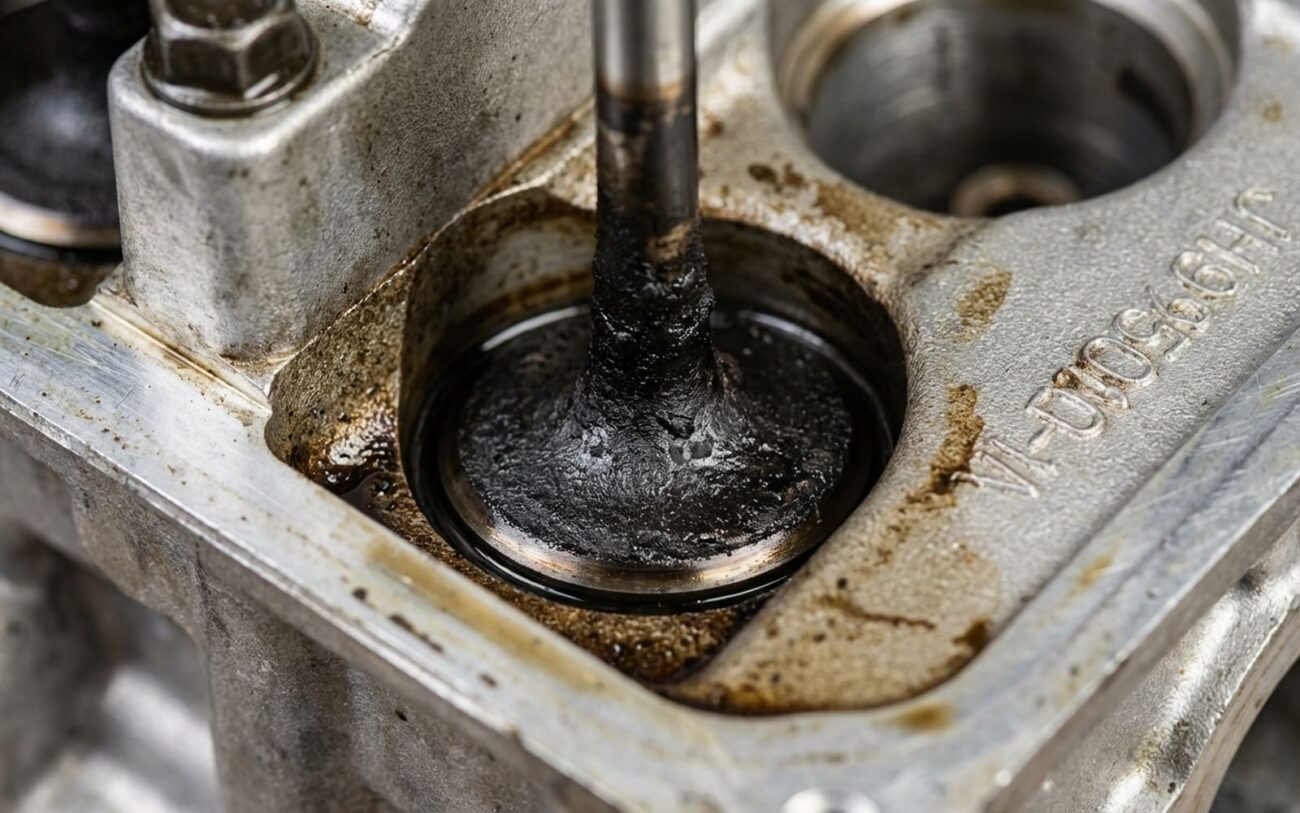
Then there are the valve stem seals. The original nitrile rubber seals just don’t hold up forever. With repeated heat cycles, they harden up and lose their flexibility. When that happens, they can’t properly wipe the excess oil off the valve stems. So, oil drips down into the combustion chamber, especially when the engine is sitting cold—that’s why you often see the cold-start smoke. Just to be clear, this is almost never a head gasket issue. A blown head gasket usually means coolant loss, white exhaust smoke (not blue), or bubbles in the coolant reservoir.
Subaru Knows: Technical Service Bulletins
Subaru has actually addressed both the ring and seal issues through technical service bulletins (TSBs). TSB 02-157-14R specifically covers diagnosing oil consumption in 2011–2014 FB25 engines and recommends updated piston ring sets. And for the valve stem seals, TSB 02-173-17 introduced revised seals for 2013–2014 models. These aren’t recalls, but they’re a clear indication that Subaru is well aware of these common failure patterns.
The Fix: Your Repair Options, Costs, and My Advice
Alright, so you’ve got a confirmed oil consumption problem. What are your options? Let me be clear: major engine repairs on the FB25 are not for the faint of heart or the casual DIYer. These jobs demand specialized tools, precise torque-angle sequences, and a lot of mechanical experience. This is definitely professional territory.
Making the Call: Is the Repair Worth It?
Let’s be honest: fixing serious oil consumption in an FB25 isn’t cheap. The decision to repair depends heavily on the vehicle’s overall value and your long-term plans for it. Here’s my rule of thumb, and it’s saved a lot of my customers from throwing good money after bad: if the estimated repair cost exceeds 50% of the vehicle’s NADA Clean Trade-in value, you really need to consider your alternatives. For example, putting $8,000 into a car that’s only worth $10,000 rarely makes financial sense. Sometimes, a professionally rebuilt engine with updated internals, even if it’s a bit more upfront, is a better investment than a dealer-level repair on an older engine. It’s all about balancing reliability with your return on investment.
After the Repair: Making Sure It Sticks
A repair isn’t truly done until it’s verified. I don’t trust “it feels better”—I want data. After a short block or ring replacement, the standard is simple: oil consumption should drop to less than one quart per 3,000 miles, confirmed over at least two full oil change intervals. Track those dipstick readings religiously—same conditions, same location, same engine temperature. If you’re still adding more than that, we may still have an issue.
For valve stem seal repairs, the primary test is visual and measurable. The goal is no blue smoke on cold start. For a more objective check, I’ll use a four-gas exhaust analyzer. A healthy engine should see hydrocarbon (HC) levels drop to within 50% of warm-engine readings within about 30 seconds of startup. Lingering high HC suggests oil is still entering the combustion chamber.
If we’ve replaced an engine due to block porosity, validating the cooling system integrity is critical. I’ll perform a pressure test: it should hold 16 psi for at least 20 minutes with no drop. Then, after about 500 miles, I’ll run a block test (combustion gas detector) on the coolant. A negative result means no internal leakage. Positive? Well, then we’ve got another problem on our hands.
Keeping It Healthy: Prevention & Monitoring
To Extend Your FB25’s Life
-
Use the right oil: Always go with a full synthetic 0W-20 that meets API SP or SN-Plus standards. Change it every 6,000 miles max, and honestly, if you do a lot of short trips, consider 5,000 miles.
-
Prevent overheating: Excessive heat is a killer for seals. Replace your coolant on schedule and fix any leaks immediately.
-
Regular monitoring: Check your oil level every 3–4 tanks of gas. Keep a log of miles driven and oil added. This data is invaluable for early detection.
-
Watch the tailpipe: Have someone start the car on a cold morning while you watch for blue smoke. A brief puff might be condensation, but a thick blue cloud is your engine telling you it’s burning oil. Catch it early, and you might save the engine. Wait too long, and you’ll be shopping for a new powertrain—or a new car.
