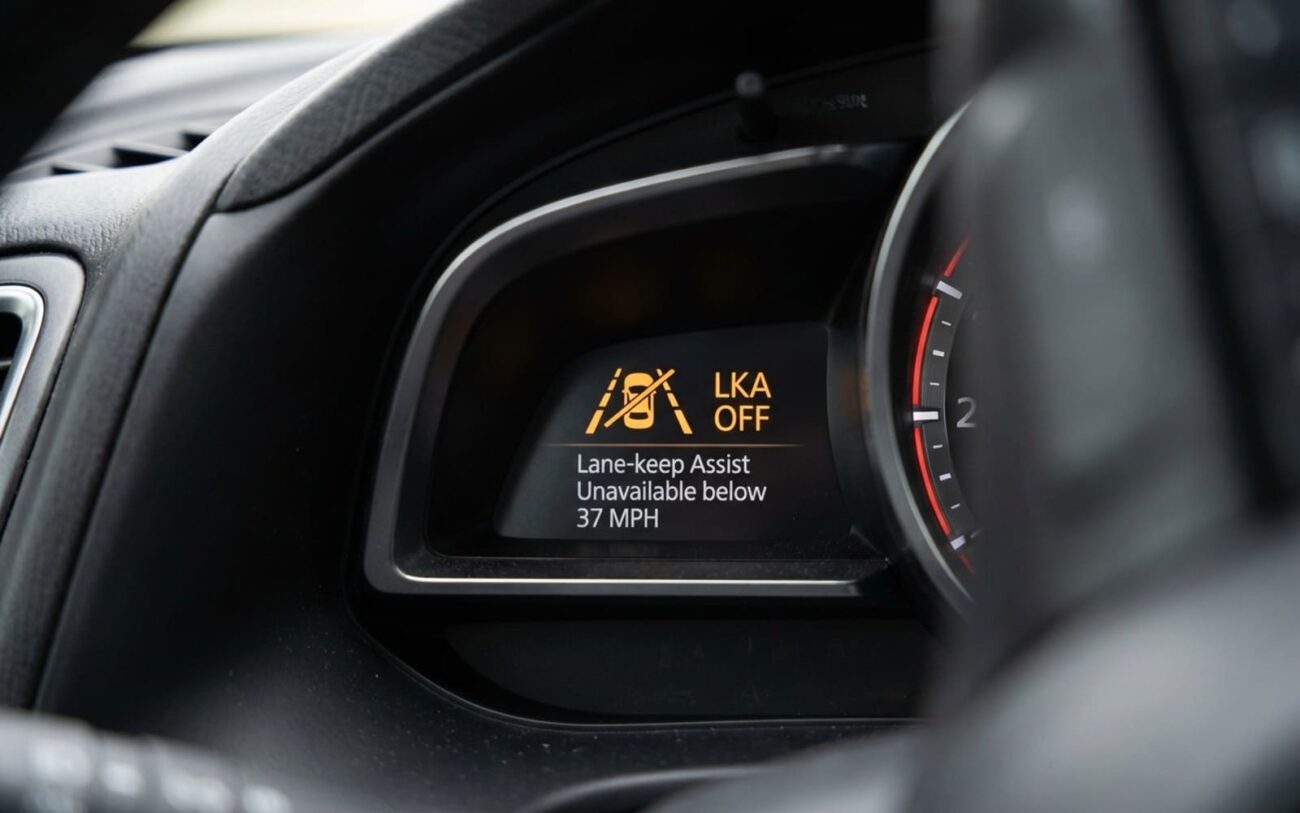
Alright, let’s talk about your Lane Keeping Assist (LKA) system. I hear this one a lot in the shop: “My LKA is broken! It turns off when I slow down!” And almost every time, I tell folks the same thing: You’re not crazy, and your car isn’t broken. It’s actually doing exactly what it’s supposed to do.
If you’ve got a modern vehicle, especially something like a Mazda with their i-Activsense suite, you’ve probably noticed that little green steering wheel or lane marker icon on your dash disappear when you drop below about 40 mph. Then, as soon as you speed back up, it pops right back on. That’s not a glitch, a loose wire, or a dying sensor. That’s just how these systems are programmed to work.
Why Your Car “Gives Up” Below 40 MPH
Engineers didn’t just pick that 37-40 mph speed limit out of thin air. There are some really good, safety-driven reasons for it. Think about it:
- Low-Speed Chaos: City streets, parking lots, roundabouts – these are places where you’re constantly changing lanes, making tight turns, and dealing with unpredictable traffic. If LKA was active, it would be fighting your steering inputs all the time. Imagine trying to park with the car subtly trying to steer you straight. It would be frustrating, and frankly, dangerous.
- Fuzzy Lane Lines: The forward-sensing camera, which is the “eyes” of your LKA system, needs clear, high-contrast lane markings to work. In urban areas, those lines are often faded, covered in dirt, or interrupted by crosswalks and stop lines. The system simply can’t reliably “see” the lanes, so it disengages rather than giving you bad information or making a mistake.
- Different Steering Feel: Your Electric Power Assisted Steering (EPAS) system is tuned differently at low speeds. It gives you more assist for easy parking and maneuvering. The subtle corrections LKA applies at highway speeds would just mess with that low-speed tuning, leading to inconsistent and unpredictable steering feel.
So, when your LKA turns off below that threshold, it’s not failing. It’s just stepping back, knowing it’s not the right tool for the job at that moment. Your owner’s manual will confirm this, usually in the section about your ADAS (Advanced Driver Assistance Systems) or i-Activsense.
Spotting the Difference: Normal Behavior vs. a Real Problem
This is where things get tricky for a lot of drivers. How do you tell if it’s just normal operation or if something’s actually wrong? The key, in my 25 years, is pattern recognition. A clean, consistent shutdown below 37 mph and reactivation above it? That’s normal. But if it’s dropping out unexpectedly at highway speeds, refusing to turn back on, or throwing warning messages, then we’ve got a real fault to chase down. Here’s how I break it down for customers:
| What You See (Symptom) | What It Usually Means (Normal) | What It Could Be (Actual Fault) | How I’d Confirm It in the Shop |
|---|---|---|---|
| LKA consistently turns off below ~37 mph and turns back on above it. No warning lights. | This is standard operating procedure for most camera-based LKA systems. It’s designed to prevent interference during low-speed driving. | Could be a very minor camera obstruction (like a smudge) or slight misalignment that only affects detection at the very edge of its operating range. |
I’d hook up my OEM scan tool (like Mazda’s M-MDS) and monitor the LKA status. I’d expect to see “Available: NO” below the threshold and “YES” above, with no stored diagnostic trouble codes (DTCs).
|
| LKA is unavailable at all speeds, with a persistent “Lane Keep Assist Unavailable” message on the dash. | Definitely not normal. This points to a system-wide failure, not programmed behavior. | Could be a failed camera module, a damaged windshield right in the camera’s field of view, a power or ground issue to the ADAS module, or a lost communication signal on the CAN bus. |
First, I’d scan for active fault codes in both the Forward Sensing Camera module and the EPAS module. Then, I’d check the live camera feed through the scan tool and use an oscilloscope to test signal integrity on the communication lines.
|
| Lane Departure Warning (LDW) vibrates the steering wheel, but no actual steering correction is applied. | This tells me the camera is seeing the lanes, but the EPAS system isn’t getting or executing the steering torque commands. It’s a subsystem fault. | Could be a failing EPAS motor, a degraded steering angle sensor, or a software conflict with the vehicle’s stability control system. |
I’d pull DTCs from the EPAS and Vehicle Stability Control (VSC) modules. A steering angle sensor calibration would be next. Then, on a test drive, I’d monitor commanded vs. actual assist torque to see if the EPAS is responding correctly.
|
What I Do in the Shop: Diagnosing LKA Issues
If your LKA is acting up beyond that normal low-speed cutoff – failing on the highway, throwing warnings, or just not working at all – then you’ve got a real fault. This isn’t a job for guesswork or a cheap code reader from the auto parts store. These ADAS systems are complex, relying on precise camera alignment, secure data buses, and meticulously calibrated sensors.
When a car comes into my bay with an LKA fault, the first thing I do is hook up an OEM-level scan tool. We’re talking Mazda’s M-MDS, or a high-end aftermarket tool like an Autel MaxiSys with ADAS coverage. I’m looking for active and stored DTCs in the Forward Sensing Camera module, the EPAS module, and sometimes even the ABS/VSC module, as they all communicate.
Beyond codes, I’m checking live data. I want to see what the camera is “seeing” – is the image clear? Is it detecting lane lines? What’s the system’s confidence level? I’ll also check for proper power and ground to the modules, and use an oscilloscope to verify signal integrity on the CAN bus lines. A loose connection or a corroded wire can cause intermittent headaches that are tough to track down.
And here’s a big one: if the windshield has been replaced recently, a recalibration of the forward-sensing camera is almost always needed. Many glass shops skip this or don’t do it correctly, and it’ll cause all sorts of ADAS problems. It’s similar to diagnosing a misfire – you don’t just throw parts at it. You follow a diagnostic tree, test, and confirm. Guessing will cost you time and money.
Validating the Fix: My Road Test Protocol
A good shop doesn’t just clear codes and send you on your way. After any repair or calibration on an ADAS system, a thorough validation process is critical. For LKA, here’s what I do:
- Clear Codes and Drive: All diagnostic trouble codes must clear and stay clear. I’ll perform a full drive cycle that includes both low-speed (below 37 mph) and highway-speed (above 45 mph) segments.
- Functional Road Test: On a highway with clear, visible lane markings, I’ll engage the LKA. The indicator light (usually green) needs to illuminate, and I should feel the system applying gentle, corrective steering torque to keep the vehicle centered.
- Signal Check: I’ll confirm that the system disengages immediately when I activate the turn signal. This is a crucial safety feature.
- Scan Tool Monitoring: Throughout the road test, I’ll keep the scan tool connected, monitoring LKA status and any relevant sensor data to ensure no intermittent faults reappear.
This validation step is non-negotiable. Without it, you might leave the shop with a system that looks okay but fails under real-world driving conditions, which is just asking for trouble.
Costs and Risks: Don’t Pay for Nothing
Repair costs for ADAS systems can vary wildly, and the risk of misdiagnosis is pretty high if you don’t understand the root cause. I’ve seen customers drop $1,500 or more on a perfectly good camera replacement because someone didn’t know about the speed limit cutoff. Here’s a realistic look at what you might face:
| What Needs Doing | DIY Cost | Shop Cost | Success Rate (if diagnosed correctly) | What Happens if It Fails (Secondary Risk) |
|---|---|---|---|---|
| No Repair (Normal Behavior) | $0 | $0 | 100% | You might over-rely on the system in low-speed situations where it’s not active, thinking it should be working. |
| Camera Recalibration Only | Not Feasible | $150 – $400 | >95% | Poor LKA performance, frequent disengagement, or false warnings if the alignment is off even slightly. |
| Camera Module Replacement + Calibration | Not Feasible | $800 – $2,000+ | >90% | System inoperability or constant warning messages if the installation or calibration isn’t perfect. This is a common issue after windshield replacement. |
| EPAS Module or Sensor Repair | Not Feasible | $500 – $1,500+ | Varies Widely | Abnormal steering effort, delayed response, or unintended steering assist if programming or calibration isn’t complete. |
Keeping Your LKA System Happy Long-Term
Maintaining consistent LKA performance really comes down to a few basic things – mostly awareness and routine care. Here’s what I tell my customers:
- Keep that windshield clean, especially the area right in front of your rearview mirror. That’s where the forward-sensing camera “sees” the world. Even a light film of grime, bug splatters, or a sticker can degrade performance.
- If you ever need a windshield repair or replacement, insist on a proper ADAS recalibration. I can’t stress this enough. Many shops cut corners here, and it leads to persistent warnings and system failures.
- Pay attention to your LKA icon during your regular drives. If it normally kicks in at 40 mph but suddenly doesn’t, or if it’s intermittent, that’s an early red flag to get it checked out.
- Stay current with software updates. Manufacturers like Mazda occasionally release firmware updates for ADAS modules that can improve detection or refine system behavior. They rarely change the core 37 mph threshold, but updates can still be important.
Think of it like any other precision system on your car: clean sensors, proper calibration, and understanding its operational limits go a long way toward keeping it working when you need it most.
