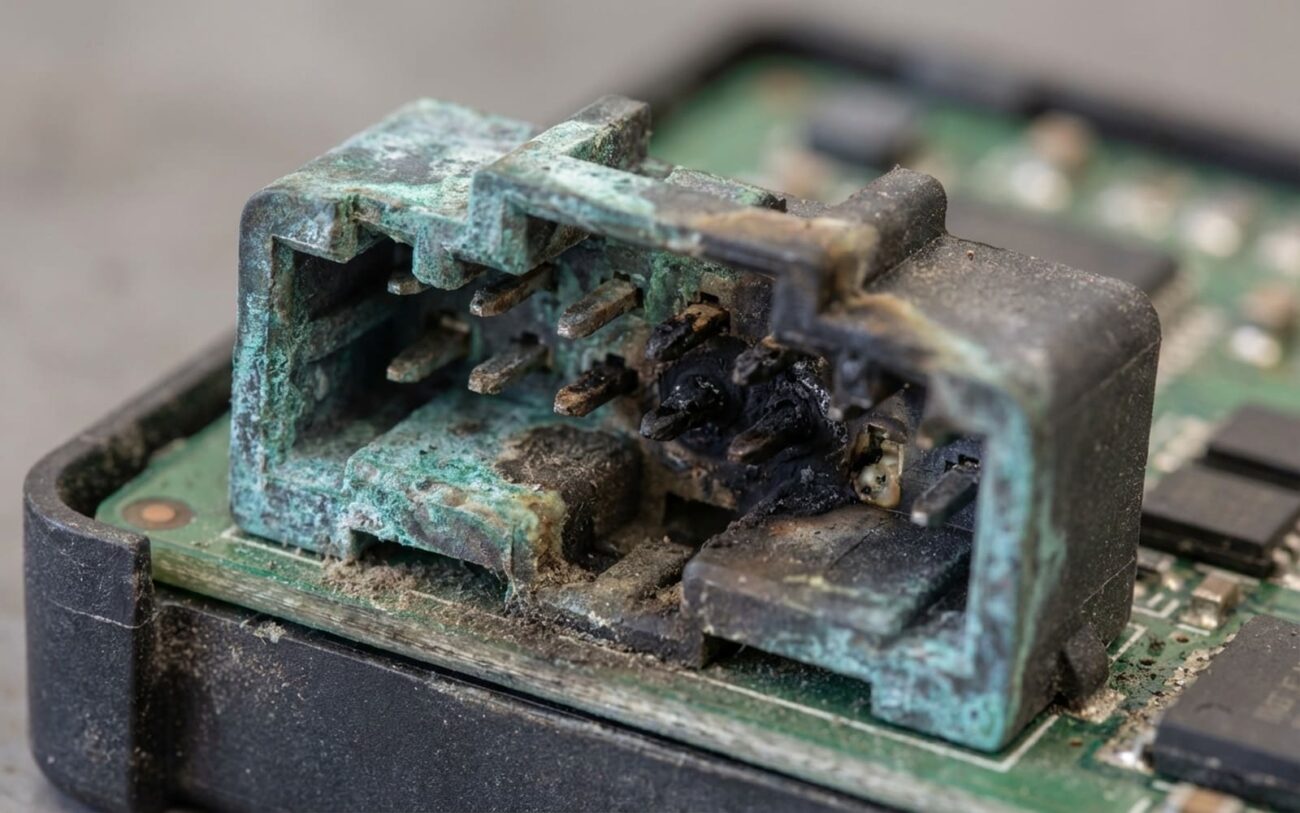
You’ve got one headlight on your Skoda Octavia A7 or VW Golf Mk7 that’s half as bright as the other. Not flickering randomly—just consistently dim, like someone turned the brightness knob down. I’ve seen this more times than I can count, especially on MQB-platform cars from 2013 to 2019. And let me tell you: it’s not the LED dying. LEDs don’t fade. They either work or they’re dead. This? This is electronics failing inside the housing—specifically the LED driver module.
Symptom = Internal Driver Failure (90% of Cases)
When a low beam LED is still on but noticeably weaker—especially if it looks yellower or uneven—that’s not the diode failing. It’s the driver board struggling to regulate current. These modules are tiny power supplies baked into the headlight assembly. They take 12V from the BCM, convert it, and deliver stable power to the LEDs while managing heat and communicating over CAN bus.
I’ve cracked open dozens of these units. The failure point? Almost always electrolytic capacitors on the driver board. They dry out, bulge, or crack from thermal cycling. Once they go, the output voltage sags. The LED stays lit, but dim. Sometimes it flickers under load—like when you turn on high beams or DRLs—because the board can’t keep up.
If you’ve pulled codes with VCDS or ODIS and found something like “Right Headlight Power Output Stage: Signal Too Low” or a J745 communication fault, that’s the BCM saying, “I told it to turn on, but it didn’t respond.” That doesn’t prove the headlight is bad—but when combined with unilateral dimming? It’s damn close.
This isn’t a BCM issue.
A failing BCM would throw codes across multiple modules—door locks, wipers, interior lights. One dim headlight? That’s isolated. And no, it’s not a fuse. Fuses are binary: full power or nothing.
How to Confirm It’s the Headlight (Not Wiring or BCM)
Before you spend $1,200 on a new OEM unit, rule out the easy stuff. I do this in every case—because once you crack the headlight seal, there’s no going back.
| Symptom | Likely in Named Component | Common External Mimics | Definitive Test to Confirm Source |
|---|---|---|---|
| Unilateral dimming, no DTCs. | Degrading LED driver module output. | Voltage drop from BCM, corroded connector, high resistance in power supply. |
Measure voltage directly at the headlight connector pins with the light on. If you’ve got 12.5V+ and it’s still dim, the fault is inside. No exceptions. |
| Unilateral dimming with relevant DTC. | LED driver module communication or internal fault. | Broken wire in harness, damaged CAN bus line, intermittent BCM output. |
Swap left and right headlights. Clear codes. Run an output test. If the code follows the headlight, it’s bad. If it stays on the same side, check wiring or BCM. |
| Flickering then dimming. | Failing capacitors or thermal fatigue in LED driver module. | Loose connector, moisture ingress, intermittent BCM signal. |
Monitor voltage at the plug with an oscilloscope while wiggling the harness. Stable voltage + flickering light = internal failure. |
What Actually Dies Inside? (Spoiler: It’s the Driver Board)
Two killers: heat and moisture. That’s it.
These headlights were designed with marginal thermal management. The driver board sits right behind the LED array, which runs hot. On early MQB models (2013–2017), the venting is weak. No active cooling. Just passive airflow through a small port. Over time, heat builds. The electrolytic capacitors—especially the ones near the MOSFETs—start to dry out. Once they lose capacitance, the current regulation fails. The LED gets unstable power. Result? Dimming. Flickering. Eventual dropout.
Moisture is the silent killer. Even minor condensation inside the lens can wick into the driver housing. I’ve seen boards with green corrosion on the traces, especially around ground connections. One pin lifts, and the whole thing goes intermittent. If you’ve ever had fogging that doesn’t clear after 24 hours, that’s a red flag. Don’t ignore it.
Fix Options: What I Recommend (And What I Avoid)
Professional Territory Only
Opening a sealed headlight requires precision heating, vacuum sealing, and leak testing. One mistake, and you’re dealing with condensation in six months. This isn’t a “YouTube DIY” fix.
OEM Headlight Assembly Replacement Professional Only
Specialist Driver Module Repair Professional Only (Specialist)
Temporary / Last-Resort
After the Fix: How I Validate It
OEM replacement? Clear codes, verify communication, and align the beam. Use the wall method: park 25 feet from a flat surface, mark the centerline and height, then adjust until the cutoff line matches specs. You want even spread, no hot spots, no glare into oncoming traffic.
If it’s a repaired module, validation takes longer.
-
Check for moisture after 48 hours. If there’s fogging, the seal failed. It’s not fixed.
-
Drive it for at least 30 minutes—use high beams, DRLs, cornering lights if equipped. Watch for flickering.
-
Measure current draw via OBD2. A healthy driver pulls steady amps. Spikes or drops mean instability.
Cost vs. Value: When to Repair, When to Replace
| Repair Type | DIY Cost | Shop Cost | Success Rate | Secondary Risk if Failed |
|---|---|---|---|---|
| OEM Headlight Assembly Replacement | $800–$1500 (part only) | $1200–$2200 (parts & labor) | 100% when installed and coded correctly | Improper aiming, bumper damage during removal, faulty remanufactured unit |
| Specialist Driver Module Repair | $50–$100 (components) – Not recommended for DIY | $300–$600 | 70–85% (depends on technician skill and initial damage) | Seal failure leading to condensation, recurring flickering, or complete module failure requiring full replacement |
Here’s my rule: if a new OEM headlight costs more than 35% of the car’s resale value, go for a repair or a verified used unit. On a 2015 Golf worth $8,000, spending $1,800 on a light doesn’t make sense. But get a used one from a junkyard with matching part numbers (check the label inside), or use a reputable repair shop. Just test it before you install it.
Prevention: What I Tell My Customers
You can’t stop aging, but you can slow it down.
Keep the vent ports clean. They’re usually on the top or side of the housing. If they’re clogged with mud or ice, pressure can’t equalize, and moisture builds. When replacing turn signals or DRL bulbs, use OEM-spec parts. Cheap halogen bulbs run hotter—adds stress to an already warm environment.
Do a quick beam check every few months. Park facing a wall at night. Look for differences in brightness, color, or cutoff sharpness. Some VW and Skoda models have a built-in headlight test in the infotainment—run it occasionally.
And after a car wash? Watch the headlights. If fogging doesn’t clear in 24 hours, investigate. Pull the plug, check for corrosion. Early intervention can save the driver board.
Bottom line: this is a known weakness in early MQB headlights. It’s not your fault. But now you know how to fix it—and how to avoid getting ripped off.
