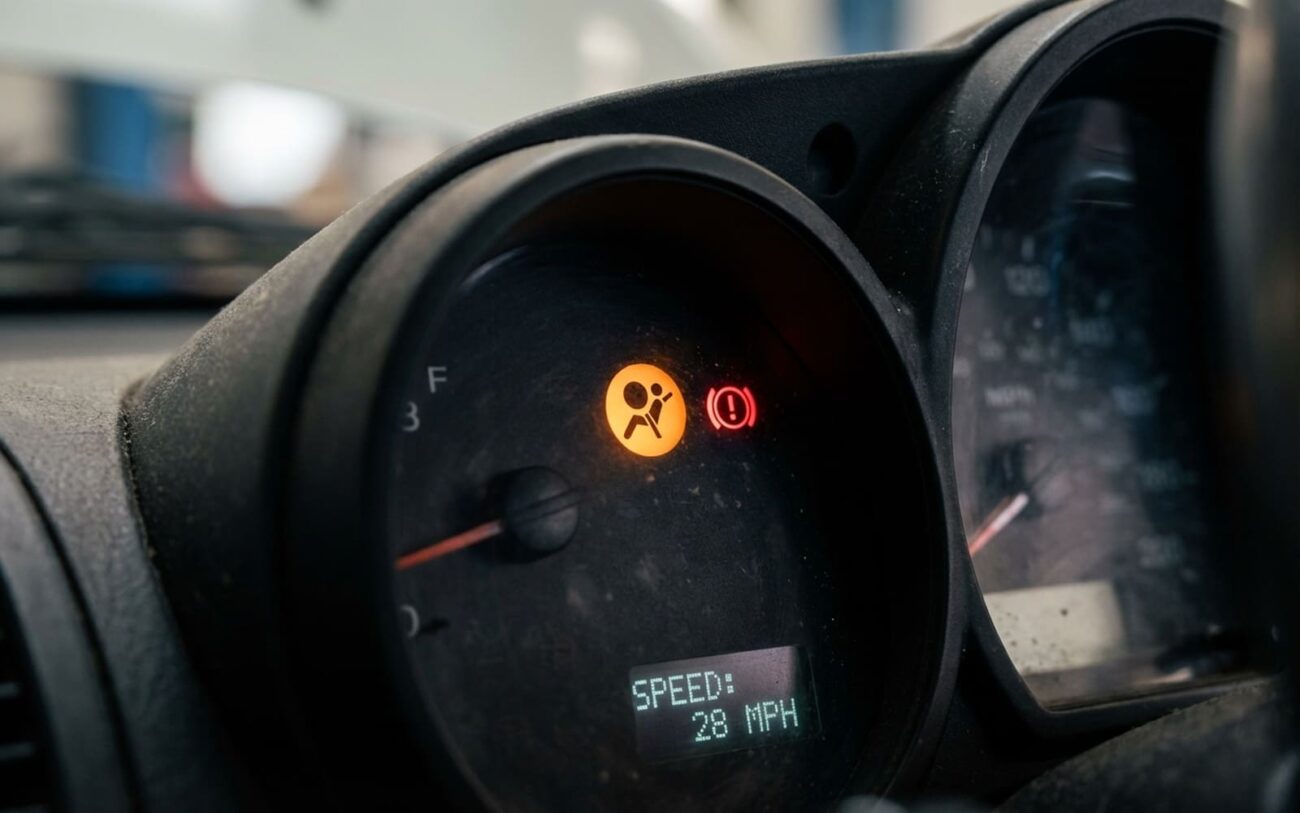
You bring in a car with a smashed front end, airbags still tucked away in the dash, and the customer’s eyes are wide: “Shouldn’t they have gone off?” I’ve heard that a thousand times. Let me tell you something I’ve learned the hard way—after 25 years tearing into SRS systems on everything from econoboxes to heavy-duty trucks: if the airbags didn’t deploy, it doesn’t mean they failed. Sometimes, they did exactly what they were supposed to.
Deployment Isn’t Automatic—It’s Calculated
The airbag system doesn’t care how bad the damage looks. It doesn’t “see” a bent hood or a cracked headlight. What it does care about is one number: delta-V. That’s the rate of deceleration during impact—how fast the car goes from moving to stopped (or slowed). The Sensing and Diagnostic Module (SDM), buried somewhere under the console or near the transmission tunnel, makes a decision in milliseconds based on that value.
If delta-V doesn’t hit the threshold programmed for that specific vehicle and crash profile? No deployment. And that’s not a defect. That’s the system doing its job.
I’ve pulled SDM data from cars with fenders ripped off and radiators hanging—yet the delta-V was under 12 mph/sec. Meanwhile, I’ve seen a sedan with barely a scratch on the bumper that inflated both front bags because it hit a curb at 30 mph and decelerated hard. Crash dynamics aren’t intuitive.
What Actually Triggers Deployment?
It’s not just speed. It’s not just force. It’s how quickly the vehicle’s momentum changes—and in which direction.
On most frontals, the SDM uses input from two or more crash sensors (usually one in each front rail and sometimes one in the passenger footwell). These are accelerometers, sampling data thousands of times per second. If the deceleration spike matches a frontal crash profile—sharp, sustained, longitudinal—the SDM sends the fire command.
But here’s where people get tripped up:
- Glancing blows: You T-bone a pole at 35 mph, but it’s a 45-degree angle. The front corner collapses, but the cabin doesn’t slow down fast enough. No deployment. I see this on older Camrys and Accords all the time.
- Soft barriers: Snowbanks, bushes, guardrails—they absorb energy over time. Delta-V stays low, even if the bumper’s gone. Ford even calls this out in TSB 15-2247—if the impact isn’t rigid, don’t expect airbags.
- Low-speed rigid impacts: Hitting a concrete barrier at 18 mph? Might not trigger. The system expects cabin intrusion or occupant movement. If the structure holds and the deceleration is gradual, it won’t fire.
And before you ask—yes, the system knows if someone’s sitting in the passenger seat. The occupancy sensor can suppress the passenger bag. But that’s a separate logic path. We’re talking driver/frontal here.
When It’s Actually Broken
Now, if the crash data shows delta-V was above threshold and the bags didn’t fire? That’s a failure. No debate.
But don’t jump there. First, check the SRS light history. If it was on before the crash, the SDM likely disabled deployment. That’s by design—can’t risk a random deployment due to a shorted circuit. I’ve had customers swear it wasn’t on, but the SDM logs don’t lie.
Next, pull the codes. Not just the current ones—pull the crash record. On most modules, you’ll see:
- “Deployment Command Not Sent” — normal if delta-V was too low.
- “Crash Data Stored” — expected. Means the SDM recorded the event.
- “Open Circuit in Driver Airbag” — now we’re talking. That’s a hard fault. Could be a blown squib, broken wire, or failed clock spring.
- “Frontal Sensor 1 Inoperative” — sensor or wiring issue. Probably why no deployment.
I had a 2018 Silverado last month—hit a deer head-on at 40 mph, crumpled the whole front clip, no airbags. Pulled the SDM: delta-V was 18 mph/sec, well above threshold. But I found a DTC: “Open Circuit in Driver Airbag.” Turns out the previous shop had replaced the clock spring and pinched the ribbon cable. Classic.
| Symptom | Likely Root: Algorithm Function | Potential Mimics: Component or Wiring Fault | Definitive Test Method |
|---|---|---|---|
| No airbag deployment in frontal collision with moderate-to-severe visible damage. | Delta-V below programmed deployment threshold (system operated correctly). | Failed crash sensor, wiring damage, low battery voltage at impact, disconnected harness. |
Retrieve crash data from the SDM using an OEM-level or high-tier aftermarket scan tool. Analyze recorded delta-V and compare to manufacturer specifications for that model. |
| SRS warning light was on before the crash. | Pre-existing fault detected by SDM, possibly disabling deployment. | Open circuit in airbag squib, failed seat belt pretensioner, damaged clock spring, faulty occupancy sensor. |
Scan for stored SRS DTCs. A code like “Open Circuit in Driver Airbag” confirms a hardware issue, not an algorithm decision. |
So What Do You Do Now?
Two paths. Only two. And you pick based on data—not damage.
If delta-V was below threshold:
No repair needed. Document the SDM data. Show the customer the numbers. Explain why the system worked. That’s it. We call this VERIFICATION ONLY – SYSTEM FUNCTIONAL. The car is safe to drive. I’ve closed dozens of these cases just by showing the data.
If delta-V was above threshold and no deployment:
Replace the SDM. No exceptions. This isn’t a “maybe.” The system failed its primary job. You’re not just fixing a light—you’re restoring a life-saving system. And yes, it’s expensive. But I’d rather explain a $1,800 repair than a wrongful death lawsuit.
When I replace an SDM, here’s what I do:
- Disconnect the battery negative terminal. (Yes, every time.)
- Wait 3 minutes. Let those capacitors bleed off. I’ve seen techs skip this and fry modules.
- Access the SDM—usually under the center console. On Fords, it’s near the shifter. On Hondas, under the glove box. (On the 2015-2017 F-150s, I see this weekly.)
- Check if the mounting bolts are single-use. GM, Toyota, and Honda all use torque-to-yield bolts here. Reuse one? You’ll get a “Sensor Mounting Fault” code later.
- Torque to spec: 8–10 N·m. No guesswork. I use a calibrated inch-pound wrench.
- Program the new module with OEM-level software. Autel MaxiSys, Snap-on, or dealer tool. No exceptions. The module needs the VIN, calibration, and configuration. Plug-and-play doesn’t exist here.
Validation: Don’t Skip This
After verification or replacement, you’re not done.
If you did nothing—just pulled data—check the SRS light: it should come on at key-on, stay for 6–8 seconds, then go out. That’s the bulb check. If it’s out, and the data shows no threshold breach, you’re good.
If you replaced the SDM, you’ve got three checkpoints:
- Bulb check passes — light on, then off.
- No active DTCs — scan again. A “Module Not Configured” code means programming failed.
- VIN and calibration match — the SDM should report the correct VIN and part number. If it doesn’t, it won’t trust the sensors.
And no, you can’t do this with a $50 code reader. You need a tool that talks full SRS protocol. If you don’t have one, partner with a shop that does. This isn’t the place to cut corners.
Cost vs. Safety: Don’t Even Debate It
| Service Type | DIY Cost Estimate | Professional Shop Cost | Success Rate | Risks of Incomplete or Improper Work |
|---|---|---|---|---|
| Crash Data Download & Analysis | Not feasible (requires OEM-level scan tool) | $100 – $250 (1.0–1.5 hours labor) | Near 100% when proper equipment is used | Misdiagnosis leading to unnecessary part replacement or driving with an undetected fault. |
| SDM Replacement & Programming | $500–$1,500 (module only – not recommended without tools/expertise) | $750 – $2,000 (includes OEM module, programming, labor) | Over 98% when OEM procedures are followed | Accidental airbag deployment, non-deployment in future crash, persistent SRS light, or legal liability in an accident. |
I’ve had customers walk out because the quote was “too high.” My response? “Then don’t drive it.” Because if the airbags don’t work and you get hit again, that’s on you—and your insurance won’t care.
Prevention: Watch for the Red Flags
You can’t stop a bad crash, but you can avoid setting up a future failure.
Biggest risk? Prior repairs. If the car was in a wreck before and the frame wasn’t pulled correctly, the crush zones won’t absorb energy the way they should. Crash sensors mounted on bent brackets? They’ll send garbage data. I’ve seen this on accident-trade-ins—looks fine, but the SDM’s getting noise.
So here’s what I do:
To Prevent Recurrence
-
Monitor the SRS light. If it’s on, scan it. Don’t wait.
-
After any impact—even a parking lot bump—pull the SDM data. It logs crashes below deployment threshold.
-
Avoid aftermarket mods near SRS components. I’ve seen a custom steering wheel installation sever a clock spring. One cut, and the whole system’s blind.
Bottom line: the SDM is the only witness that matters. It doesn’t lie. It doesn’t guess. It records. So stop looking at the dent. Plug in the tool. Read the data. And let the truth decide what comes next.
