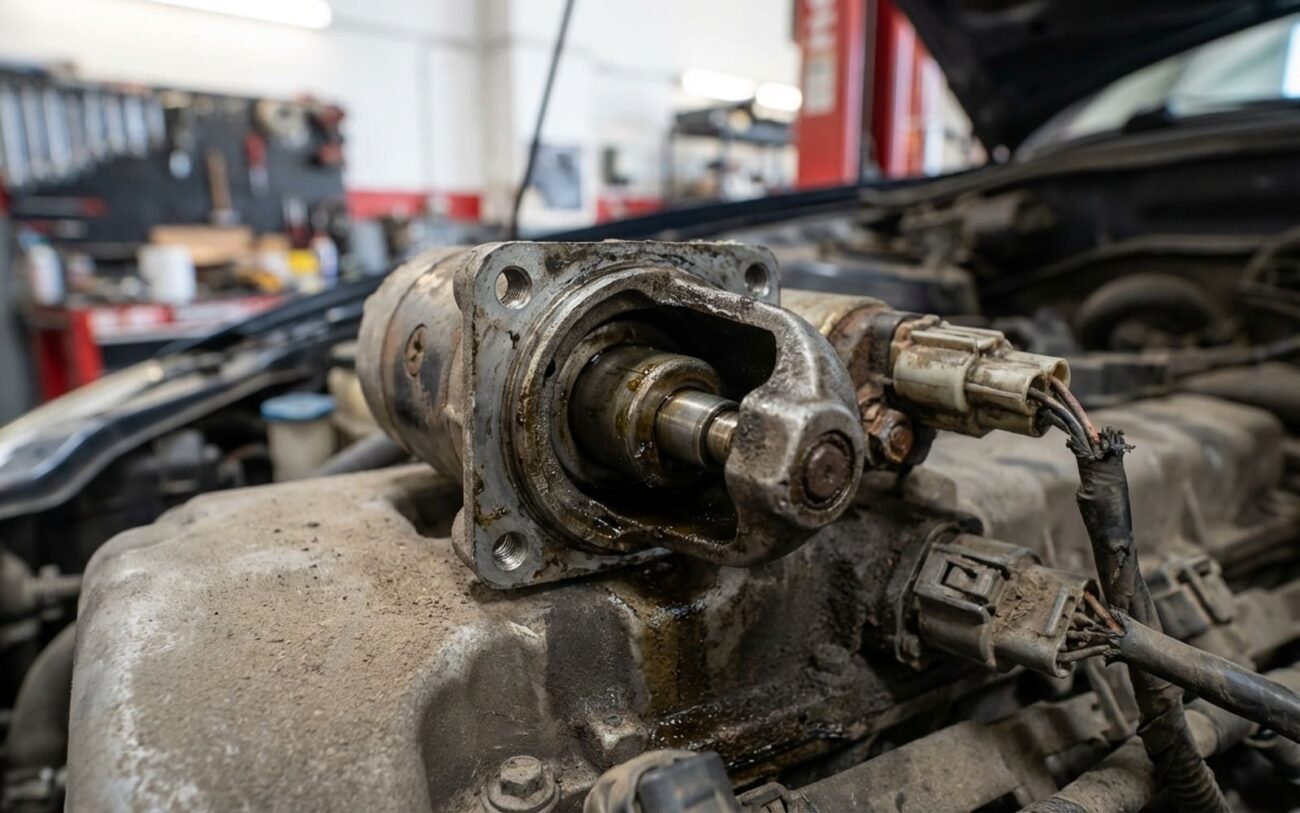
Starter Won’t Stop Cranking? Here’s What’s Really Going On
If your starter keeps spinning after the engine fires—especially if you’ve already let go of the key or button—shut it off. Now. That high-pitched scream isn’t just annoying; it’s metal-on-metal destruction in progress. I’ve pulled too many starters with chewed-up drive gears and flywheels that cost three times more to fix than the original problem.
The Bendix gear is still meshed with the flywheel, and now it’s getting dragged at 2,000 RPM instead of disengaging. That’s not a “maybe something’s wrong” scenario. That’s a “you’re actively breaking expensive parts” situation. And yeah, I’ve seen guys try to “drive it off” like it’ll magically fix itself. It won’t.
Is It the Solenoid or Something Else?
Most of the time? It’s the solenoid. But not always. And that’s why I don’t grab wrenches first—I grab my test lead.
Before you pull a single bolt, do this: With the key out, transmission in Park or Neutral, disconnect the small wire from the “S” terminal on the solenoid. It’s usually a spade connector, maybe covered in grime. Clean it if you have to. Now try to crank.
If the starter doesn’t engage, the solenoid’s fine. The fault’s upstream—ignition switch stuck, relay welded, or a wire shorted to power somewhere. But if it cranks anyway? That solenoid’s internals are fused or seized. You’re not getting that back.
| Symptom | Likely Internal to Solenoid | Common External Causes | Definitive Test |
|---|---|---|---|
| Starter cranks continuously after engine starts | Welded copper contacts inside solenoid | 1. Ignition switch stuck in START position 2. Short-to-power in starter control circuit |
Disconnect control wire at solenoid. If starter still cranks, solenoid is faulty. |
| Starter grinds or zings after start | Plunger not retracting, holding drive gear in mesh | Damaged flywheel teeth (rarely causes continuous cranking) |
Same test. If noise stops when wire is disconnected, check switch and wiring. |
| Starter runs with key completely removed | Severe internal welding or plunger seizure | Major wiring fault sending constant 12V to control terminal |
Test disconnected wire with multimeter. If 12V present with key out, fault is external. |
What Actually Dies Inside the Solenoid?
The solenoid isn’t just a switch. It’s two jobs in one: electrically connects the battery to the starter motor, and mechanically shoves the drive gear into the flywheel. When you turn the key, the coil pulls a plunger, which slams a copper disc across the main terminals while a lever arm pushes the gear forward.
The weak spot? Those copper contacts. Every time you start, a tiny arc jumps across them. Over time, especially with weak batteries or bad grounds, that arc gets worse. Pitting increases resistance, resistance increases heat, and heat eventually welds the contacts together. Once that happens, the starter’s live 24/7—key or no key.
I see this most on older GM V6s and Chrysler 3.5L engines. Why? Marginal ground straps, undersized cables, and repeated hot starts. Voltage drop kills solenoids faster than mileage. And don’t blame the starter motor—this is a solenoid-specific failure.
Less common, but still possible: the plunger sticks. Dirt, moisture, or a broken return spring can keep it jammed forward. That won’t weld the contacts, but it’ll keep the gear engaged and the motor spinning. And no, a bad relay won’t do this—it usually causes a single click or no crank. This is different.
How to Fix It — For Real
Your fix depends on the vehicle:
- Integrated solenoid (most modern cars): The solenoid’s built into the starter. No field service. Replace the whole unit. I go for Denso or Bosch remans—they last longer than cheap aftermarket stuff. On a 2018+ Honda Accord, for example, the solenoid isn’t even accessible without disassembling the starter. Just replace it.
- Remote solenoid (older trucks, some Fords): If it’s bolted to the fender or firewall, you can swap just the solenoid. Faster, cheaper. But verify the test first—don’t throw parts at it. I’ve seen guys replace three solenoids only to find a melted ignition switch harness.
Tools you’ll need: socket set with extensions, torque wrench, maybe a pry bar if it’s buried. Torque matters. Overtighten, and you crack the starter housing. Undertighten, and vibration loosens it. I’ve seen starters walk themselves off the block.
Typical specs:
- M10 bolts: 35–45 ft-lbs
- M12 bolts: 70–90 ft-lbs
Check the factory manual if you can. And inspect the wiring while you’re in there. Chafed insulation, corroded terminals, or a ground wire touching exhaust? Fix it now. That’s what kills new starters.
And about those rebuild kits? Yeah, they exist. For older GM or Ford starters, you can pull the solenoid cap, replace the contacts, clean the plunger. But it’s bench work. You need to test contact alignment, spring tension, plunger travel. One misaligned disc and you’re back at square one. I do it in my shop—when I have time. For most people? Just replace it.
How to Know It’s Fixed — Not Just Lucky
Don’t trust one start. Test it.
First, multimeter check. With the key in “RUN” (engine off), probe the starter’s main motor terminal to ground. Should be 0 volts. Then have someone crank. Voltage should jump to battery level (12.4V or higher) and drop to zero the instant the key releases. Any residual voltage? Something’s still feeding the solenoid.
Then do a real-world start. Engine should crank fast, fire, and the starter should drop out cleanly. No grinding, no spinning after. If you rebuilt it, bench-test the current draw if you can. Healthy starter pulls 60–150 amps no-load. Over 180? Something’s dragging—bad bushings, worn commutator, or shorted windings.
Cost vs. Value: Is It Worth Fixing?
| Repair Type | DIY Cost (Parts Only) | Shop Cost (Parts & Labor) | Success Rate | Risks If Repair Fails |
|---|---|---|---|---|
| Complete Starter Replacement | $150 – $400 | $450 – $800 | 98%+ | Low risk if installed correctly. Main issues stem from poor connections or incorrect torque. |
| Remote Solenoid Replacement | $50 – $150 | $200 – $400 | 95%+ | Moderate risk if original diagnosis was wrong—underlying switch or wiring fault may persist. |
| Starter/Solenoid Overhaul (Bench Repair) | $30 – $100 (kit cost) | $300 – $500 (labor-intensive) | 80–90% | High risk if reassembly is flawed. Common issues include incorrect plunger travel or contact alignment. |
I’ve worked on cars worth $500 with $800 in repairs coming due. If this fix is over 40% of what the car’s worth to you—and you’ve got rust, bad suspension, or a tired transmission—ask yourself: is this the hill to die on? Sometimes the answer’s no.
How to Keep It From Happening Again
To Prevent Recurrence
-
Low voltage kills solenoids. If cranking voltage drops below 10V, the solenoid can’t pull in fully. It “chatters,” arcing across the contacts every time. That’s how pitting starts. Keep your battery above 12.4V and clean all terminals.
-
Check the charging system. A failing alternator—especially one with a dying internal regulator—can cause voltage spikes or drops that stress the solenoid. Test output and ripple voltage if you’re chasing repeat failures.
-
Listen to how it starts. Hesitation? Clicking? Sluggish crank? That’s not “just cold.” That’s a warning. And during oil changes, take five seconds to look at the starter. Oil-soaked? Insulation melted? Rubbing on exhaust? Fix it before it fails.
