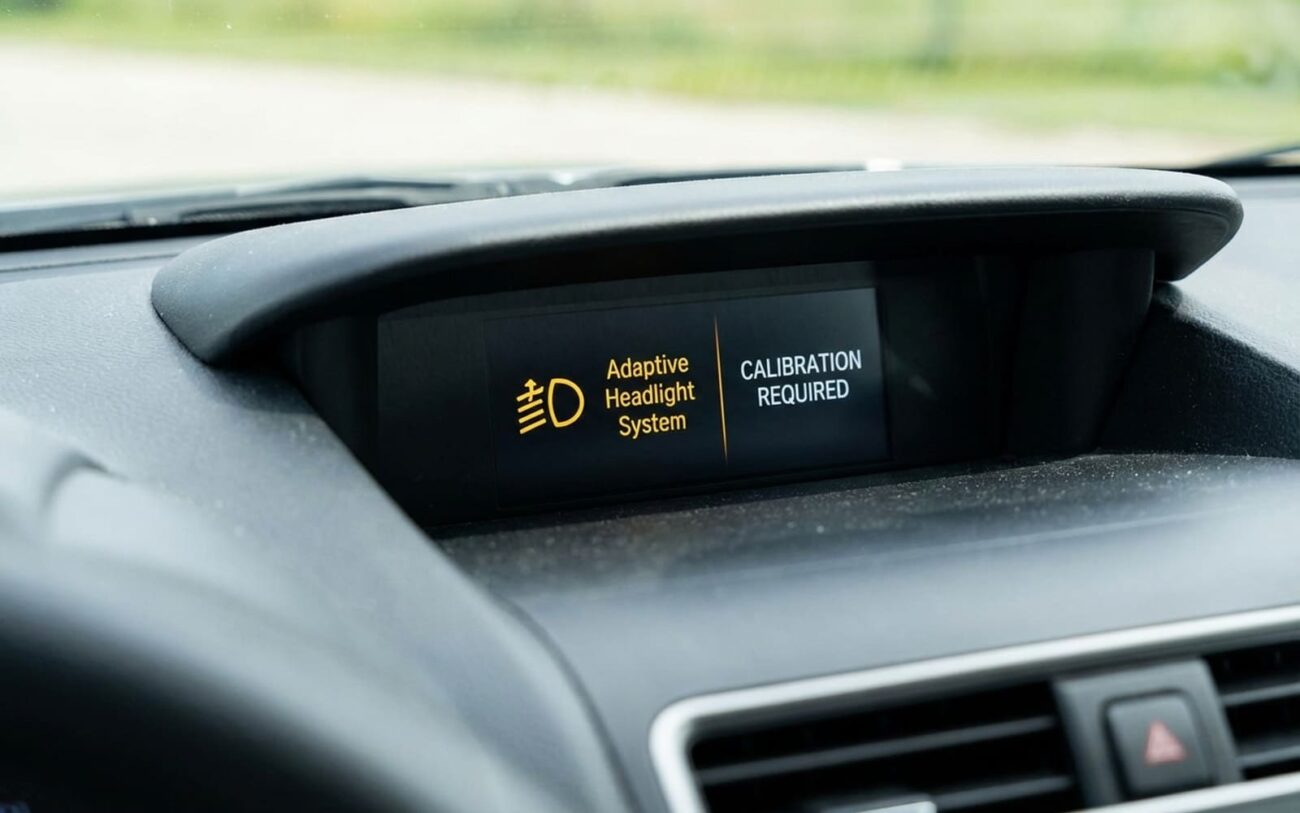
If people keep flashing you at night—even when your adaptive headlights say they’re working—you’ve got a problem. But it’s probably not the bulbs. Not the aim. It’s deeper. On modern cars, a headlight isn’t just a light. It’s a computer with lenses. And when it starts blinding other drivers, it’s either lying to itself or someone fed it bad data.
Here’s What’s Actually Happening
I’ve seen this a hundred times: customer swears their Matrix LED or adaptive high beams are working. Dashboard says “auto on.” But every oncoming driver gives them the flash. Sometimes within seconds of turning the feature on.
The system thinks it’s being smart. It’s not. It’s projecting full high beam right into the eyes of the guy in the oncoming lane. That shadow cutout—the one that’s supposed to avoid the other car? Missing. Or shifted. Or just plain wrong.
And no, it’s not because the headlight got hit. At least not usually. The real issue? Calibration loss. Or corrupted data. Or a dirty camera feeding garbage input.
On a 2020+ BMW or Audi, I’ve had these systems go sideways after a simple battery replacement. No memory saver? Boom—calibration wiped. The car doesn’t know where the headlights are pointing anymore. But it still thinks they’re adjusted. That’s when you start getting flashed.
Symptoms That Tell You Where to Look
Don’t guess. Test. But first, recognize what you’re dealing with.
Oncoming drivers flashing you consistently? That’s not random. That’s a system failing to mask the beam. Classic sign of incorrect anti-glare mapping. Could be software, could be hardware.
Check the dash. If the adaptive beam indicator is on but people are still getting lit up, the system is active but misbehaving. That’s not a bulb issue. That’s a control issue.
Scan for codes. Look for B1A00—“Adaptive Front Lighting System Calibration Not Learned.” That’s the car saying, “I don’t know where my headlights are.” Seen it on VWs, Audis, BMWs, even some newer Toyotas. It’s not rare. And it’s not always the headlight’s fault.
Do the wall test. Park 25 feet from a garage door. Turn on low beams. The cutoff line should be level, horizontal, no tilt. If one side is higher? That’s either a physical shift inside the headlight, or the leveling sensor is lying to the ECU.
And yes—ride height matters. If your air suspension is sagging, or a spring is cracked, the system will never aim right. Adaptive lights don’t work in a vacuum. They depend on accurate sensor data. No data, no intelligence.
How to Diagnose Without Wasting Time (or Money)
I used to replace headlights too soon. Learned the hard way. Now I rule out the cheap stuff first.
| Symptom | Likely in Headlight or Calibration | Common External Mimics | Definitive Test to Confirm Source |
|---|---|---|---|
| Oncoming driver flashing | Incorrect anti-glare segment mapping or failed dynamic beam adjustment in headlight control unit. | Dirty or fogged windshield in front of camera, faulty forward-facing camera, incorrect base headlight aim. |
Perform both static and dynamic calibration using a capable diagnostic scan tool. If problem persists post-calibration, the fault is likely internal to the headlight assembly. |
| DTC for calibration or aiming control e.g., B1A00 |
Lost or corrupted calibration data in headlight control module after power interruption. | Faulty headlight leveling sensor, wiring fault in LIN or CAN bus, failed internal actuator. |
Clear DTCs, perform basic mechanical aim. If code returns immediately without vehicle movement, suspect internal module memory loss. Monitor sensor data streams for implausible values. |
| Uneven or tilted beam pattern on wall | Physical displacement of LED array, DLP chip, or projector lens inside sealed unit. | Incorrect ride height (suspension or air spring fault), failed automatic leveling sensor, damaged headlight mounting points. |
Check ride height and leveling sensor operation. Perform mechanical headlight aiming with an optical aimer. If pattern remains distorted, the issue is internal to the headlight. |
That table? That’s my workflow. I don’t skip steps. I’ve seen shops replace headlights because they didn’t check the camera lens. One Audi A6 came in—owner spent $3,800 on a new headlight. I wiped the windshield. Problem gone.
When the Headlight Itself Is the Problem
Once you rule out external causes, you’re left with the unit. And yes—these things fail internally.
Not often from impact. More from thermal stress. I’ve pulled apart failed Matrix LEDs where the micro-mirrors in a DLP system had shifted. No crash. No collision. Just years of heat cycling. The plastic mounts warped. The beam pattern? All over the place.
Actuators fail too. Tiny stepper motors that adjust the shutter or mirror position—they burn out. When that happens, part of the beam won’t dim. Or it’ll stick in high beam mode. No amount of recalibration fixes that.
And no, you can’t rebuild these. Not economically. The housing is sealed. You’d spend more on tools and parts than a reman unit costs. I’ve tried. Won’t do it again.
Some models are worse than others. BMW’s 2016-2018 7 Series? Known for calibration drift after software updates. Audi A8s with DLP lights? Same. There are TSBs for this. But dealers often don’t know about them unless you push.
How to Fix It Right (Without Screwing It Up)
Professional Territory Only
This isn’t a DIY job. You need OEM-level tools, calibration targets, and safety gear. High-intensity LEDs can damage eyes. And one wrong torque spec? You’ll warp the housing.
Software Recalibration Professional Only
Headlight Assembly Replacement Professional Only
Did It Actually Work? (Most Shops Skip This)
Clearing the code isn’t enough. Neither is seeing “calibration complete” on the scanner.
First, road test. At night. With oncoming traffic. The system should mask the beam smoothly—no flickering, no gaps, no sudden high beam blasts. If it hesitates or misses a car, it’s not calibrated right.
If you replaced the headlight, do a mechanical aim with an optical aimer. Check vertical and horizontal alignment. Then run dynamic calibration. Then test drive.
And verify all functions: cornering lights, dynamic turn signals, glare-free high beam. I had a BMW come back because the cornering lights didn’t work. Turns out, the module wasn’t coded. Easy fix. But the shop didn’t test it.
To Prevent Recurrence
-
Always use a memory saver when disconnecting the battery. A 12V jump pack costs $30. A recalibration costs $400. Do the math.
-
Keep the windshield clean—especially the strip behind the rearview mirror. That’s where the camera lives. Water spots, bugs, tint residue? All can fool the system. Same way a clogged cabin filter kills airflow—small thing, big effect.
-
Check your beam pattern every few months. Park in front of a wall. If the auto high beams react slow, or you get flashed once, get it scanned. Early fix? Usually under $200. Wait too long? You’re buying a new headlight.
The Cost Reality (And When to Walk Away)
Software Recalibration
Typical shop cost. DIY feasibility is low, requiring OEM-level scan tool and target setup. High success rate (>95%) for confirmed software/data issues. Secondary risk: may reveal underlying hardware fault.
Headlight Assembly Replacement
Typical shop cost. DIY feasibility is very low, requiring coding, calibration, and precise alignment. Very high success rate (near 100%) if installation and calibration are correct. Secondary risk: incorrect calibration or torque can lead to repeat failure or ASIL system faults.
Always check your vehicle’s warranty status before authorizing repairs.
Let’s be real: if you’re looking at $4,000 in headlight repairs on a car worth $10,000, ask yourself—is it worth it? I’ve seen people do it. Pride, attachment, whatever. But sometimes, the smarter move is to disable the adaptive function and run standard low beams. Or consider moving on.
But if you drive a lot at night? Or value the safety of not blinding others? Then yeah—it’s worth it. Just don’t skip the calibration. That’s where the whole thing falls apart.
