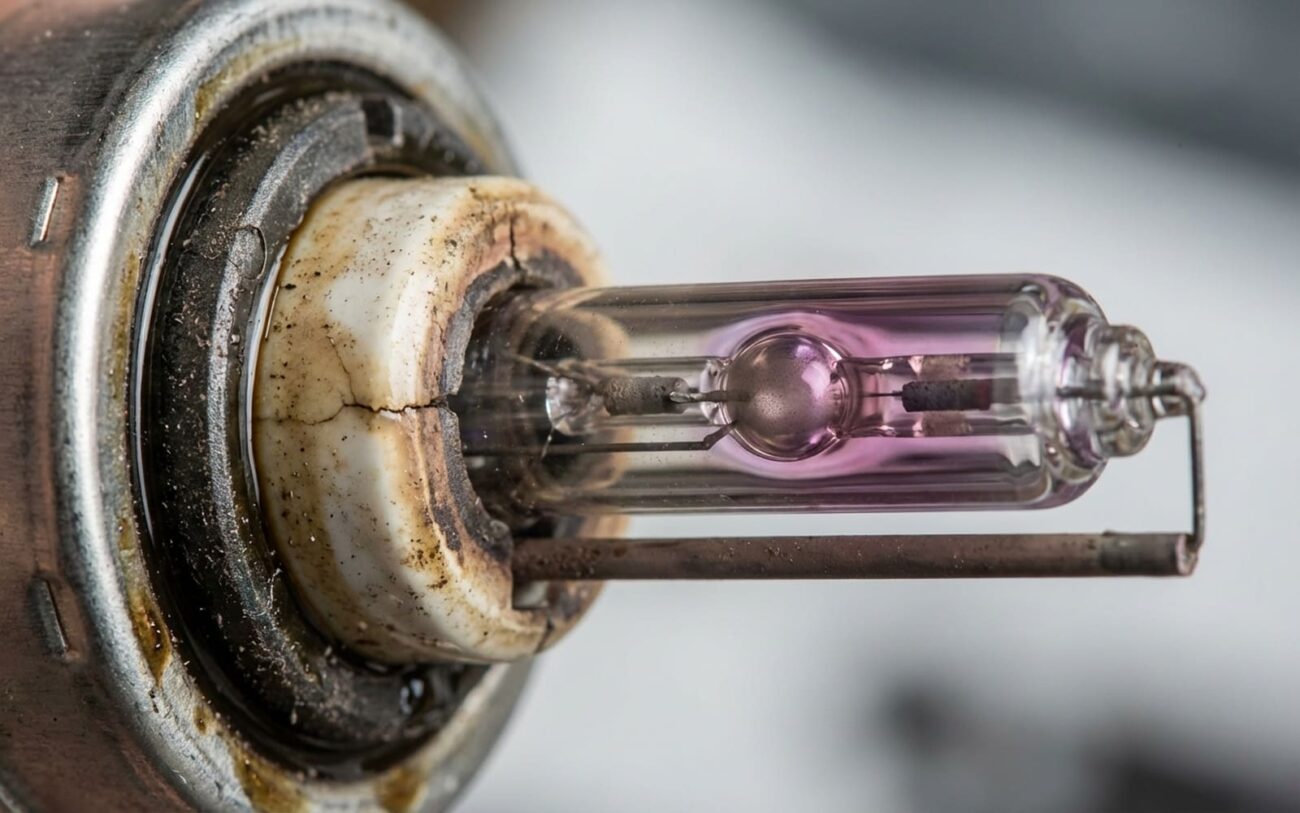
You’ve got one headlight looking pink, the other crisp white. Or maybe both are flickering like a strobe when you start the car. I’ve seen this a hundred times—on BMWs, Acuras, Infinitis, you name it. And nine times out of ten? It’s not the ballast. It’s the bulb. But don’t just swap parts and hope. Let’s walk through how I diagnose HID failure in my shop, step by step.
Symptoms That Scream “Bulb’s Done”
When an HID bulb dies, it doesn’t just go dark. It tells you—loud and clear—what’s wrong. The big one? Color shift. That clean 4300K white starts creeping into pink or purple. I’ve had customers swear their car was hit with a black light.
Why? Inside the arc tube, tungsten sputters off the electrodes over time. That contaminates the metal halide salts. The arc’s spectrum changes. Out comes pinkish light—especially on OEM 4300K bulbs. Higher temp bulbs (6000K+) drift into deep violet. It’s not subtle. Park at a wall and you’ll see it instantly.
| Original Color | Failure Color Shift |
|---|---|
| 4300K (OEM standard) | Pink / purple tint |
| 5000K (Pure white) | Deep blue to purplish |
| 6000K (Aftermarket ice blue) | Violet or indigo |
Dimming on one side? That’s electrode erosion. The gap between the tungsten tips widens. The arc struggles. Light output drops. And flickering? That’s the arc dropping out during startup—especially in cold or humid weather. I’ve seen bulbs flicker for five seconds before stabilizing. That’s not normal. That’s end-of-life.
Is It the Bulb? Or Something Else?
Let’s be honest—most shops replace ballasts first. They’re expensive. They “feel” like the problem. But I start cheap. I swap the bulb.
Take the suspect bulb, move it to the opposite headlight. Fire it up. If the pink tint or flicker moves with it? Bulb’s shot. If the problem stays on the same side? Now you’re looking at ballast, wiring, or ground issues.
Here’s how I break it down:
| Symptom | Bulb-Related Cause | External Causes | How I Test |
|---|---|---|---|
| Color shift | Electrode sputtering, salt depletion | Wrong bulb type, failing ballast frequency | Swap the bulb. If the color moves, it’s the bulb. |
| Dimming | Widened arc gap from erosion | Low ballast output, voltage drop, bad ground | Check ballast voltage with scope. If output’s clean but light’s dim? Bulb’s gone. |
| Flickering | Unstable arc from worn electrodes | Failing igniter, corroded connector, ground fault | Swap bulb first. If flicker stays on one side, check power and ground circuits for resistance. |
On 2010–2015 BMWs, I see bad grounds behind the headlight housing all the time. Corrosion builds up, voltage drops, and the system blames the bulb. Clean the ground, and the flickering stops. No parts replaced.
Why HID Bulbs Fail (And Why You Can’t Fix Them)
No filament. No simple burnout. HID bulbs create light with an arc between two tungsten electrodes inside a quartz tube filled with xenon and metal halides. Every time you start the car, the igniter fires a 20,000+ volt pulse to strike the arc. The ballast then regulates it to around 85 volts to sustain it.
Over time, the electrodes erode. That’s physics. The arc gap grows. The bulb needs more voltage to start. The ballast struggles. Flickering begins. Light output drops. And the salts inside? They deplete or react with tungsten vapor. Color shifts. The quartz tube can even cloud from heat stress—especially if the headlight lens is fogged or cracked.
And no, you can’t “recharge” the gas. The tube’s sealed. It’s a consumable. Like a timing belt. You replace it before it fails.
Replacing the Bulb: Do It Right or Don’t Bother
Yes, this is a DIY-FEASIBLE with caution job—but only if you do it right. First rule: replace in pairs. Always.
Even if only one is bad. Why? Because the other one’s just as worn. It’s running on borrowed time. Put a fresh bulb next to a 5-year-old one, and you’ll get mismatched color and brightness. One side looks blue, the other pink. Your eyes can’t adjust. Night vision suffers. It’s not just annoying—it’s dangerous.
Use OEM-spec bulbs. Philips, Osram, Sylvania. Not the $30 Amazon specials. I’ve tested them side by side—cheap bulbs drift in color within six months. OEM-spec D2S or D4S bulbs last longer and stay consistent.
And for the love of all things electrical—wear gloves. Skin oils on the quartz? They create hot spots. The bulb overheats. Cracks. Fails early. I keep a pair of nitrile gloves in my tool bag just for this.
Access varies. On some Acuras, you pull the wheel liner and reach in. On BMWs? Often need to remove the bumper. Don’t force clips. Don’t yank connectors. Take your time. Rush it, and you’ll break a headlight retainer—$150 part and another hour of labor.
Did It Work? Here’s How to Know
Turn the lights on. Both should ignite within 1–2 seconds. No flickering. No delay. Both stabilize to the same color.
Then do the wall test. Park 10 feet from a garage door at night. Compare beam patterns. Color. Intensity. If one side looks pink, bluer, or dimmer—you’ve got a mismatch. Either the bulbs aren’t matched, or you’ve got a system issue.
Some cars—especially Audis and BMWs—will throw a warning on the dash if there’s a startup fault or imbalance. Don’t ignore it. That’s the system telling you something’s wrong.
What If the New Bulb Dies Fast?
Then you’ve got a real problem. And it’s not the bulb.
If a new bulb fails in under six months, stop. This is a PROFESSIONAL-ONLY diagnosis required situation. You’ve likely got a ballast overvoltage, a bad ground causing spikes, or a wiring fault.
I’ve seen ballasts outputting 120 volts instead of 85. That cooks the bulb. Or poor grounding on a Mercedes headlight harness—causes erratic ignition pulses. You need an oscilloscope to catch this. Guessing won’t fix it.
| Repair | DIY Cost | Shop Cost | Success Rate | Risks |
|---|---|---|---|---|
| Matched bulb replacement | $100–$400 (OEM D2S/D4S) | $300–$700 (labor-heavy access) | 99% if system is healthy | Contamination, mismatched bulbs, broken clips |
| System diagnosis (repeat failures) | $0–$500 (scope rental) | ~$150 (1-hour diag) | 100% with proper tools | Misdiagnosis, wasted ballast/igniter replacement |
How to Catch It Early
You can’t stop wear—but you can catch it before it leaves you half-blind at night.
Check your lights monthly. Park at a wall. Look for:
-
Color mismatch—one side pinker or yellower
-
One beam dimmer or smaller
-
Slow startup or flickering in damp conditions
And if your car does the gauge sweep on startup? Use that moment. Glance at the headlights. Many systems do a self-check. A flicker during sweep? That’s your warning.
Keep lenses clean. Cloudy or yellowed lenses trap heat. That shortens bulb life. A $20 restoration kit can add years to your lighting system.
Bottom line: HID bulbs fail from the inside out. Diagnose smart. Replace in pairs. And if it keeps failing—dig deeper. Because the bulb’s never the first failure. It’s just the first one you see.
