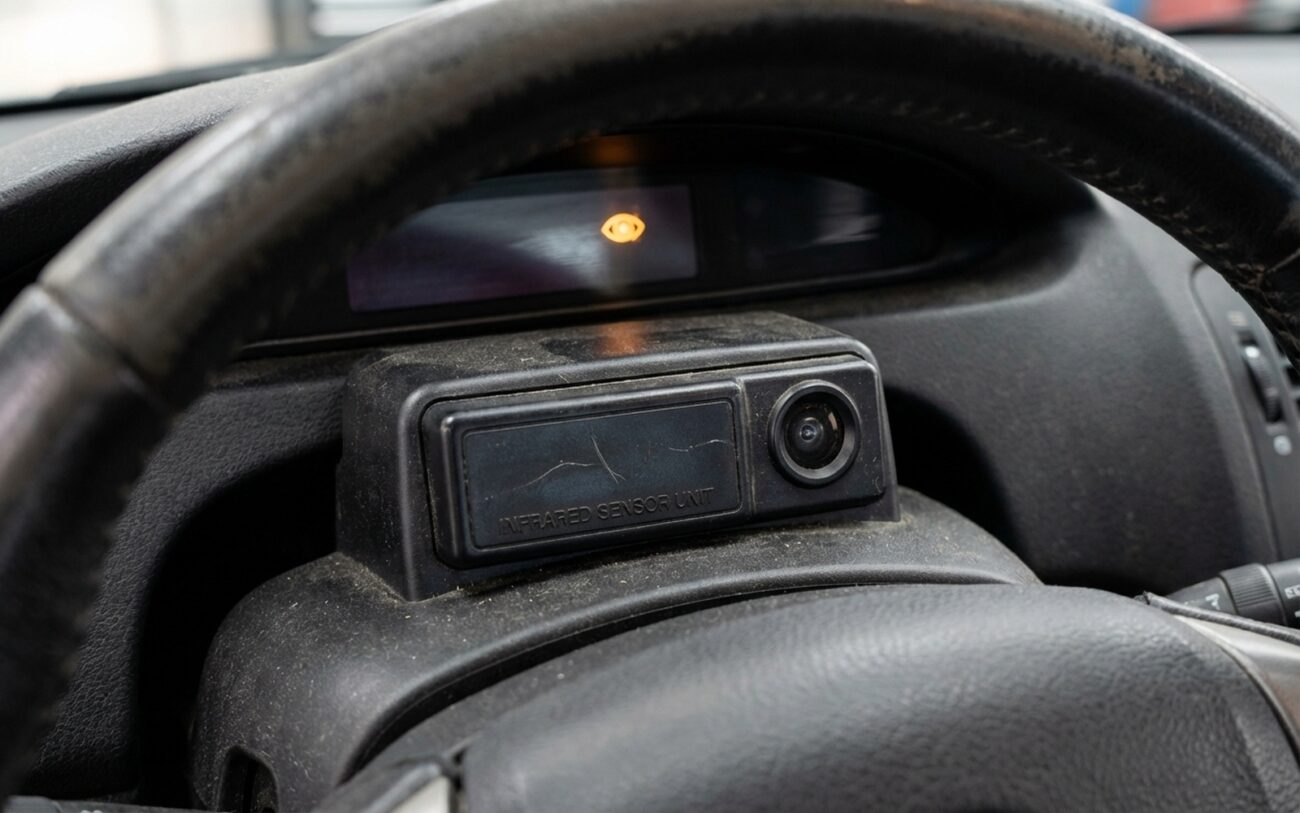
Driver Fatigue Monitoring Systems (DFMS) don’t fail randomly. When that “Take a Break” warning pops up while you’re wide awake—or worse, when the whole system goes dark—it’s not magic. It’s mechanics, electronics, and software colliding in real time. I’ve pulled apart dozens of these setups across BMWs, Mercedes, Fords with Co-Pilot360, and GM’s Super Cruise. Most shops jump straight to replacing the camera. That’s how they bill $1,500. But in my experience, half the time, it’s not the module—it’s something simpler. Let me walk you through how I diagnose this right.
Symptom First, Diagnosis Second
You don’t start with a scan tool. You start with observation. I ask the customer: “Is it yelling at you when you’re alert? Or is it silent when it should be talking?” That tells me everything.
If the system throws false drowsiness alerts—especially at sunrise or under fluorescent garage lights—it’s likely not broken. It’s being fed bad data. The IR camera can’t see through a greasy lens, and it sure as hell can’t handle glare off your sunglasses. But if the message says Camera Unavailable and stays there, we’ve got a hardware or communication failure. No guessing.
And here’s one people miss: unexplained steering wheel vibration. They think tire balance. Nope. On BMWs and many newer Toyotas, the DFMS triggers haptic feedback through the same motor used by Lane Keep Assist. So when the system thinks you’re nodding off, it shakes the wheel—even if you’re wide awake.
Worse, these systems don’t live alone. Kill the DFMS, and you often kill Automatic High Beams, Lane Departure Warning, even Traffic Sign Recognition. They’re all bundled into the same ADAS domain controller. So when one fails, others go down like dominos.
Differential Diagnosis: What’s Really Broken?
I don’t replace parts. I prove failure. Here’s how I break it down—fast.
| Symptom | Likely DFMS Component | Common External Mimics | Definitive Test to Confirm |
|---|---|---|---|
| False drowsiness alerts | Faulty interior camera or corrupted driver profile | Extreme lighting (sunrise), dirty lens, bad seat position |
Recalibrate via scan tool. Create a new driver profile. If alerts persist in neutral lighting, the camera is shot. |
| System "Unavailable" (No alerts) | Camera module failure or internal FFC cable break | System disabled in menus or aftermarket obstructions |
Check DTCs for "No Communication." Perform a live data check. If status shows "Not Available" with no blockage, replace module. |
| Erratic haptic (vibration) warnings | Faulty algorithm in the DFMS ECU | Lane Keep Assist (LKA) sensor fault or bad steering angle sensor |
Turn off LKA. If vibrations continue on a straight road, the DFMS ECU is sending a "ghost" alert command. |
Root Causes: Why These Systems Die
I’ve torn apart failed modules. And more often than not, it’s not software. It’s physics.
Delamination: The Silent Killer
The IR filter on the camera lens? It’s not glass. It’s a thin polymer coating. On certain 2021–2022 BMWs (TSB SI B84 04 22), that coating starts peeling—like cheap window tint left in the sun. Light scatters. The camera sees double. The system thinks your eyes are closed when they’re wide open.
And you won’t see it with the naked eye. You have to remove the module and inspect it under a bright light. Look for cloudiness, rainbow tints, or micro-bubbling. If it’s there, the lens is junk.
Heat Kills Solder Joints
These cameras live in hell—behind the rearview mirror, baking in direct sun. I’ve seen interior temps hit 180°F on a summer day. That heat cycles daily. Expand-contract. Expand-contract. Eventually, the tiny solder balls under the image processor crack. Connection drops. “Camera Unavailable.”
It’s intermittent at first. You’ll see the warning, then it clears. Next day, it’s back. Classic thermal stress. Only fix? Replace the module. Reflowing the board might work for a month—but not long-term.
Software That Can’t Tell a Glance From a Nap
Some systems are just dumb. I had a 2020 A6 come in where every time the driver checked the side mirror, the car thought they were “distracted.” The neural net wasn’t trained on real-world behavior—only lab conditions.
These aren’t hardware failures. They’re logic flaws. And the only fix is a firmware update. But—and this is critical—if the voltage dips below 13.5V during the flash, you brick the module. I keep a battery maintainer on every ADAS job. (Yes, this matters.)
How I Fix It: Three Paths
Clean the Lens [DIY-FEASIBLE]
Replace the Module Professional Only
- Parts: Must be OEM. Aftermarket modules don’t calibrate right.
- Tools: You need a capable scan tool (like Autel or Snap-on with ADAS coverage) to access the security gateway.
- Torque: Mounting bolts are delicate—8 Nm max. I’ve seen techs crack the housing with a 10 Nm wrench.
- Calibration: Static first (in-shop alignment), then dynamic (on-road, 10–15 minutes of driving). The system needs to map your face position relative to the seat.
Flash the ECU Professional Only
Did It Work? Test Like You Mean It
I don’t trust “Calibration Complete” messages. I test in the real world.
The Road Test & Diagnostic Sweep
-
The Road Test: 30 minutes. Highway, city, turns. Check mirrors naturally. No false alerts? Good. If it chirps “Take a Break” while you’re singing along to the radio, something’s still off.
-
Diagnostic Sweep: Final scan for DTCs. Trigger a forced test via the scan tool. If the system responds correctly, you’re done.
Cost vs. Risk: What’s Worth Fixing?
Let’s be real. Not every repair makes sense.
| Repair Type | DIY Cost | Shop Cost | Success Rate | Secondary Risk |
|---|---|---|---|---|
| Lens Cleaning | <$20 | $50 – $100 | High (if dirty) | None |
| Module Replacement | N/A | $800 – $1500 | High | Bad calibration disables safety features |
| Software Update | N/A | $150 – $300 | Medium-High | Risk of "bricking" the ECU during flash |
Cost-Saving Tip
If the car’s older and the module is $1,500, some customers just disable the system. It’s an option. But know this: in Europe, disabling ADAS can fail inspection. In the U.S., it won’t fail emissions, but it might affect resale or insurance discounts.
Prevention: Keep It Alive Longer
These systems don’t last forever. But you can double their life.
First: no oily interior cleaners near the camera. That mist floats up and coats the lens. I’ve seen it kill sensitivity in under six months.
Second: use a sunshade. Every time. That module behind the mirror gets roasted. Thermal cycling is the enemy. On a black car parked in Phoenix? That thing hits 180°F daily. That’s murder on microelectronics.
And if you start getting false alerts more than once a week? Don’t wait. Pull the module and inspect the lens. If it’s delaminating, replace it now—before the whole system quits on the highway.
