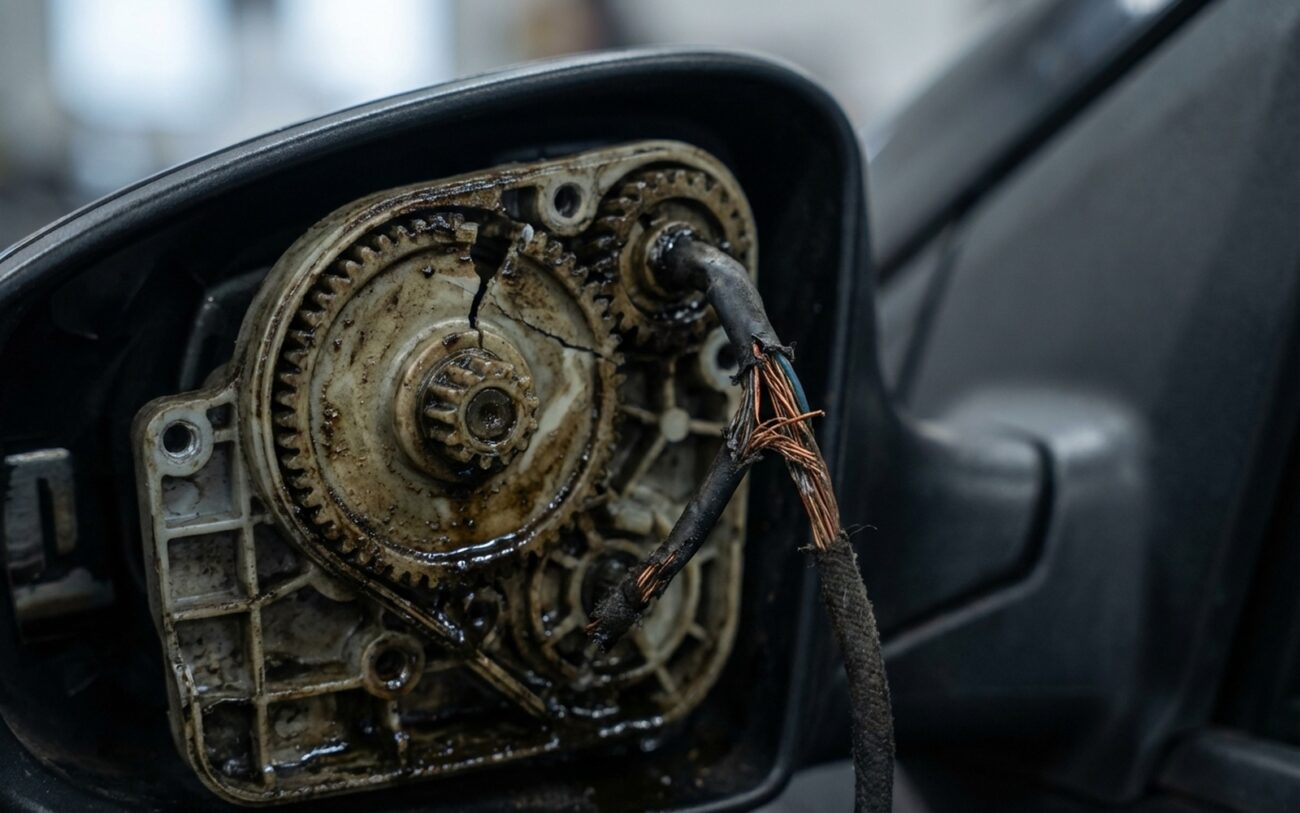
Power-folding mirrors stop working all the time—especially on Fords, Toyotas, and German cars from 2010–2020. I’ve torn into dozens of them in my shop. Most of the time, it’s not the whole mirror that’s dead—it’s one tiny gear, a worn-out motor brush, or a wire that finally gave up inside the door boot. But people panic, assume they need a $1,200 replacement, and hand over their credit card without checking. Don’t do that. Let’s walk through how I diagnose these step by step—because 70% of the time, you can fix it for under $200 if you know what you’re doing.
First: What’s It Doing? Or Not Doing?
Forget parts swapping. Start with observation. Press the fold button and watch what happens—or doesn’t.
No sound. No movement. Dead silence? That means power isn’t getting to the motor. Could be a fuse, broken wire in the door hinge area (those rubber boots crack over time), or a failed door control module (DCM). But don’t jump to conclusions—test first.
You hear a buzz or rapid clicking, but the mirror won’t budge? That’s mechanical. The motor’s getting voltage and trying to turn, but something’s jammed. Most likely: a stripped plastic gear inside the gearbox. I see this constantly on 2012–2016 F-150s and Camrys. Cold weather makes it worse—those nylon gears get brittle after 8–10 years.
Mirror moves slow, stutters, or stops halfway? Could be worn motor brushes, a failing position sensor, or high resistance in the wiring. Modern mirrors use a potentiometer or hall-effect sensor to tell the DCM where the mirror is. If that signal drops out, the system thinks it hit an obstacle and cuts power. Safety feature. Annoying when it’s false.
Is It the Mirror or the Car? Critical First Test
Before you pull the door panel, answer this: is the problem in the mirror assembly itself, or upstream?
I’ve had customers come in convinced their mirror motor was dead—turned out it was a blown 10A fuse in the BCM fuse block. Another time, a chewed-up LIN bus wire in the driver’s door boot mimicked total failure. So don’t condemn the mirror until you’ve checked the circuit.
| Symptom | Most Likely Fault | Common False Positives | How to Confirm |
|---|---|---|---|
| No movement, no sound | Open motor winding or seized mechanism | Blown fuse, failed DCM, broken wire in door boot, bad switch |
Use a multimeter. With the connector unplugged from the mirror, command fold/unfold and check for 11.5V+ at the motor pins. Got voltage and no movement? The mirror’s the problem. No voltage? Trace back—check fuses, switches, and wiring in the door boot. |
| Buzzing, no movement | Stripped gear or internal bind | Low system voltage, corroded connector |
Measure current draw at the motor connector. Normal range: 2–5A. If it spikes above 8A and holds, you’ve got mechanical resistance—almost certainly inside the mirror. |
| Erratic motion, stalls mid-cycle | Failing position sensor or damaged gear teeth | Faulty switch, DCM glitch, LIN bus error |
Use a scan tool with live data. Watch the mirror position sensor reading as you manually move the mirror. If the signal jumps or drops, the sensor is bad. No scan tool? Unplug it—the DCM should throw a code. |
Why These Fail: The Real Culprits
After 25 years, I can tell you the top four reasons these things die—and none of them are “just wear and tear.”
Plastic gears strip. Yeah, they’re quiet and cheap, but nylon gears in the folding gearbox don’t last forever. On Toyota Camrys and Highlanders, I’ve pulled apart units where one tooth sheared off, then the next, until the gear was just a lopsided star. Cold weather accelerates this. Ford issued a TSB for some F-150s recommending upgraded metal-reinforced gears. If your car’s on that list, use the updated part.
Motor brushes wear down. The folding motor is a small DC unit with carbon brushes. After 100,000 cycles (about 10 years of daily use), those brushes get short, start arcing, and eventually lose contact. You’ll notice slow movement first—then hesitation—then nothing. Not repairable. The whole motor has to go.
Water gets in. The mirror housing is sealed, but over time, gaskets dry out, clips break, or the glass adhesive fails. Once moisture gets inside, it corrodes the motor terminals or shorts the position sensor. I’ve seen motors that tested fine when dry—but failed under load because of internal corrosion. That’s why you can’t just test voltage and call it good.
Someone forced it. Manual folding is fine if the system’s off—but if the motor’s engaged, forcing the mirror can strip gears or bend pivot arms. I’ve had guys try to fold them by hand during car washes. Bad idea. Even a small misalignment increases resistance enough to burn out a motor over time.
Key point:
A failed DCM or broken wire in the door boot isn’t a “bad mirror.” It’s a car electrical issue. The mirror might be perfect—it just never gets the signal. Always rule out the system before replacing the mirror.
Your Repair Options: What Actually Works
Replace the Motor/Gearbox DIY-FEASIBLE
Internal Repair (Gears/Sensor) Professional Only
Full Mirror Assembly Replacement
Manual Fold & Disable Last Resort
