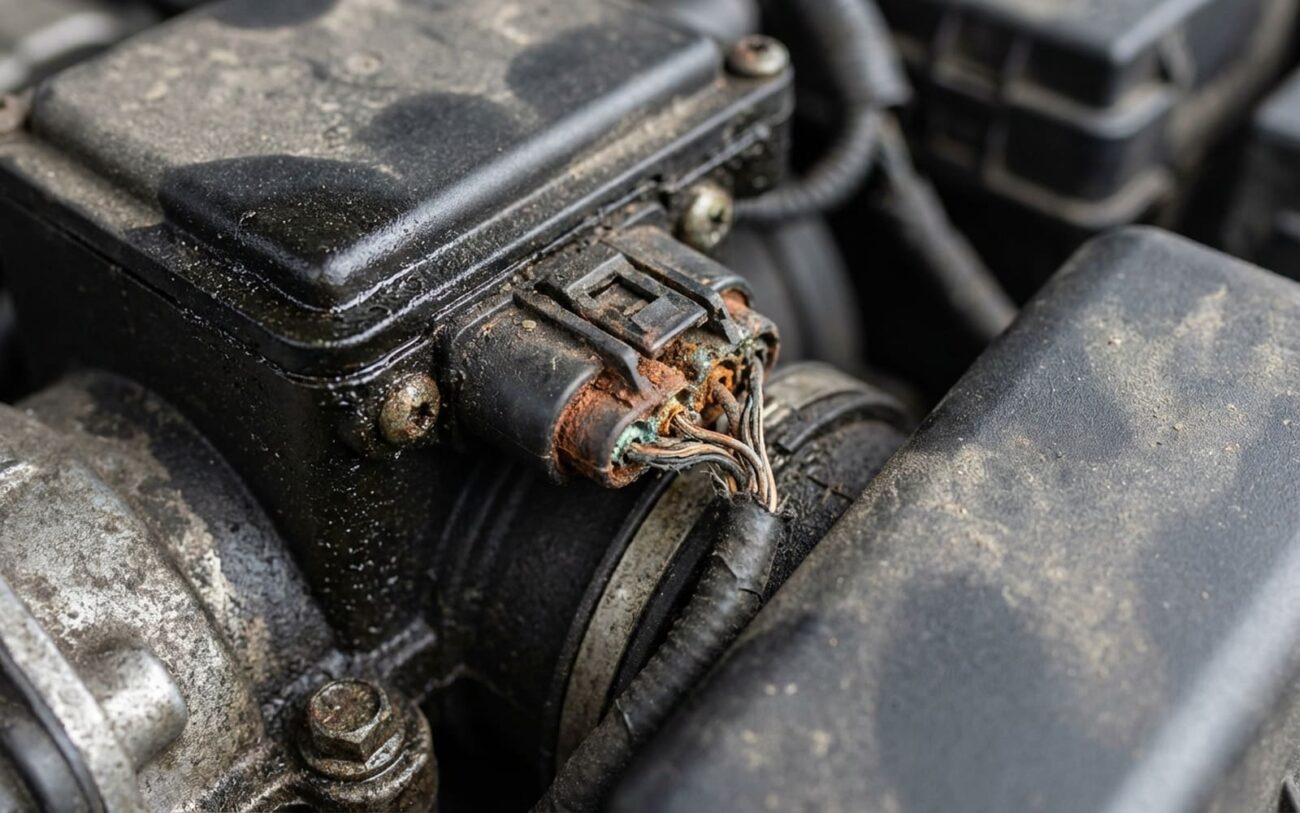
That annoying jerk under light acceleration – whether you’re pulling away from a stop or just trying to hold a steady 35 mph – isn’t just a nuisance. Trust me, after 25+ years in the shop, I can tell you it’s your car trying to tell you something important. The biggest mistake I see? Guessing whether it’s an engine problem, a transmission issue, or something else entirely. Get that wrong, and you’ll be throwing good money after bad, chasing ghosts instead of fixing the real problem. My rule of thumb, and it’s one I live by: “Misdiagnosis is the most expensive part of any repair. Data must lead the way.”
Is It the Engine or the Transmission? The Initial Clues
First things first, you need to pay close attention to how the car is acting up. This isn’t just about a “jerk”; it’s about the feel, the timing, and the conditions.
Transmission Troubles: A Rhythmic Feel
If that jerk feels more like a rhythmic bump, almost like a slight shudder, or you notice the engine RPMs flare up for a second without the car actually speeding up, you’re probably looking at a transmission problem. This usually happens right when the transmission is trying to shift gears – say, from 2nd to 3rd, or 3rd to 4th. That’s a classic sign of the transmission slipping, meaning it’s not transferring power to the wheels smoothly.
I see a lot of folks come in with a shudder that only happens at a specific speed, maybe 40-50 mph, usually when they’re just barely on the gas. That’s almost always the torque converter clutch (TCC) trying to lock up and just not quite making it. It’s slipping, either because the clutch material is worn or the fluid’s contaminated. This is super common on older automatics and some CVTs – I’m looking at you, early 2000s Hondas and Nissans! And here’s the absolute critical part: every single time that TCC slips, it generates a ton of heat. That heat cooks the clutch material, and all that burnt debris gets pumped through the whole transmission system. It clogs up the valve body, degrades the fluid even more, and before you know it, that minor shudder you felt for a few weeks turns into a complete transmission failure. Don’t let it get to that point.
Engine Hesitation: A Stumble or Flat Spot
Now, if the jerk feels more like a quick stumble, a hesitation – like the engine just briefly lost its spark or wasn’t getting enough fuel – and it doesn’t seem tied to any specific gear change, then you’re probably dealing with an engine misfire. This often shows up under light load, when you’re just cracking the throttle open, like when you’re gently accelerating. It feels like a “flat spot” in the power, almost like the engine just hiccups for a split second.
Beyond the “Feel”: Getting Real Data
Look, your “gut feeling” about a car problem is a start, but it’s never enough. You absolutely need data. The line between a transmission shudder and an engine misfire can be incredibly subtle, and I’ve seen countless misdiagnoses because someone skipped the proper diagnostic steps and just started throwing parts at the car. That’s a surefire way to empty your wallet and still have the same problem.
For Suspected Transmission Issues:
If you’re leaning towards a transmission problem, especially a TCC shudder or a shift-related slip, you need a good scan tool – not just a basic code reader. You’ll want to monitor the Transmission Control Module (TCM) data. Specifically, I’m looking at commanded gear ratio versus actual gear ratio, and turbine speed versus output shaft speed. If you see a significant difference (more than, say, 50-100 RPM) between the turbine and output shaft speeds when the TCC should be locked, or a discrepancy in gear ratios during a shift, that’s your smoking gun for internal transmission slippage. Also, check for any stored transmission-specific codes (P07xx series usually).
For Suspected Engine Misfires:
For an engine stumble or hesitation, the first thing I do is hook up my scanner and check for any stored OBD2 codes. A P030x code (where ‘x’ is the cylinder number) is a dead giveaway for a misfire. But even if there’s no active code, I always dive into Mode $06 data. This shows you the misfire counters for each cylinder, even if they haven’t happened enough times to trigger a Check Engine Light. It’s like catching the problem before it becomes a full-blown emergency. While you’re there, quickly check your fuel trims and MAF sensor readings – sometimes a dirty MAF or a vacuum leak can mimic a misfire.
Pinpointing the Problem: Common Culprits
Once you’ve used your data to confirm whether the issue is definitely in the engine or the transmission, the next step is to narrow down the actual failed part. This is where experience really comes into play.
Typical Transmission Failures I See:
Most transmission jerks or shudders come from a few common areas. You might have an internal hydraulic failure, which usually means worn bores in the valve body or solenoids that aren’t actuating correctly. Or it could be worn-out clutch packs or bands – that friction material breaks down and contaminates the fluid, making everything worse. And, as I mentioned, that TCC shudder is often due to worn lock-up clutch linings or fluid that’s just plain contaminated from all the slipping.
Common Engine Misfire Causes:
For engine misfires, the culprits are usually pretty straightforward. It’s often the ignition system: failing coils, cracked spark plug insulators (especially on those long-reach plugs), or just plain worn-out spark plugs. Fuel delivery issues are also big, particularly with direct-injection engines where injectors can get clogged or start leaking. And then there’s the more serious stuff: mechanical integrity problems like low compression, worn piston rings, or even a cracked cylinder wall. Those are the ones that make your heart sink a little.
Don’t confuse maintenance with actual failures:
Before you start tearing into an engine or transmission, always rule out the simple stuff. A dirty throttle body, a clogged air filter, or even old, stale fuel can cause hesitation that mimics a misfire. And believe it or not, a failing wheel speed sensor can sometimes trick the traction control system into acting like a transmission shudder. Always check the basics first.
The Fix: DIY, Pro, or Replace?
Once you’ve got the diagnosis locked down, it’s time to talk about the fix. Not all repairs are created equal, and some are definitely not for the weekend warrior.
Safety & Precision Aren’t Optional
Let me be blunt: internal transmission work and serious engine mechanical repairs are not for the faint of heart or the poorly equipped. You need specialized tools, specific torque sequences, and a deep understanding of how these systems work. One slip-up, one wrong torque value, and you’re looking at immediate, catastrophic failure. Don’t risk it if you’re not absolutely confident.
External Components & Ignition DIY-FEASIBLE
Internal Accessible Repairs Professional Only
Major Mechanical Overhaul or Replacement
Proving the Repair: Post-Fix Validation
Here’s a lesson I learned early on: a repair isn’t actually “done” until it’s properly verified. Just throwing parts at a problem and hoping for the best is a shortcut to customer comebacks and a bad reputation. You need to confirm the fix.
After a Transmission Repair:
For transmission work, I always perform an extensive road test. I’ll drive it under all sorts of conditions: light throttle, moderate acceleration, even coast-down shifts. I’m looking for smooth, seamless shifts – no flares, no bumps, nothing. And I’ll have my scan tool hooked up, monitoring actual versus commanded gear ratio. If I see a difference of more than 50 RPM between the turbine and output shaft speeds during a shift, that tells me there’s still some residual slippage, and the repair isn’t quite right.
After an Engine Mechanical Repair:
If we’ve done any internal engine work, like replacing rings or dealing with cylinder issues, validation starts right in the shop. A leak-down test is crucial. Anything over 5% leakage on a repaired cylinder is a red flag for me. Then, it’s out on the road. I’ll put the engine under load – maybe 50% throttle in 3rd gear – while I watch for zero misfire counts on my scanner and stable fuel trims. If everything looks good there, then I’m confident in the repair.
The Hard Numbers: Cost, Risk, and Tough Decisions
Let’s talk money, because that’s often the biggest factor for folks. Some repairs are worth it, some aren’t. And there’s always a risk involved, no matter how good the technician.
Typical Repair Costs & Risks (Estimates):
For something like a transmission valve body replacement, you might be looking at $400-$800 in parts if you DIY, but a shop will typically charge $1,200-$2,000 once labor and fluid are factored in. Success rate is usually around 85%, but here’s the kicker: if the transmission has been slipping for a while, there might be clutch debris in the system that can damage your shiny new valve body. That’s a risk you need to be aware of.
On the engine side, if you’re talking about something like cylinder sleeving for a serious mechanical issue, the parts alone could be $500-$1,500. A professional shop will charge $2,500-$4,000 for that kind of work. The success rate is high, often above 95%, but the risk is always that you might have undetected micro-cracks in the block that could lead to coolant intrusion down the road. It’s a gamble, even for the pros.
My “60% Rule” for Major Repairs
Here’s my personal rule for when a major repair might not be worth it: If the total estimated repair cost starts to climb above 60% of what your vehicle is actually worth (think private-party sale value, not what the dealership would give you), it’s time to seriously consider your options. Is it smarter to put that money towards a remanufactured engine or transmission swap, or even a down payment on a newer, more reliable vehicle? Especially for high-mileage cars, a quality remanufactured unit often gives you more bang for your buck and better peace of mind than trying to rebuild a severely worn component in-house.
Keeping It Running: Prevention and Early Warning
The best repair is often the one you don’t have to do. A little preventative maintenance goes a long way in avoiding these costly jerks and shudders.
-
Transmission Maintenance: Always, and I mean always, use the OEM-specified transmission fluid. Don’t cheap out here. And despite what some manufacturers claim, there’s no such thing as “lifetime” fluid. I recommend changing it every 60,000 miles, especially if you do any towing or heavy driving.
-
Engine Maintenance: Stick to OEM spark plugs. Aftermarket plugs often cause more problems than they solve. If you have a direct-injection engine, plan on a professional intake valve cleaning (walnut blasting or chemical) every 60,000 miles or so. Carbon buildup on those intake valves is a huge cause of misfires and hesitation.
-
Early Detection: For vehicles over 100,000 miles, I often suggest an annual combustion block test. It’s a simple test that can catch early signs of a head gasket leak or block porosity before it turns into a major engine meltdown.
And one last thing: if your CVT is juddering under light throttle, or your DCT shudders when you pull away from a stop, don’t just assume it’s “normal.” Modern drivetrains are designed to be smooth. Persistent shuddering or hesitation is a symptom, not a feature of the car. Get it checked out.
