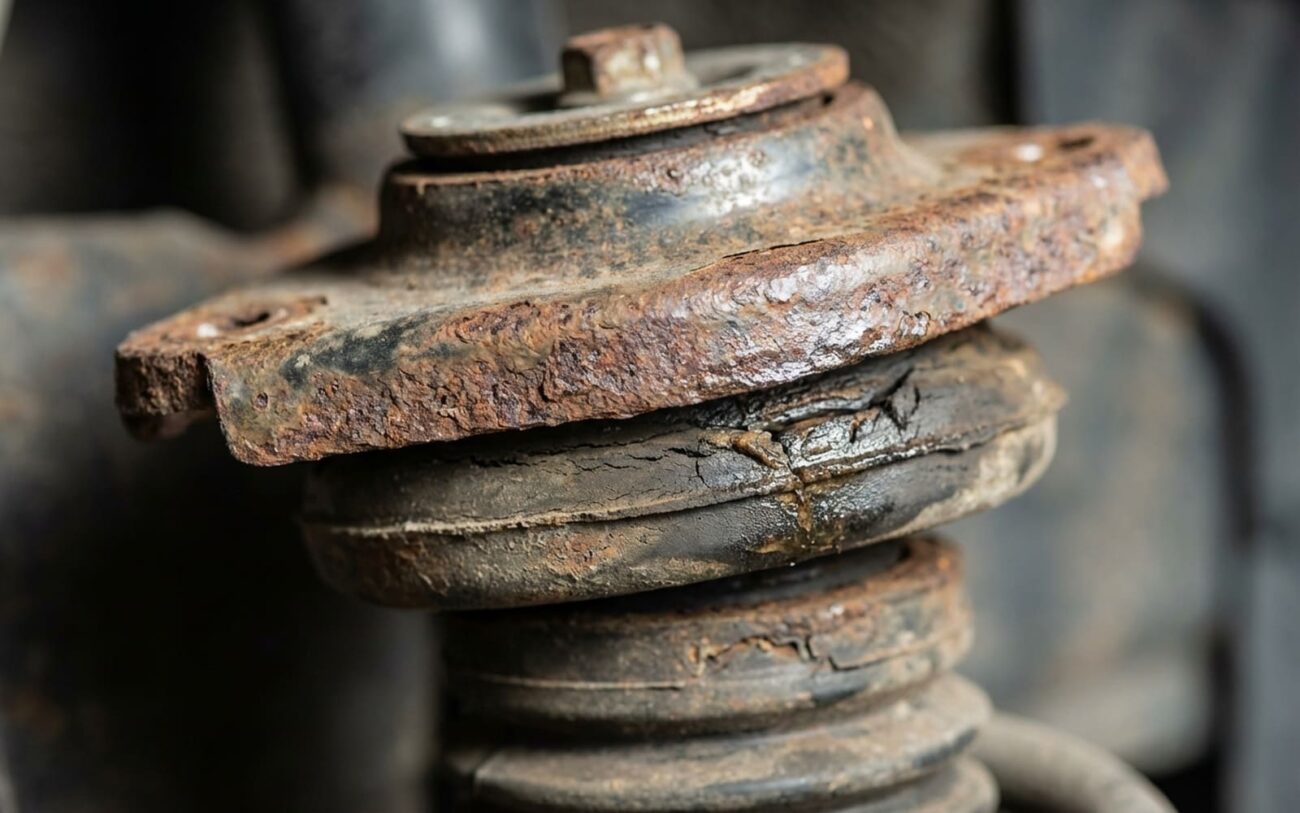
Alright, let’s talk about that annoying squeak you hear when you’re just sitting there, turning the steering wheel. You know the one—parking, backing out of a spot, doing a three-point turn. It’s a sharp, sometimes metallic, grinding noise that seems to pulse right along with your steering input, not the speed of the car. In my 25+ years in the shop, I’ve heard this sound hundreds of times, and almost every single time, it points right back to one culprit: a failed upper strut mount bearing.
That Standstill Squeak: What It Is (And Isn’t)
This isn’t your power steering pump whining, which is usually a constant groan under load, especially at full lock. This noise is distinct: it’s directly tied to the steering wheel’s movement when the car isn’t moving, and it disappears the moment you stop turning. Often, you’ll feel a gritty, notchy resistance through the steering wheel as you turn, almost like the wheel is catching or binding. That’s a huge tell—it means the bearing isn’t rotating smoothly, it’s dragging.
Now, other things can make noise when you turn the wheel. A dry lower ball joint, for instance, might squeak, but usually, it’s more of a rubbery groan or a pop when the suspension moves. An unlubricated intermediate steering shaft U-joint can squeak, too, but that’s typically felt and heard more inside the cabin, sometimes near the firewall. And a rubbing plastic boot on the steering column? That’s usually a lighter, plastic-on-plastic sound, not a deep metallic grind. The key is isolating the sound right at its source.
My Go-To Diagnostic Method
This is how I pinpoint it in the shop, and it’s pretty straightforward. You’ll need a helper for this. Have them get in the car, start the engine, and slowly turn the steering wheel from left to right, just a little past center each way. While they’re doing that, you’ll be under the hood, or sometimes under the vehicle, listening.
The Shop Floor Trick:
Grab a mechanic’s stethoscope. If you don’t have one, a long screwdriver works just as well—just press the handle to your ear. Carefully touch the tip of the stethoscope or screwdriver to the top of the strut assembly. Focus on the center nut where the strut shaft comes through, and also around the coil spring perch.
If that squeak and grind is loudest right there, at the very top of the strut, you’ve found your problem. It’s the strut mount bearing. If the noise is coming from lower down, say near the control arm, then you’d start looking at ball joints or control arm bushings. But remember, a worn bushing usually makes a clunk or a knock, not this specific squeak. That distinction is important; it saves you from chasing the wrong problem.
Why These Bearings Give Up: It’s All About Corrosion
The vast majority of the time, this failure comes down to moisture getting where it shouldn’t. Inside that upper strut mount, there’s a sealed bearing. Its job is to let the strut rotate smoothly as you turn the steering wheel. But over time, the rubber or plastic seal around that bearing degrades. It’s just wear and tear, compounded by the elements.
The Breakdown
Once that seal is compromised, water, road grime, and especially road salt (if you live in a cold climate) get inside. It’s like trying to roll a marble through a tray of wet sand—the smooth motion is replaced by grinding friction. That grit and moisture cause galvanic corrosion on the steel bearing races and the balls themselves. You get pitting, rust, and pretty soon, that smooth rolling surface is a rough, binding mess.
I’ve seen service bulletins from manufacturers acknowledging this, particularly for vehicles in areas with heavy winter road treatment. It’s a common problem, not just a fluke.
The Repair: This Is Not a Job to Take Lightly
CRITICAL SAFETY WARNING:
Replacing a strut mount means disassembling the entire MacPherson strut assembly. That involves compressing the coil spring. Let me be clear: a compressed coil spring holds hundreds of pounds of tension. If your spring compressor slips, that spring can release with enough force to cause serious injury or even death. This is not an exaggeration. Unless you’re an experienced DIYer with professional-grade tools and training, this is a job for a qualified shop.
If you do decide to tackle this yourself, you’ll absolutely need a heavy-duty, high-quality spring compressor—the cheap ones are a recipe for disaster. You’ll also need an impact wrench to get the top nut off (and on, carefully) and, crucially, a good torque wrench. The final torque spec on that center nut is vital. On many front-wheel-drive vehicles, it’s typically in the 50–60 ft-lb range. Under-torquing it can lead to the strut shaft separating from the mount, which means immediate and total loss of steering and suspension control. Trust me, you don’t want that.
After the Repair: Don’t Skip These Steps
Once you’ve got the new strut mounts installed and the car is back on the ground, the verification is simple. Turn that steering wheel slowly from lock to lock. The squeak, the grind, the notchiness—it should all be completely gone. The steering should feel smooth and effortless, just like it did when the car was new.
Mandatory Alignment:
You absolutely, positively need a wheel alignment after this repair. Disconnecting the strut changes the front suspension geometry. Skipping the alignment is asking for uneven tire wear, poor handling, and a car that just doesn’t feel right. Don’t cheap out on this step.
And speaking of not cheaping out: always replace strut mounts in pairs. If one has failed, its partner on the other side is usually not far behind. Mismatched components can lead to imbalanced steering response, and frankly, you don’t want to do this job twice.
Cost and Prevention
For parts alone, replacing both front strut mounts will typically run you $150–$300. If you take it to a professional shop, expect to pay anywhere from $400–$800, which includes parts, labor, and that mandatory alignment. Remember that secondary risk I mentioned? Improper torque on that strut nut can lead to catastrophic failure, so that shop cost includes peace of mind.
Pro Tip: Look Around While You’re In There
Since you’re already tearing into the suspension, take a good look at other related components. Are the control arms, ball joints, or bushings showing signs of wear? If so, it might make sense to address them now. It’s about making a smart, long-term decision and avoiding another trip to the shop (and more labor costs) down the road.
As for preventing future failures, it really comes down to managing moisture and salt. If you live in a region where they dump road salt in the winter, regular undercarriage washes are your best friend. Just avoid blasting high-pressure spray directly at the strut mount seal itself; you don’t want to force water into it. A regular rinse is usually enough to clear away corrosive buildup.
