“Check DCT” in Traffic? Don’t Panic, It’s Often the TCU, Not Your Transmission
Alright, let’s talk about that moment: you’re stuck in rush hour, inching along, and suddenly your Hyundai or Kia dashboard lights up. You see “Check DCT,” maybe “Transmission Hot,” or “Drive Carefully.” Then the car lurches, shifts hard, or gets stuck in a single gear. I’ve seen that look on countless faces walking into my shop – pure dread, thinking the transmission’s completely blown.
But here’s the thing I’ve learned over 25 years turning wrenches: in many of these stop-and-go scenarios, the problem isn’t your clutch packs or the transmission itself. More often than not, it’s the Transmission Control Unit (TCU) that’s overheating and throwing a fit to protect its own electronics. It’s putting the vehicle into a “limp mode” to save itself, not because the mechanical parts are necessarily failing.
I’ve had dozens of customers convinced they’ve destroyed their expensive dual-clutch transmission (DCT), only to find the clutch packs are still in good shape. The real issue was the TCU’s internal temperature climbing past its safe limits, triggering that fault and making the car act like it’s dying.
Status: 118°C
That dashboard graphic you’re seeing above? That’s a classic example of what I pull up on my scan tool. Notice the TCU Core temp is way up at 118°C, while the clutch temps are still reasonable. That’s your smoking gun right there.
It’s crucial to understand that modern DCTs monitor multiple temperature points. When that “Transmission Hot” warning pops up, it’s easy to jump to conclusions about the clutch or the fluid. But you’ve got to dig deeper to see if the heat is coming from the mechanical side (clutch, fluid, cooler) or the electronic control side (the TCU itself).
Diagnosing the Real Heat Source: Scan Tool is Key
You can’t guess with these transmissions. A scan tool capable of reading live transmission data is absolutely essential. And I’m not talking about a cheap code reader from the auto parts store. You need something that can pull OEM-level data. Aftermarket tools often don’t display critical parameters like “TCU Internal Temperature” or the clutch adaptation values accurately, if at all.
When I’m troubleshooting, I focus on two critical parameters: TCU Internal Temperature and Clutch Fluid Temperature. These two readings tell me exactly where the problem lies. Here’s a quick breakdown of what I look for:
| Symptom | Likely TCU-Related Cause | Common Mechanical Mimics | My Definitive Test |
|---|---|---|---|
| Transmission overheat warning in stop-and-go traffic | TCU internal thermal protection triggered—its own electronics are overheating. | Actual clutch pack overheating due to low fluid or clogged cooler. |
Monitor live data: If TCU Temp > 115°C while Clutch Fluid < 100°C, the TCU is the source. |
| Harsh or shuddering shifts when hot | Thermal throttling in the TCU processor causing incorrect clutch pressure. | Worn clutch packs or faulty clutch actuator position sensor. |
Perform clutch adaptation reset. If harsh shifts return only when TCU is hot, suspect the TCU. |
Why These TCUs Get So Hot in Traffic
The Problem
“It’s a thermal sandwich: engine bay heat from above, transmission heat from below, and internal electrical heat in the middle.”
The TCU isn’t some component chilling out in the glovebox; it’s bolted right to the transmission housing. That puts it squarely in the “hot zone.” During long stretches of stop-and-go driving, it’s getting hit from all sides: ambient engine bay heat from above, and significant heat soaking up from the transmission case below. On top of that, it’s generating its own electrical heat internally as it works.
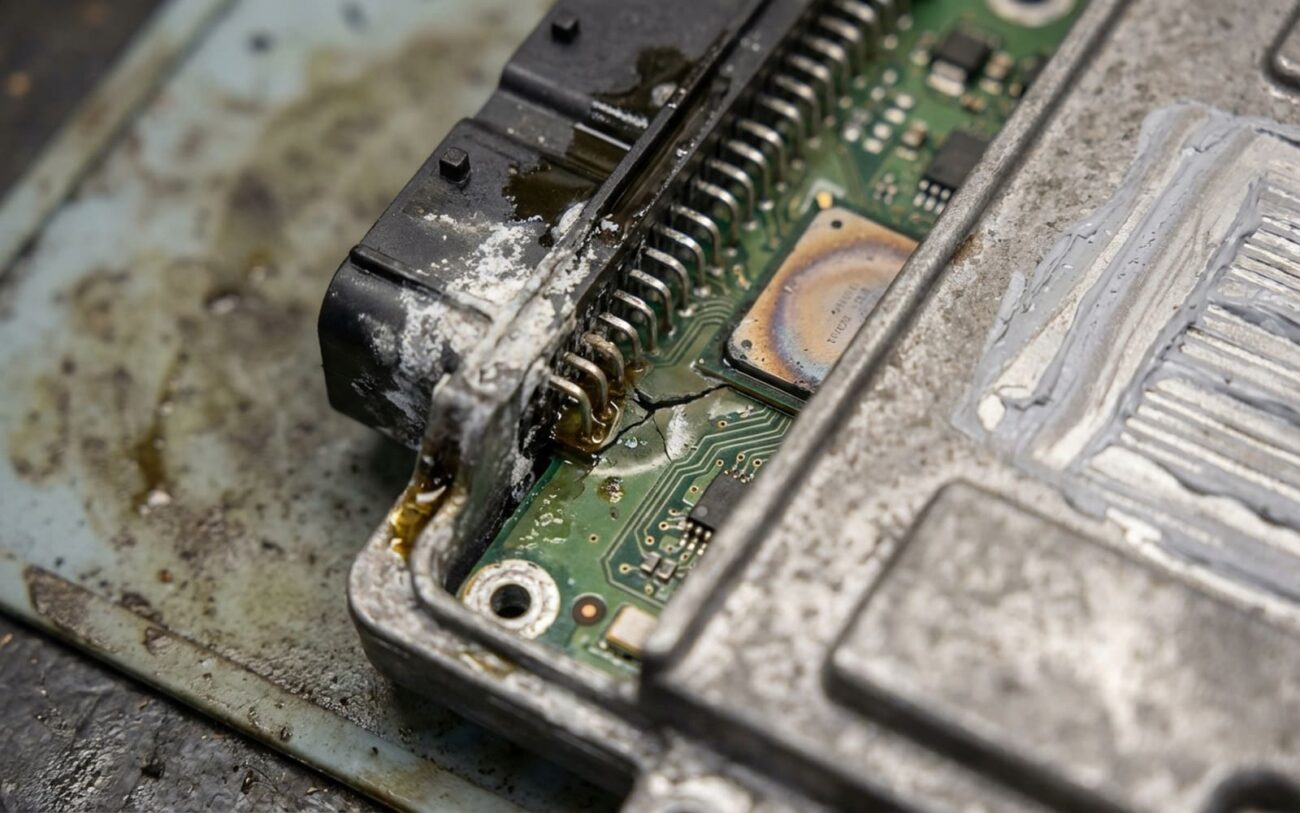
This constant cooking eventually overwhelms the TCU’s ability to dissipate heat. Over time, that repeated overheating degrades the internal components. We’re talking about electrolytic capacitors drying out and solder joints on the high-current MOSFETs (which control the clutch actuators) cracking from all that thermal cycling. It’s a slow killer for electronics.
Heads Up: Service Bulletin Alert!
For a lot of 2020–2022 Hyundai and Kia models with the 7-speed dry dual-clutch transmission (7DCT), there are known service bulletins. These bulletins point to suboptimal TCU software calibration as a major factor. Basically, the original factory firmware wasn’t managing clutch engagement timing efficiently enough, which increased the electrical load and heat buildup right inside the TCU itself. A software update often fixes this.
Your Options: Getting It Fixed Right (No DIY Here)
This is Professional Territory, Period.
Look, fixing a DCT overheating issue that stems from the TCU isn’t a weekend project. Everything hinges on having OEM-level software, secure programming capabilities, and proper calibration. Try to flash one of these modules with a weak battery or an incorrect tool, and you’ll “brick” it – turn it into an expensive paperweight. I’ve seen it happen, and it’s not pretty.
TCU Software Update (My First Step) Professional Only
TCU Replacement & Programming Professional Only
Transmission Fluid Service & Cooler Inspection
Confirming the Fix and Preventing Recurrence
Just clearing fault codes isn’t enough; that’s a rookie mistake. You need to validate the repair under real-world conditions. If it was a software update, confirm the new TCU calibration part number is actually stored. Then, I always do a road test that specifically simulates stop-and-go driving for at least 30 minutes, all while monitoring that TCU Internal Temperature live on the scan tool. You want to see it stay within spec.
For a TCU replacement, the work isn’t done until you’ve run the full adaptation sequence. That means clutch fill, clutch position learning, and shift adaptation. Skip these steps, and you’re asking for trouble: poor shifts, shuddering, or even re-triggered faults because the TCU is “blind” to the current clutch wear and engagement points.
Cost, Warranty, and Keeping It Running
TCU Software Update
Covers labor and diagnostic time for secure flashing at a dealership or qualified independent shop.
TCU Replacement
Includes the OEM module, physical labor, and full system programming/adaptation. This is a significant repair.
Full Transmission
This is a major financial hit, and often unnecessary if the TCU was the actual root cause. Always, always diagnose first!
My Advice for Preventing Recurrence
-
Fluid Matters: Always use genuine Hyundai/Kia SP-IV DCT fluid. And if you’re doing a lot of city driving or in severe conditions, change it every 30,000 miles. Don’t cheap out here.
-
Drive Smart in Traffic: In heavy stop-and-go, try using manual mode and locking it into 2nd gear. This prevents the constant clutch cycling and reduces the electrical load and heat buildup on the TCU. It really helps.
-
Watch for Early Signs: Don’t ignore those occasional harsh shifts, especially on hot days. Catching this problem early often means a $250 software update instead of a $2,000 TCU replacement. Your wallet will thank you.
A Note on Independent Shops
If your vehicle is out of powertrain warranty, a qualified independent EV/Hybrid specialist can often perform these adaptations and updates. They typically charge 30–40% less than dealership pricing. Just make absolutely sure they have the proper CAN FD diagnostic interface and the necessary factory software access. Not all shops are equipped for this specific work.
