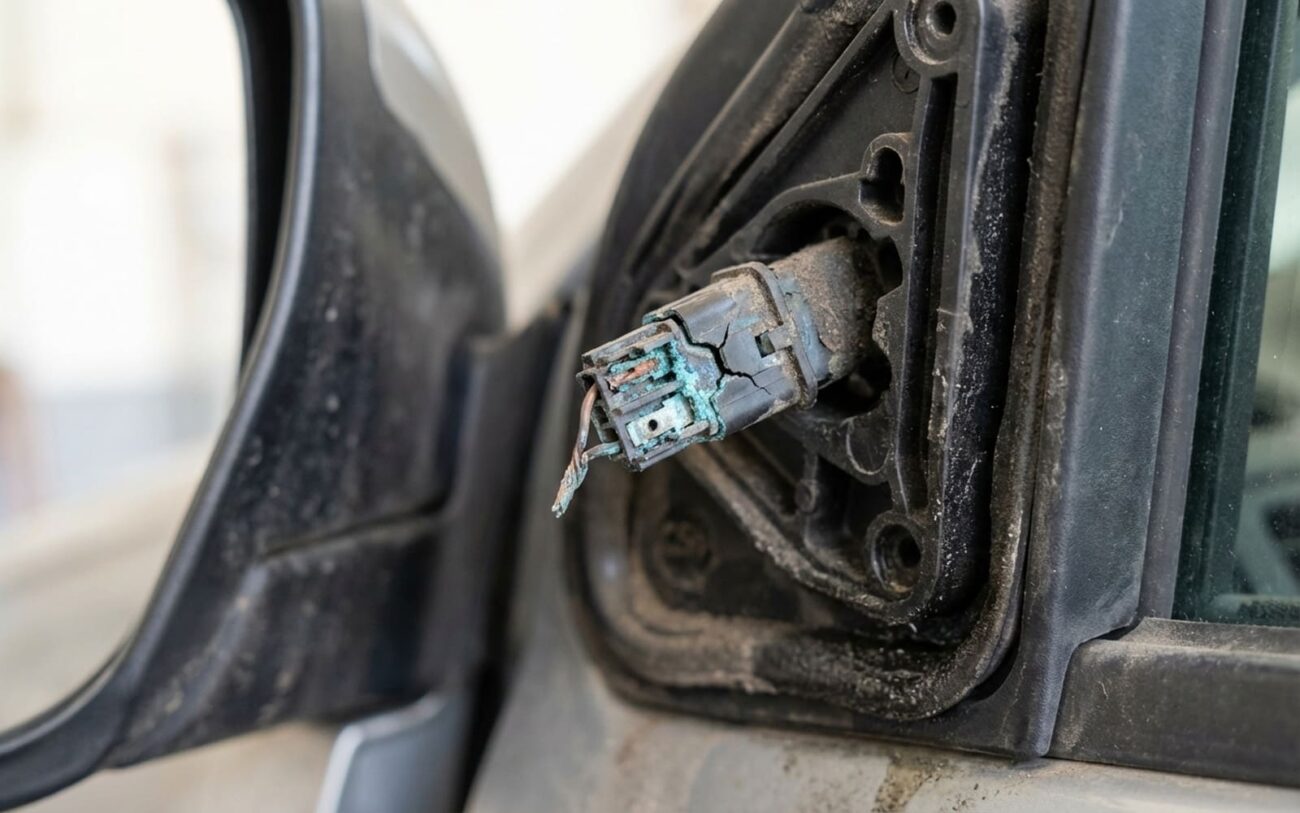
Memory mirror problems? Let’s cut through the noise. I’ve been fixing these systems for over 25 years—from early Lincoln Town Cars to the latest GMs and Fords—and I can tell you this: most shops replace parts they don’t need because they skip the real diagnostics. The mirror doesn’t work? That’s not a diagnosis. That’s a symptom. What you’re seeing—erratic movement, no recall, drift after ignition—is a message. Learn to read it, and you’ll fix it right the first time.
Symptom Tells You the Story
If the mirror jerks to some random position when you hit the memory button—like it forgot where home is—that’s not a motor issue. That’s a corrupted command. The memory module (usually baked into the door control module or seat module) is sending garbage data. I see this all the time on 2010–2016 GMs and Fords. The manual controls still work? Then the motor, wiring, and power are fine. The brain is broken.
And if the mirror does nothing during recall—no noise, no twitch—but moves fine when you use the manual switch? That’s not a dead motor. That’s a missing signal. The module isn’t talking. Could be internal failure, could be a data bus hiccup, but the motor isn’t the problem. Don’t waste time pulling the door panel yet.
Now, if the mirror moves slowly or stalls halfway during recall, but manual control is snappy? That’s often weakening driver circuits inside the module. It’s not dead—yet. But every time it slams into the mechanical stop, it’s stressing the gears. I’ve seen cracked mirror brackets from this. It’s a slow death, but it’s coming.
Then there’s the mirror that resets to a different “home” position every time you cycle the ignition. That’s the angle sensor going bad. It’s a potentiometer inside the mirror housing that tells the module where the mirror is. If it’s worn or contaminated, the system thinks it’s in one spot when it’s actually somewhere else. So it overshoots or undershoots. The module is doing its job—it’s just working with bad intel.
And if both manual and memory controls fail? That’s not always a dead motor. Could be the sensor failed open or shorted, and the control system shut down to protect itself. Seen it on BMWs and Lexuses where the sensor shares a circuit with the motor driver. One fails, the whole thing goes dark.
How I Diagnose (And What I Test First)
Before touching a screwdriver, I check power and ground at the mirror connector. Sounds basic? You’d be surprised how many techs skip this and go straight to the module. I’ve saved customers hundreds because a pinched wire in the door boot was the real issue. The harness flexes every time you open the door—eventually, it fails.
Here’s my go-to sequence:
| Symptom | Most Likely Cause | What Else Could Mimic This | How I Confirm It |
|---|---|---|---|
| Mirror dead on memory recall, manual works | Memory mirror module failure | Faulty memory switch, data bus fault (DCM/BCM) |
Use a bi-directional scan tool to command the mirror motor directly. If it moves when the tool tells it to, but not when you press the button, the module is the problem. This rules out the switch and wiring. |
| Mirror position changes after ignition cycle | Mirror angle sensor drift | Loose mechanical linkage, bent mirror arm |
Back-probe the sensor signal wire with a multimeter. Move the mirror slowly through its range. Look for smooth, linear voltage change. Any flat spots, jumps, or dropouts mean the sensor is worn. (Check service manual for pinout—usually 3 wires: 5V ref, ground, signal.) |
| No movement at all—manual or memory | Mirror motor or sensor failure (shorted/open) | Blown fuse, broken wire in door boot, bad ground |
Verify 12V and ground at the connector. If good, disconnect the sensor and apply 12V directly to the motor terminals. If it runs, the motor’s fine—the fault is in the sensor or control circuit. |
Why These Parts Fail (And Where I See It Most)
The memory mirror module doesn’t die randomly. Heat cycles crack solder joints—especially on Fords parked in the sun. I’ve reflowed a few boards in a pinch, but it’s temporary. Moisture gets in through a failed door seal or leaking window regulator, and corrosion takes out the traces. And yes, a bad alternator spike can fry the voltage regulator inside. But here’s the thing: the module is rarely the first thing to fail. Check the switch and data bus first. I’ve seen shops replace a $400 seat module because the driver’s door switch was intermittent.
The mirror angle sensor? It’s a potentiometer with a wiper riding on a resistive strip. Over time, that strip wears. Carbon builds up. You get dead zones. A hard bump—like a shopping cart hitting the mirror—can bend the wiper arm. And on some Lincolns and Cadillacs, the sensor is known to drift even without impact. It’s a design thing. The tolerances are tight, and contamination from inside the housing screws it up.
And don’t assume the motor and sensor are a pair. They’re not. One can fail without affecting the other. I’ve replaced sensors on motors that still had full torque. I’ve also seen motors burn out with a perfect sensor reading.
How I Fix It (And What’s Worth Doing)
Replace the Module? It’s a Pro Job Professional Only
Sensor-Only Replacement DIY Feasible
Mirror Motor Assembly Replacement Non-Repairable (Sensor Integrated)
Test It Like I Do
After any repair, I don’t just plug it in and call it good. I cycle the ignition five times and test each memory position. It has to return to the exact same spot every time. If it drifts, the sensor isn’t stable or the calibration failed.
I also clear any DTCs with the scan tool—codes like B2575 (mirror position fault) are common. Then I drive the car, unlock it, and watch the mirror. Does it “hunt” for position? That’s a sign the sensor is still noisy.
And I always run the mirror initialization procedure. On most systems, that means holding the control in each direction for 2–3 seconds after power-up. But some require a menu option in the scan tool. Check the service manual. Skipping this step is how you burn out a new motor.
Cost, Risk, and When to Walk Away
| Repair Type | DIY Cost | Shop Cost | Success Rate | Secondary Risk if Failed |
|---|---|---|---|---|
| Mirror Motor Assembly (includes sensor) Replacement | $150–$400 | $350–$700 | >95% | Pinched harness or cracked glass during reassembly—common if you rush. |
| Door/Seat Memory Module Replacement & Programming | N/A | $500–$1200+ | >98% | Wrong programming can kill window auto-up, door locks, or even key fob sync. Needs OEM tool. |
| Mirror Angle Sensor Only Replacement | $50–$150 | $200–$400 | ~80% (if diagnosed right) | If the motor was also failing, you just wasted time and money. |
Prevention? Here’s What I Actually Do
No scheduled service for these systems. But I check the rubber boot in the door hinge every time I do a brake job. If it’s cracked, I replace it. Water gets in, corrosion follows, and next thing you know, the mirror’s dead. Costs $20 now, saves $600 later.
And if you notice the mirror making tiny adjustments when you unlock the car—like it’s “hunting” for position—that’s early sensor drift. Not urgent, but plan for it. Don’t wait till it fails on a road trip.
After any windshield or door work, test the mirror. A hard jolt or ECU reset can lose the memory sync. Usually, reprogramming the positions fixes it. But if it doesn’t, now you know where to start.
