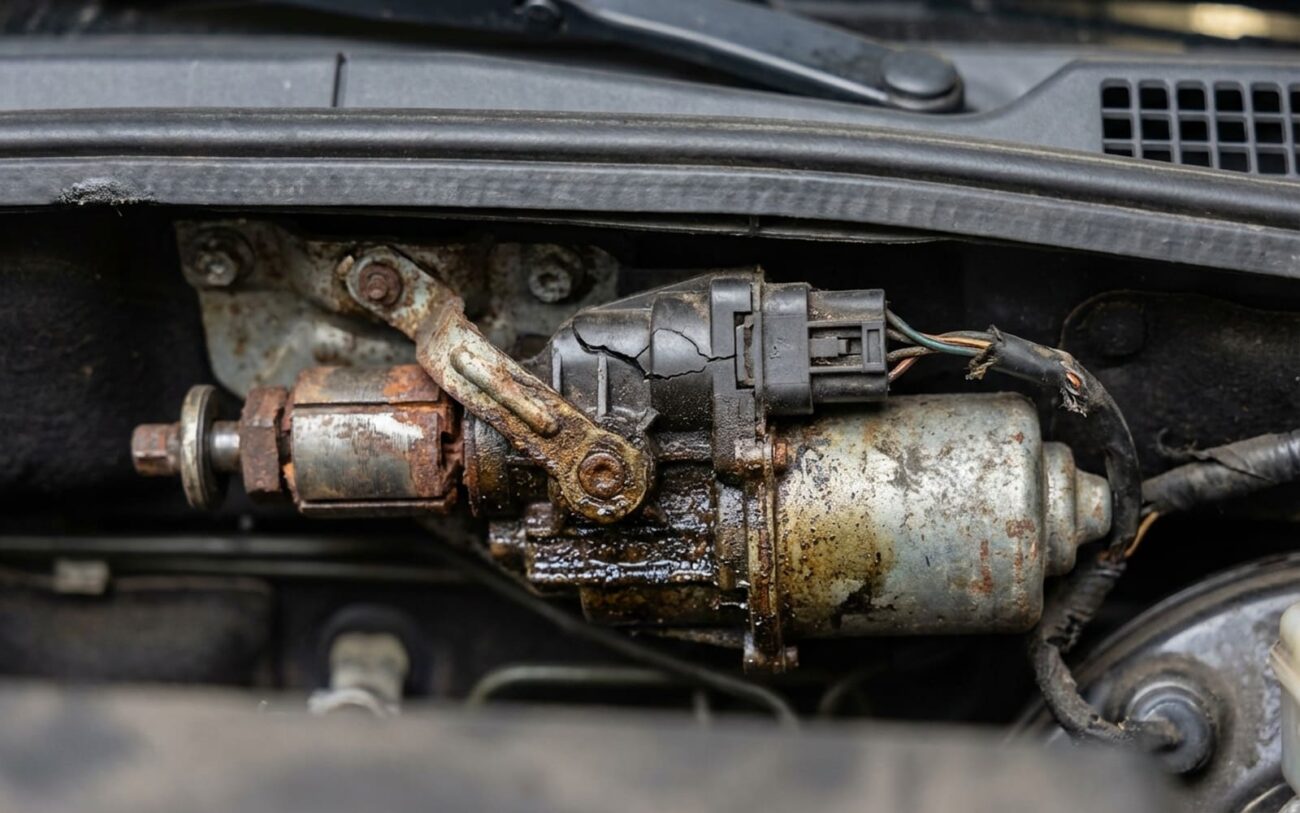
That Humming Sound? Your Wiper Motor Is Fighting for Its Life
I’ve pulled more dead wiper motors than I can count. And without fail, the first clue is the same: you flip the switch, and instead of sweeping across the glass, you hear a low, strained hum coming from under the cowl—right where the motor lives. That’s not a good sign. That hum means the motor’s getting power, the circuit’s live, but something’s jammed. The electromagnetic field is building, trying to turn the shaft, but it can’t. It’s like watching a guy push against a locked door—lots of effort, zero movement.
And here’s what most people don’t realize: if you keep it running like that, you’re cooking the windings. I’ve seen motors that started with a seized gear turn into charred, unrepairable bricks in under five minutes. The insulation burns off, the copper shorts, and now you’re not just replacing a gear—you’re replacing the whole assembly.
Diagnose Before You Disconnect: Is It the Motor or Something Else?
Before you start pulling bolts, ask yourself: is this really the motor? I’ve had customers come in convinced the motor was dead, only to find a $5 fuse blown from a short in the wiper switch. Or worse—someone jammed a leaf blower down the cowl trying to “clean it,” bent the linkage, and now the motor’s seized from mechanical overload.
Here’s how I break it down in the shop:
| Symptom | Likely in Motor | Looks Like Motor, Isn’t Motor | How I Confirm |
|---|---|---|---|
| Humming, no movement | Seized gear train, failed bearings. | Frozen linkage pivot, ice-packed cowl, bent transmission rod. |
Disconnect the motor from the linkage—usually a 10mm nut on the crank arm. Power it directly with jumper wires. If it hums but the shaft doesn’t turn, the motor’s internally seized. If it spins free, the problem’s in the linkage. Check each pivot for binding. |
| Dead silent, no response | Open armature, blown thermal fuse, dead brushes. | Blown fuse, failed relay, bad switch, wiring open. |
Back-probe the motor connector with a DMM while activating the switch. If you’ve got 12V, the motor’s the issue. If not, trace upstream: check fuse #17 (common location), test the relay (swap with horn relay), and inspect the switch for continuity. |
| Wipers stop mid-wipe, won’t park | Failed park switch, cracked cam gear. | Faulty multi-function switch, BCM glitch, wiring fault. |
Find the park sense wire (usually tan or gray, check wiring diagram). Monitor voltage while cycling wipers. It should go high when wipers are running, drop to zero when they hit park position. If it never drops, the internal switch is dead. If it toggles fine, look at the BCM or switch. |
What Actually Breaks Inside the Motor (And Why)
I’ve cracked open hundreds of these things. Two failure modes dominate: mechanical and electrical. And they’re not equally repairable.
Mechanical failures almost always start with the gear train. Most wiper motors use a plastic or nylon reduction gear. It’s quiet, it’s cheap, but after 10–15 years? That gear turns brittle. I see it all the time on vehicles in northern climates—winter freezes the wiper blades to the glass, and when you hit the switch, that sudden load strips the gear teeth. Or worse, water gets in.
And water gets in more often than you think. Clogged cowl drains? That’s the #1 culprit. Leaves, pine needles, gunk—blocks the channels, and now every rainstorm pools right over the motor. Water creeps past the output shaft seal, corrodes the bearings, and eventually seizes the whole assembly. Look for rust trails or white crust around the housing—tells you it’s been soaking for months.
Electrical failures are trickier. Carbon brushes wear down over time. When they’re too short, they lose contact with the commutator, and the motor cuts out. Intermittent at first, then dead. And don’t forget the thermal fuse—built into many motors to protect against overload. Once it blows (usually from trying to run with frozen wipers), it’s done. No reset. No workaround. And the park switch contacts? They arc and corrode, especially in humid climates. That’s what kills the park function.
Oh, and if you drive a Ram from 2011–2014? Yeah, there’s a known issue. The connector seal is garbage. Water gets in, corrodes the terminals, and kills the motor. FCA even issued a TSB for it. If you’re in a salty or wet region, check the connector boot. Replace it if it’s cracked.
Repair Paths: What’s Worth Doing, What’s a Waste of Time
[DIY-FEASIBLE] Fixing a Corroded Connector
[PROFESSIONAL-ONLY] Rebuilding a Gear Train Professional Only
[NON-REPAIRABLE] Electrical Failure? Just Replace It Non-Repairable
[TEMPORARY] Parking Failure? Here’s a Stopgap Temporary
Did It Really Work? How to Test Like a Pro
Don’t just turn it on and walk away. I see too many “fixed” motors fail a week later because nobody tested properly.
Run it through all speeds: low, high, intermittent. Listen. A healthy motor hums smoothly. If it’s grinding or pulsing, something’s binding. Every time you turn it off, it must return to the exact same park position. No exceptions.
Use a DC clamp meter. Normal draw is 3–8 amps. If it’s pulling 10+, there’s resistance—either mechanical or electrical. That’s a failure waiting to happen. And if you fixed the connector? Do a voltage drop test. With wipers running, measure across the terminals. Should be less than 0.1V. After five minutes, touch the connector. If it’s warm, you’ve still got resistance. Recheck your work.
Is It Worth Fixing? The Real Cost Math
| Repair Type | DIY Cost | Shop Cost | Success Rate | Risk if Failed |
|---|---|---|---|---|
| Connector clean/repair | $10–$40 | $100–$200 | High (if corrosion was only issue) | Low—motor can still be replaced later |
| Gear service/regrease | $0–$50 | $150–$300 | Moderate (depends on wear) | Medium—partial repair may fail under load |
| Full motor replacement | $80–$300 | $300–$600 | Very high (when done right) | Low (assuming clean install) |
Here’s my rule: if the repair cost hits 5% of the car’s trade-in value (check KBB), and the car’s got high miles or other issues, question it. Dropping $500 on a wiper motor for a $2,000 beater? Might be smarter to keep a snow brush in the glovebox and wait for a real breakdown. I’ve done it. Sometimes the best repair is no repair.
Prevention: 10 Minutes That Saves You $300
Most wiper motor deaths are preventable. Clean the cowl drains twice a year—spring and fall. Takes 10 minutes. Use a plastic putty knife to scrape out gunk, then flush with a garden hose. On a 2015–2017 F-150, I see this weekly: leaves packed in, water pooling, motor corroded. Preventable.
Lubricate the wiper pivots with white lithium grease. Dry pivots increase load on the motor. And listen. A healthy motor hums steady. If it sounds labored, check for binding. Catch it early, save the motor.
And during routine checks? Look at the motor housing. Rust streaks? Damp grease around the shaft? That’s moisture inside. Address it now—before you’re stuck in a downpour with wipers frozen mid-sweep.
