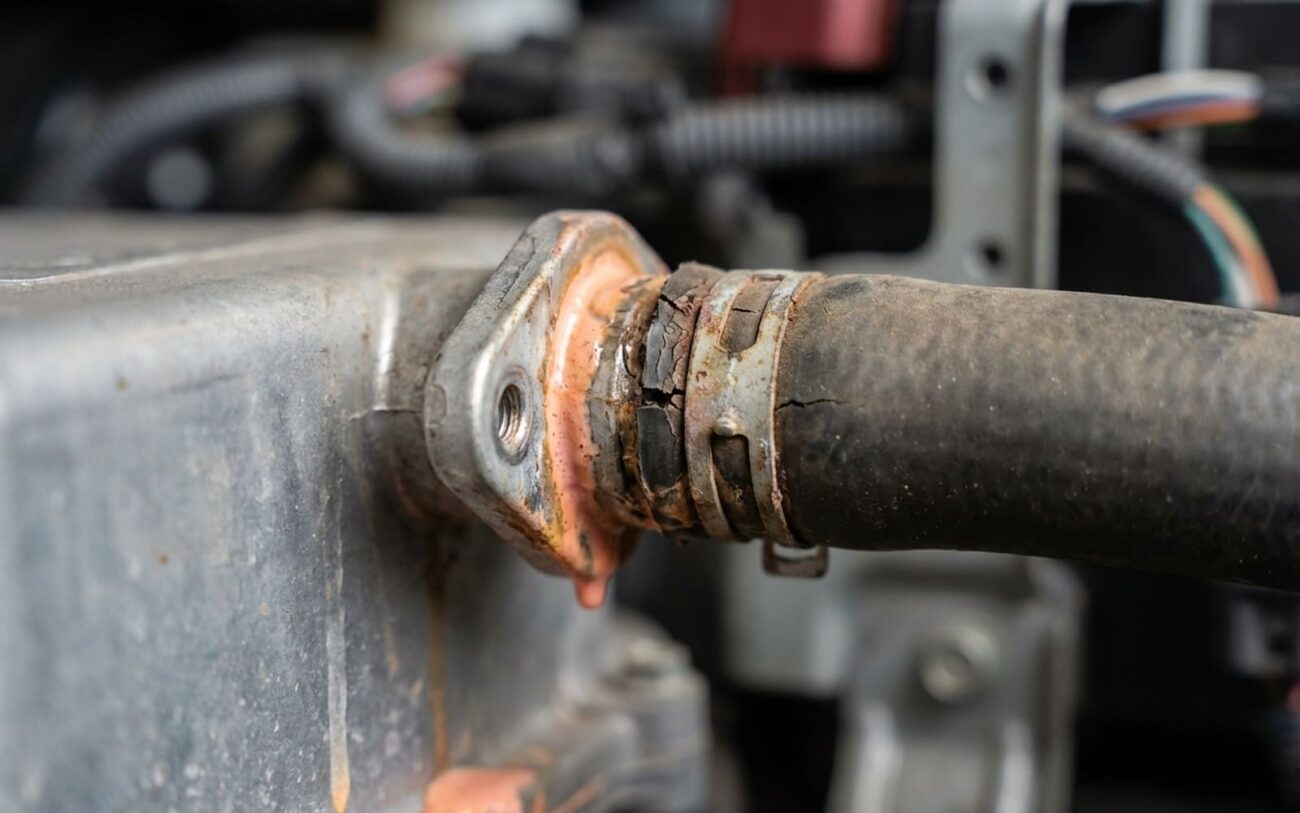
Alright, let’s talk about the dreaded “Battery Cooling System Fault” on a Nissan Leaf. If you’re seeing that warning pop up on your dash, don’t ignore it. That’s the Battery Management System (BMS) telling you it can’t keep the high-voltage battery at a safe temperature anymore. And trust me, that’s not a minor issue. I’ve been wrenching on these for years, and what I typically see is this fault showing up more often on those early- to mid-generation Leafs, especially the ones with higher mileage or a spotty service history.
What That Warning Really Means (and What Else to Look For)
That alert, often accompanied by DTCs like P33F0 or P33F1, means the sealed coolant loop, which runs through aluminum cooling plates under each battery module, isn’t doing its job. It’s a direct threat to your battery’s health.
Beyond the warning light itself, there are usually other clues. The most consistent one I see is a noticeable drop in DC Fast Charging (DCFC) performance. You’ll either get much slower charging speeds or the session will just terminate early. That’s the BMS cutting back the charge rate to protect the battery from overheating when the cooling system is compromised.
Another big indicator is the coolant pump. Listen closely under the rear seat – that’s where it’s mounted. You might hear a new whining noise, or it could be cycling irregularly, or sometimes, it’s just completely silent. Any of those sounds (or lack thereof) can point directly to a pump issue. If you let this go, persistent overheating will accelerate battery degradation. In extreme cases, the car might even refuse to charge or start at all. Don’t ever assume this fault will just “reset itself” – it’s a hard fault that needs a proper diagnosis.
My Diagnostic Approach: Pinpointing the True Source
The biggest mistake I see folks make is assuming a “Battery Cooling System Fault” means the entire battery pack is toast. That’s not always the case. This fault can easily stem from external components or sensors that just mimic an internal failure. You can’t use a generic OBD2 scanner for this; you absolutely need a tool like Nissan CONSULT-III or a high-end aftermarket scanner with specific EV capabilities. My goal is always to rule out the simple, repairable stuff before we even think about the worst-case scenario.
Scenario 1: DTCs (P33F0, P33F1) & Suspected Low Coolant
When the BMS reports low coolant, but the external reservoir looks full, that’s a red flag. It usually points to a sensor issue, an air lock, or an internal leak within the sealed battery pack. Here’s how I confirm it:
- First, I use CONSULT-III to read the battery coolant level and temperature in real time. If the external reservoir is full but CONSULT says “Low,” something’s off.
- Next, a pressure test is critical. I connect a pressure tester to the service ports and pressurize the system to 14–16 psi. I then monitor it for 10 minutes. If the pressure drops by more than 1 psi, you’ve got a leak.
- To isolate the leak, I’ll clamp off the external hoses going to and from the battery pack. If the pressure still drops after clamping, the leak is internal to the pack – that means it’s in the cooling plates, internal hoses, or manifold inside the sealed unit. If the pressure holds, the leak is external, usually at a hose, fitting, or the auxiliary pump.
Scenario 2: Reduced DC Fast Charging Speed
This symptom almost always means the battery isn’t shedding heat efficiently. It could be air pockets, an internal blockage, or a restriction in the coolant flow within the battery’s chiller unit. Sometimes it’s a faulty DCFC inlet temperature sensor or even degraded battery cells, but usually it’s cooling related. My process:
- I monitor individual battery module temperatures via CONSULT during a DCFC session. If you see modules showing high or uneven temperatures, but the coolant inlet/outlet temps remain similar, that tells me the cooling efficiency inside the pack is poor.
- I’ll back that up with an IR thermometer, checking the temperature across the inlet and outlet hoses. A small temperature delta there also suggests inadequate coolant flow or poor heat transfer.
Scenario 3: Coolant Pump Inoperative (No Sound)
If you don’t hear the pump running when it should, it’s either the pump itself or something feeding it. Common external mimics include a blown fuse, a failed coolant pump relay, damaged wiring, or corrosion at the GTR connector (a known weak point under the hood). Low 12V battery voltage can also cause modules to misbehave and mimic sensor or actuator faults, so I always check the 12V battery first.
- I use CONSULT’s active test function to command the pump on.
- While the command is active, I check for 12V and ground at the pump connector. If power and ground are present but the pump doesn’t run, the pump motor is likely failed internally.
- If there’s no power, I trace back through the fuse, relay, and wiring harness. And yes, I always inspect that GTR connector for corrosion.
Root Causes: When the Pack Itself is Compromised
A true internal failure means the problem is inside the sealed battery pack assembly – we’re talking cooling plates, internal hoses, or the manifold integrated right into the pack. The most frequent root cause I’ve seen is porosity or micro-cracks in the cast aluminum cooling plates. These aren’t always visible, and they can develop over time from manufacturing variances or repeated thermal cycling. I’ve been in teardowns where coolant had clearly seeped into the battery tray, leading to corrosion on cell terminals and module connectors. Nissan even acknowledged this issue in their service literature for early ZE0-generation Leafs, particularly 2011–2015 models, though it’s not strictly limited to those years.
Electrolytic corrosion is another serious concern, especially if non-OEM coolant was used. Mixing coolants or using the wrong type can cause galvanic reactions in aluminum systems, accelerating wear significantly. Over very long periods, say 10+ years, even properly maintained systems can develop fatigue cracks at brazed joints due to constant expansion and contraction.
It’s crucial to understand the distinction here: a leaking quick-connect on the pack’s external manifold or a failed auxiliary pump are not internal failures. But once coolant is inside the battery housing or a cooling plate is breached, field repair isn’t an option.
Resolution Pathways: How We Fix It (or Don’t)
The repair path depends entirely on where the problem lies. There’s no one-size-fits-all solution; each scenario demands a specific approach.
External, Accessible Defects: Professional Only
Internal Defects: Non-Repairable → Replace or Refurbish
Temporary Fixes: Temporary / Last-Resort
Post-Repair Validation: Don’t Skip This Step!
Just fixing the system isn’t enough; you absolutely have to verify it’s truly sealed and functioning correctly. For any external repair, I always retest under pressure: 16 psi for 30 minutes, and I expect less than a 0.5 psi drop. Then, I perform a vacuum hold test—pulling to 28 inHg and monitoring for 5 minutes; the loss should be less than 1 inHg.
After refilling, I use CONSULT-III to run the “Battery Coolant Fill Mode.” This cycles the pump and vents air automatically. I monitor live data until the Battery Coolant Level Sensor reads “OK.” Then, I clear all DTCs and complete at least three full drive cycles (cold start to full operating temp) to confirm the system remains stable. Skipping these steps risks undetected air pockets or residual faults. The required tools—a pressure tester with Nissan adapters, a vacuum filler, and CONSULT-III—are non-negotiable for a reliable repair.
The Hard Truth: Cost, Risk, and Your Wallet
Let’s be realistic about cost and value. Repair pricing varies dramatically depending on the issue, but here’s what I typically see:
| Repair Type | Shop Cost (Typical) | Success Rate | Secondary Risk if Failed |
|---|---|---|---|
| External hose/O-ring seal replacement | $300 – $800 (includes labor, coolant, seals) | High (>95%) when done correctly | Improper bleeding causes air locks, leading to pump damage or localized battery overheating. |
| Battery pack cooling plate/internal leak | $5,000 – $9,000+ (remanufactured pack + labor) | 100% for full pack replacement | Attempting internal repair without proper tools risks total pack loss. Even refurbished packs carry some risk of future cooling issues. |
Here’s how I advise customers: if the repair cost for an internal cooling fault exceeds 50% of your Leaf’s current market value, you need to seriously weigh whether it makes financial sense. For example, putting $7,000 into a car worth $9,000—even if it’s otherwise in good shape—may not be sustainable long-term. Consider the battery’s overall degradation (its “State of Health”), any remaining warranty (unlikely on older models), and local incentives for EV replacements. This isn’t just a mechanical decision; it’s an economic one.
Prevention & Monitoring: Keep Your Leaf Running Cool
The best way to handle a battery cooling system fault is to avoid it altogether. Prevention starts with using the correct coolant: Nissan Blue Long Life Coolant (or an exact equivalent) in a 50/50 mix with distilled water. Seriously, never substitute with standard green or orange coolants—those can trigger electrolysis in aluminum systems, and you don’t want that. While Nissan’s official schedule might list battery coolant service at 15 years or 150,000 miles, in my experience, I recommend checking the system every 5 years, especially on older Leafs.
Always inspect under the rear floor for any blue-green coolant stains; those are early signs of a leak. Listen for changes in the coolant pump’s sound. A new whine or irregular cycling can signal bearing wear or electrical issues. And if the “Battery Cooling System Fault” appears even once and then clears itself, don’t just ignore it. Pull the history codes with CONSULT or a capable scanner—intermittent faults often precede a full-blown failure. Early detection of a failing sensor, a minor leak, or an air lock can genuinely save you thousands down the road.
For those doing DIY maintenance, remember: while you can check fuses, relays, and external hoses, anything involving the sealed battery pack belongs in a qualified shop. Stay proactive, use the right tools, and always respect the high-voltage system—your battery’s lifespan, and your safety, depend on it.
