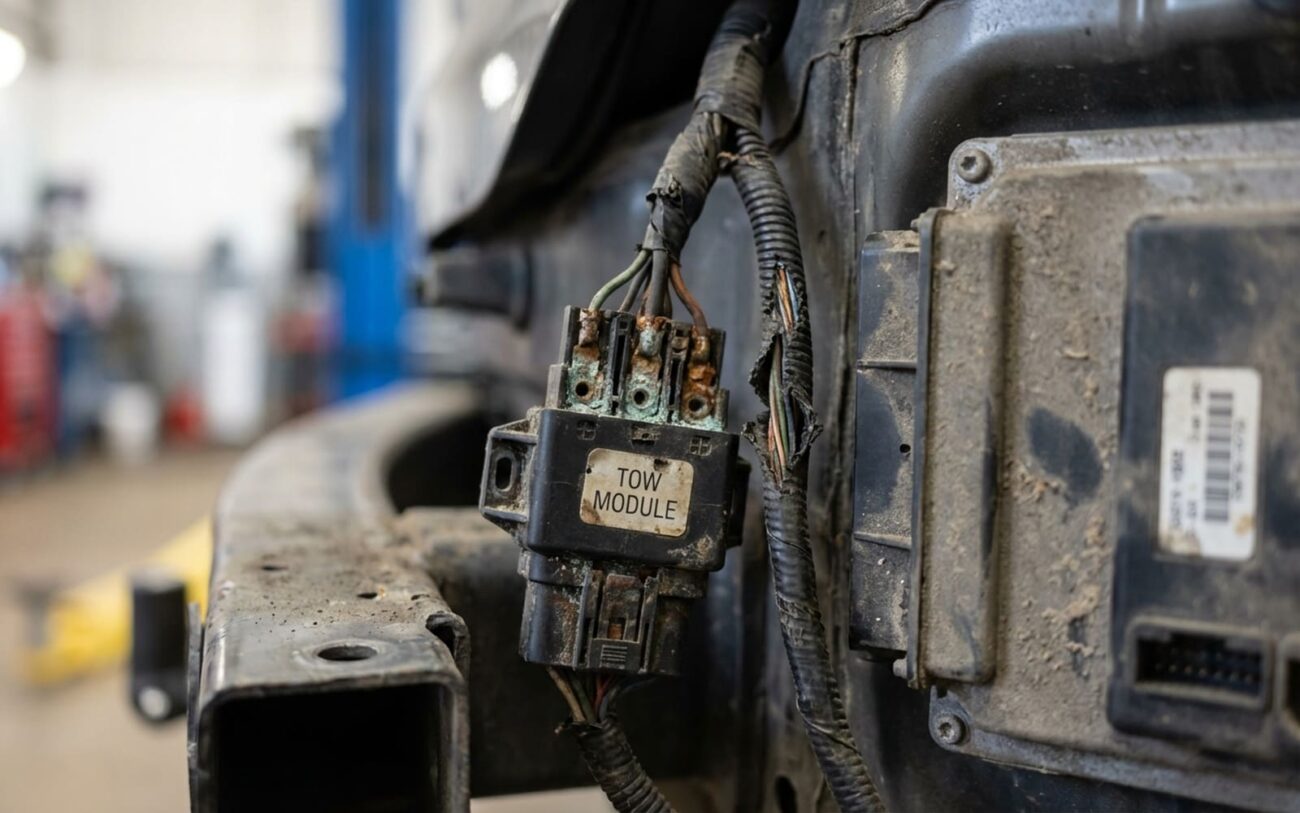
Alright, let’s talk about tow-bar modules and the headaches they can cause. You’d think a module for trailer lights would just mess with trailer lights, right? Wrong. In my 25+ years turning wrenches, I’ve seen these little boxes bring down an entire vehicle network. When a tow module goes sideways on the CAN bus, it’s not just a flickering bulb; it’s a communication breakdown that can make your truck act like it’s possessed. It’s a tricky one to diagnose, so let’s get into how I tackle it.
The Symptoms: What You See (and What I See)
When a tow-bar module starts acting up, especially on the CAN bus, the symptoms can be all over the map. You might see the obvious stuff, like trailer lights not working right, but that’s just the tip of the iceberg. What’s really happening is the module is sending out bad data, or too much data, and it’s jamming up the whole network. The Body Control Module (BCM) is usually the first one to throw a fit because it manages so many interior functions. So, what I often see are weird electrical gremlins that only show up when a trailer is hooked up:
- Interior lights randomly turning on or off.
- Power windows failing for a second or two.
- Wipers activating without you touching the stalk.
- Door locks cycling on their own.
- Sometimes, even the radio cutting out.
These aren’t just random glitches; they’re signs of a serious network conflict. The BCM is basically getting yelled at by the faulty tow module.
Now, when I plug in my scan tool, I’m not just looking for basic trailer lamp faults. Those are usually secondary. My eyes go straight to the U-codes and B-codes. These are your communication and network codes. A U0121, for example – “Lost Communication with Trailer Brake Control Module” – that’s a classic red flag. The key diagnostic clue here, the one I always stress, is whether these codes appear or clear depending on whether you’ve got a trailer plugged in. If the codes vanish when you unhook the trailer, you’re definitely on the right track.
In the worst cases, a completely failed module can pull the whole CAN bus into what we call a “constant dominant state.” Think of it like someone screaming into a microphone so loud no one else can talk. This overwhelms the network. I’ve seen vehicles come in with a no-start condition, blank instrument clusters, or even systems dropping offline while driving. That’s not just an inconvenience; it’s flat-out dangerous. Continuing to drive like that can actually damage other modules because of the sustained bus errors or voltage irregularities. You don’t want to replace a BCM because a tow module went bad.
My Diagnostic Approach: Isolating the Real Problem
Just because the weirdness starts when you plug in the trailer, don’t automatically blame the tow-bar module. That’s a common misdiagnosis, and I’ve seen too many expensive modules replaced prematurely. My first step is always to rule out the simpler, more common stuff. You have to be methodical.
Here’s what I check before I even think about condemning the module itself:
- Trailer Wiring & Ground: A poor ground at the trailer connector (the 7-pin or 13-pin plug) can mimic CAN bus interference. It creates feedback loops through shared circuits. Same goes for a short in the trailer’s own wiring – damaged insulation or water getting in can send all sorts of erratic signals back into the vehicle’s system. I always start by checking the trailer itself, or better yet, using a known-good trailer or a trailer simulator.
- Vehicle-Side Connector: Is the vehicle’s trailer connector clean? Are the pins bent? Is there corrosion? These are exposed to the elements, so it’s a prime spot for trouble.
- Main Vehicle CAN Bus Wiring: Especially on older trucks, the main CAN bus harnesses run under the frame or in other exposed areas. Road salt, debris, moisture – they all take a toll. Physical damage to the wiring can destabilize the entire network, and it has nothing to do with the tow module.
- Termination Resistors: Less common, but a failing termination resistor in another module, or even a marginal connection in the OBD-II harness, can throw the whole network off.
My job here is to figure out if the tow-bar module is the source of the conflict, or just another module getting knocked offline by a bigger electrical problem. You have to think beyond the obvious.
| Symptom | What I Suspect First | How I Confirm It (My Go-To Test) |
|---|---|---|
| Intermittent BCM malfunctions (lights, windows, locks) with trailer connected. | Could be the tow-bar module sending bad data, OR a poor ground/short in the trailer/connector. |
First, disconnect the trailer. If symptoms vanish, the problem is external to the vehicle. If they persist, disconnect the main vehicle-side connector to the tow-bar module. If the vehicle returns to normal, the module is the likely culprit. Always check ground resistance at the module connector – I want to see less than 5 ohms to chassis ground. |
| CAN bus error DTCs (U-series, B-series) that clear when the trailer is unplugged. | Internal fault in the tow-bar module corrupting the CAN signal. Could also be physical damage to the vehicle’s CAN wiring or another module’s termination resistor. |
This is where an oscilloscope shines. Monitor the CAN High and CAN Low waveforms at the OBD-II port. If you see a distorted, noisy, or incorrect voltage waveform only when the tow module is connected (and ideally, with a trailer connected), that points squarely to the module. A good CAN signal should look like clean square waves. |
| No communication with BCM, instrument cluster, or other critical modules (e.g., no-start). | The tow-bar module has completely failed, pulling the CAN bus to a constant dominant state. Could also be a blown CAN system fuse or a BCM issue. |
First, check the termination resistance at the OBD-II port (pins 6 & 14). You should see around 60 ohms. If it’s much lower (like 0-10 ohms), you have a bus short. Then, I start isolating. Disconnect modules one by one, starting with the tow module, and re-check the bus resistance and communication. When the bus resistance returns to normal (or communication is restored), you’ve found your culprit. |
Why These Modules Fail: My Observations
Once you’ve done your homework and confirmed it’s the tow-bar module itself, it’s worth understanding why these things bite the dust. They’re not just simple relays anymore; they’re complex, microprocessor-driven CAN nodes with sensitive electronics. Based on years of pulling these failed units off trucks, I can tell you there are usually three main culprits:
- Voltage Transients: Trailer wiring is a harsh environment. You’ve got inductive loads like brake light coils, maybe poorly regulated converter chargers on the trailer side. All that can send voltage spikes, or “back-EMF,” right back into the tow module. If that module doesn’t have robust transient suppression, those spikes will fry the CAN transceiver or the microcontroller. It’s like a tiny lightning strike inside the box.
- Environmental Damage: This is a big one. These modules are almost always mounted under the rear bumper, in the fender well, or on the frame rail. That’s prime real estate for road salt, gravel, constant vibration, and water intrusion. Over time, that leads to cracked solder joints, corrosion eating away at circuit board traces, or seals failing and letting moisture right inside. I’ve opened up units where the entire ground plane on the circuit board was just gone, eaten away by corrosion.
- Firmware Corruption/Incompatibility: While less common, it definitely happens. Sometimes it’s a manufacturing defect, but often it’s related to aftermarket brake controllers or other trailer electronics that aren’t fully compatible with the factory network. The module starts sending malformed messages or, worse, floods the bus with high-priority frames, essentially jamming all communication. I’ve seen service bulletins, especially from Ford, that specifically reference communication conflicts caused by incompatible trailer electronics forcing BCM resets. Now, let’s be clear: a short in the trailer’s wiring isn’t a tow-bar module failure. Corrosion in the main vehicle CAN harness under the dash isn’t a tow-bar module failure. We’re talking about failures within the sealed, factory-mounted module itself.
Getting It Fixed: My Repair Paths
Your repair path really depends on what you find during diagnosis and what tools you have at your disposal. Sometimes, you get lucky, and it’s a simple fix.
Connector Cleaning/Repair DIY-FEASIBLE
But if the module itself is truly faulty – whether it’s an internal component failure or corrupted firmware – then repair isn’t really an option. These units just aren’t designed to be field-serviceable. You can’t open them up and solder new components in, at least not reliably.
Module Replacement & Programming Professional Only
In rare cases, if you’re stranded and just need to get the vehicle moving safely, there’s a last-resort option:
Temporary Disconnection Last-Resort
Post-Repair Validation: Don’t Skip This
You know, some guys think the job’s done once the DTCs clear. Not in my shop. A proper repair requires thorough verification, and I do it at three levels. If you don’t do this, you’re just asking for a comeback.
- Functional Testing: Connect a known-good trailer or, even better, a trailer light simulator. Test all the circuits: running lights, turn signals, brake lights, and electric brake output. Confirm the timing, brightness, and responsiveness are all correct.
- Network Verification: Clear all those DTCs. Then, cycle the ignition (off, open the door, on, start). Let it run for a bit, then rescan for codes. You shouldn’t see any U0121 or other communication codes return. If your scan tool has live data, monitor the communication status of all modules. Make sure they’re all talking happily.
- Signal Integrity (If You Have the Tools): If you have an oscilloscope, hook it up to the CAN High and CAN Low at the OBD-II port. The signal should be clean, nice square waves, with proper voltage levels (typically 1.5–3.5V differential). No distortion, no noise. This is the ultimate proof that the bus is healthy.
Finally, and this is crucial, perform a road test with the trailer connected. Drive it like you normally would. Monitor for any recurrence of those BCM-related symptoms – door locks cycling, lights flickering, instrument cluster dropouts. Only when everything remains stable under load, and you’ve put some miles on it, can you truly confirm the repair.
The Cost, The Risk, and Making a Smart Decision
Money talks, right? Here’s a quick breakdown of what you’re looking at, plus my take on making the call.
| Repair Type | DIY Cost | Shop Cost | Success Rate (In My Experience) | Secondary Risk if It Fails |
|---|---|---|---|---|
| Connector Cleaning/Repair | $20 (for cleaner/grease) | $100–$200 | High, if that’s the actual problem. | Low. If it doesn’t fix it, you move to the next step. No harm done. |
| Module Replacement & Programming | $300–$800 (part only) | $500–$1,200 | Very High, if diagnosed and programmed correctly. | Medium. Incorrect programming can cause mismatched settings or even brick the module, requiring another replacement. This is why it’s a pro job. |
| Temporary Disconnection | $0 | N/A | 100% (for restoring vehicle function) | High. Complete loss of trailer functions means a huge safety liability if you try to tow. Only for getting the vehicle home. |
Here’s a rule I’ve used in the shop for years: if the total cost of a proper module replacement (part plus programming, which can be significant) starts to exceed, say, 30% of the vehicle’s current market value, and you barely ever tow anything, it might be more economical to just disconnect the module permanently and forget about trailer use. That’s not a repair, it’s a risk-managed decision. Just be aware that removing trailer functionality will affect the resale value and could raise red flags during vehicle inspections. Make sure your vehicle still meets all local safety regulations without it.
Prevention: Keeping Your CAN Bus Happy
Look, an ounce of prevention is worth a pound of cure, especially with electrical stuff. Preventing CAN bus conflicts starts with smart installations and regular maintenance.
- Use OEM-Style Harnesses: Avoid those cheap universal splice-in trailer harnesses. They’re asking for trouble. Always use a vehicle-specific, OEM-style harness with proper seals and protected routing. These kits are designed to integrate cleanly with your factory wiring and minimize the risk of back-feeding voltage or creating ground loops that mess with the CAN bus.
- Dielectric Grease is Your Friend: Every single time you connect a trailer, put a small amount of dielectric grease on the pins of the vehicle’s trailer connector. It doesn’t conduct electricity, but it’s fantastic at sealing out moisture and preventing corrosion, which is the enemy of electrical connections.
- Inspect Regularly: Periodically check that trailer connector for bent pins, debris, or any signs of overheating. After extended trips, especially in wet or salty conditions, give the tow module’s housing and wiring a quick inspection for physical damage.
My Top Tip for Intermittent Faults:
Pay close attention to any intermittent faults that seem to depend on external connections – like when you plug in a trailer. These are often manageable if you catch them early, before they cause permanent damage. Early detection can prevent a full network failure and save you from being stranded on the side of the road. Don’t ignore those little warnings!
