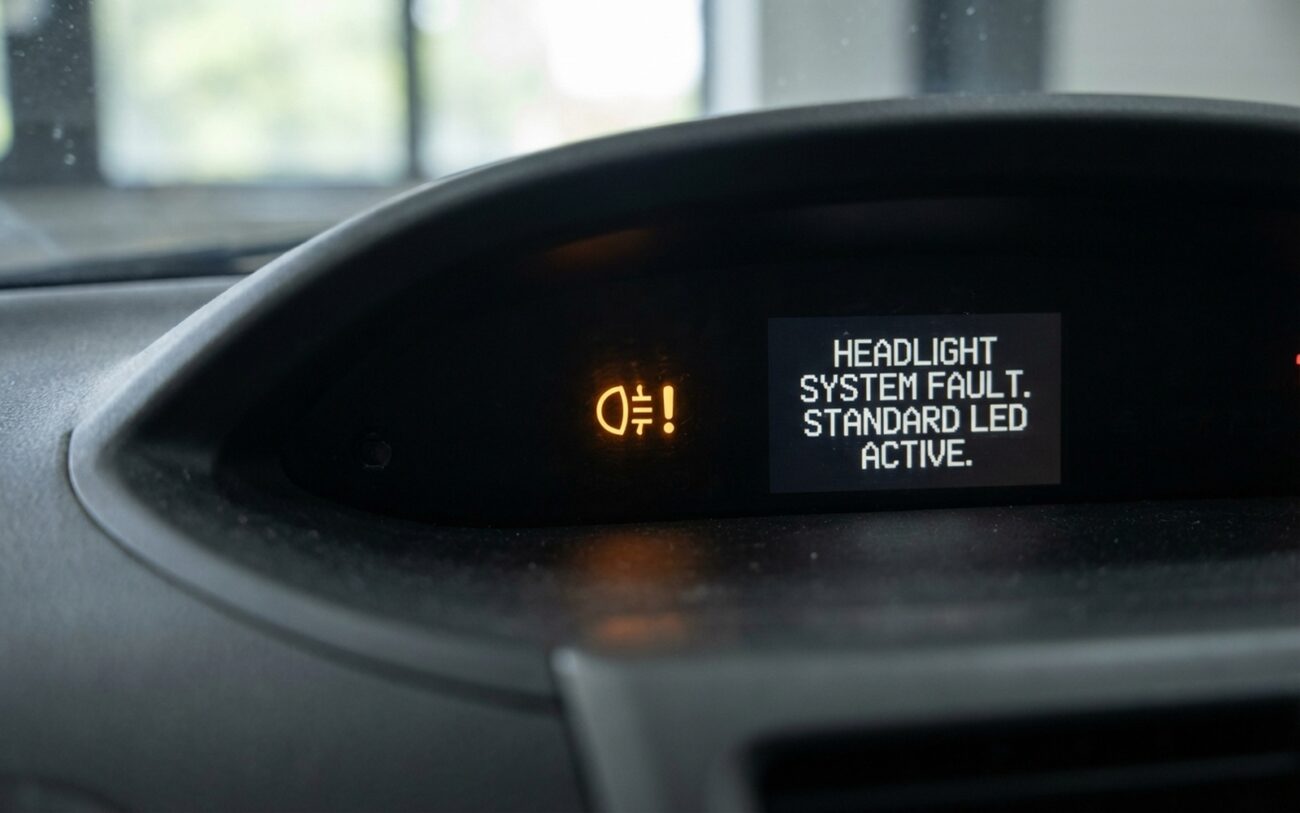
You’re driving down a dark stretch of highway and notice your high beams don’t reach like they used to. The dash throws a warning—maybe a headlight icon with an exclamation mark. You flip on the high beams: the LEDs come on, but the long-range punch of the laser system? Gone. That’s not a glitch. That’s the system doing exactly what it’s supposed to when something goes wrong.
What You’re Actually Seeing
This isn’t a partial failure. The laser system is either fully on or completely off. When it drops out, the car defaults to LED high beams—same bulb, just without the laser assist. That’s by design. The system doesn’t “limp” the laser; it kills it dead and falls back to the LEDs to stay legal and safe.
I’ve seen this on BMWs, Audis, and a few Mercs—especially models from 2018 to 2021. The most common culprit? The Laser Module Control Unit (LMCU). It’s a sealed black box tucked inside the headlight assembly, and when it fails, the laser stays off. Period.
You’ll usually get DTCs like 8C57 or 8C58 on BMWs—those point straight to the LMCU or its communication with the FEM. But—and this is important—not every LMCU code means the module is dead. I’ve chased wiring issues, bad grounds, and even faulty ambient light sensors that looked like a blown LMCU at first glance.
How to Tell If It’s Really the LMCU
You can’t diagnose this with a $30 OBD2 scanner from the gas station. You need factory-level tools: ISTA for BMW, ODIS for Audi, XENTRY for Mercedes. Without them, you’re guessing.
Here’s what I do in my shop:
First, I command the LMCU to activate the laser using the scan tool. If the BCM sends the signal but the LMCU doesn’t respond—no current draw, no feedback—the module is likely dead. But if the command never leaves the BCM? Then the problem is upstream: bad sensor input, missing speed signal, or a communication fault on the CAN bus.
I also check live data. The LMCU needs valid inputs: ambient light level, vehicle speed, camera status (for adaptive beams). If those are good but the LMCU still throws internal faults, it’s not the sensors—it’s the brain.
What Actually Breaks Inside the LMCU
These modules aren’t repairable. They’re sealed, potted, and not meant to be opened. But based on what I’ve seen in failed units, the failures follow a pattern:
- Thermal stress: The laser driver runs hot. Over time, solder joints crack—especially on power transistors and voltage regulators.
- Moisture: If the headlight seal fails, condensation gets in. Corrosion on the board kills the LMCU fast.
- Electrical spikes: Jump-starting with reversed cables or a failing alternator can toast the input circuitry.
- Factory defects: Some units had marginal components. I’ve seen capacitors rated for 105°C installed in spots that routinely hit 110°C. It’s a slow death.
And no—this isn’t the same as a broken fiber optic line. Some older laser systems used a remote diode with a fiber feeding the light to the headlight. But in most BMWs and Audis from the last five years, the diode and LMCU are built into the headlight. Fiber issues are rare now.
How to Fix It (Without Wasting Money)
Replace the LMCU Professional Repair
- Use a VIN-specific part. These modules are coded to the car.
- Secure all connectors—finger-tight plus a quarter-turn on locking tabs.
- Program it. You must use OEM software (ISTA, ODIS, etc.) to register, code, and calibrate the module. Skip this, and the laser stays off—or worse, you get CAN bus errors.
I don’t care what the aftermarket says: this isn’t plug-and-play. I’ve had customers come in after trying a “direct replacement” that never synced. Took an extra hour just to clear the ghosts from the network.
Check Power and Grounds First DIY-Feasible
- Check for 12V at the LMCU power pin with ignition on.
- Test ground: less than 0.5 ohms between ground pin and chassis.
- Verify CAN bus signals with an oscilloscope if possible. Clean square waves at ~2.5V bias on both CAN High and Low.
If power, ground, and comms are good but the module still doesn’t respond? Then replace it. There’s no workaround.
Did It Actually Work? Test Like a Pro
Don’t just drive around and say “looks better.” That’s not validation.
Here’s what I do:
Drive above 40 km/h in the dark, high beams on. The laser should kick in automatically—no input needed. You’ll see the beam stretch out another 300 meters. Some systems make a faint click when switching; listen for it.
Then, back on the scanner:
- Clear all DTCs from the LMCU, BCM, and front modules.
- Run the headlight initialization routine. This forces the system to re-learn the new module.
- Restart, cycle the lights, drive a short loop.
- Scan again. Any pending codes? If so, something’s still off.
If it passes, you’re good. If not, don’t assume the part is bad—double-check coding and connections first.
Cost, Risk, and Whether It’s Worth It
| Repair Type | DIY Cost | Shop Cost | Success Rate | Secondary Risk if Failed |
|---|---|---|---|---|
| LMCU Replacement & Programming | $800–$2,000 (part only) + scan tool access ($100–$300). | $1,200–$3,000+ (labor, programming, calibration). | Near 100% when done right. |
Bad coding can brick the module or disrupt the CAN network. And headlight removal? One wrong move and you crack the lens or break a mounting tab—especially on newer BMWs with tight front-end designs. |
Look, I get it—$2,500 for headlights stings. If you’re out of warranty, I’d consider an independent shop with OEM tools. I’ve seen them charge half what the dealer does. But verify they’ve done this before. This isn’t a job for a guy who mostly changes oil.
And yeah, you can just leave it in LED-only mode. It’s legal. It works. But you lose the range, and if you drive rural roads at night, you’ll notice. Plus, it’ll hurt resale. People pay for laser lights. They expect them to work.
Real-World Tip
On 2018–2020 BMW X5s (G05), this was a known issue. Dealers replaced LMCUs under warranty all the time. If your car’s near that window, check for open recalls or TSBs. Might save you a grand.
Can You Prevent It?
How to Protect the LMCU
-
Keep the charging system healthy. Replace the alternator or battery at the first sign of voltage instability.
-
Never jump-start with reversed cables. It’s amazing how many LMCUs I’ve seen killed by a 10-second mistake.
-
Inspect headlight seals yearly. If you see fogging that doesn’t clear, address it. Moisture kills electronics.
-
Watch the instrument cluster on startup. That blue laser icon should flash briefly. If it stops, dig in early.
These systems are complex. Just like premium audio or adaptive suspension, they demand respect. Treat the electrical system right, and the LMCU will last. Ignore it, and you’ll be staring at a $2,500 repair bill wondering what went wrong.
