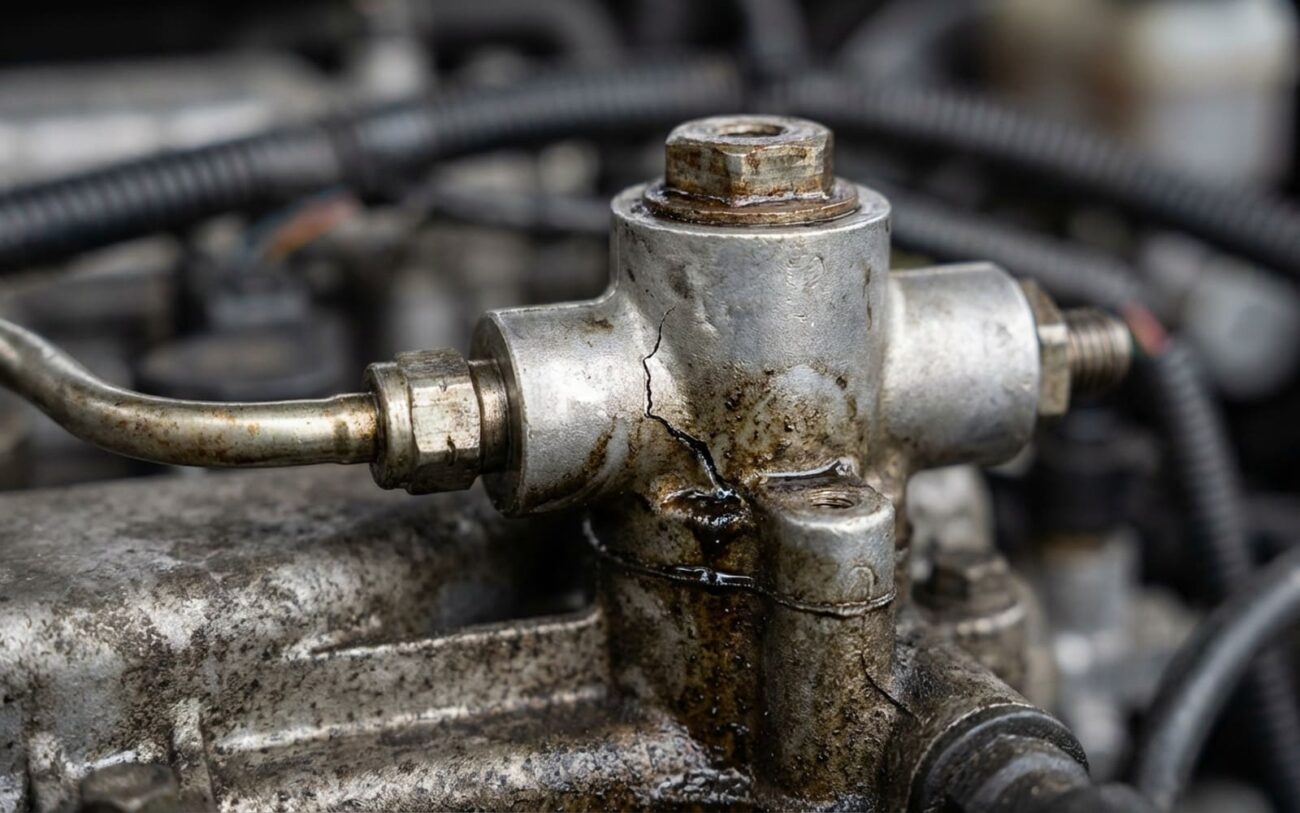
After 25 years wrenching on diesel engines, I can tell you this: when a common rail system starts acting up with high fuel pressure, the High-Pressure Control Valve (HPCV) is almost always at the top of my suspect list. And for good reason. This little valve is the traffic cop of your high-pressure fuel rail, constantly adjusting how much fuel gets sent back to the tank to keep that rail pressure exactly where the engine needs it. When it sticks, especially closed, that pressure builds and builds, and that’s when things get dangerous.
What I Look For: Symptoms of a Stuck HPCV
The clearest sign, the one that screams “HPCV!” in my ear, is a big difference between what the Powertrain Control Module (PCM) wants for fuel rail pressure and what it’s actually getting. You’ll see this on your scan tool, plain as day.
Let’s say the PCM is asking for 5,000 psi at idle – a pretty normal request. But your scan tool is showing a steady 20,000 to 25,000 psi. That’s way out of spec, and it tells me the HPCV isn’t opening up to relieve that excess pressure. This usually throws a P0088 diagnostic trouble code, which means “fuel rail pressure too high.”
Now, here’s where experience really counts: a bad fuel rail pressure sensor can lie to the PCM. It can report sky-high pressure even if the actual pressure is normal. So, while high live data points to the HPCV, you can’t just jump to conclusions. You’ve got to rule out that sensor first.
Another common symptom I see is a hard start, especially when the engine is hot. Think about it: when you shut down a healthy diesel, the HPCV should allow the rail pressure to bleed off. If it’s stuck closed, that pressure stays trapped in the rail. Next time you try to start, the starter motor has to fight against that residual pressure, making the engine crank slowly and laboriously. I’ve had countless customers come in convinced they need a new battery or starter, only to find the real problem is hydraulic lock from trapped fuel pressure.
The most critical scenario is when you have uncontrolled high pressure across all operating conditions. If that rail pressure is pegged at maximum whether you’re idling, coasting, or just barely touching the throttle, you’ve got a system in serious distress. Fuel lines, injectors, and the rail itself aren’t built to handle sustained over-pressure. This can rupture lines, spray high-pressure diesel all over a hot engine, and create a massive fire hazard. If you see this, do NOT drive the vehicle. Get it towed in immediately.
My Diagnostic Playbook: Confirming the HPCV Fault
Diagnosing an HPCV isn’t about just reading a code and throwing parts at it. It’s about systematically testing the system’s behavior. My approach is to isolate the HPCV from other components that can cause similar symptoms, like the pressure sensor, the high-pressure fuel pump (HPFP), or even low-pressure supply issues.
You absolutely need a good scan tool that can read live data PIDs and, ideally, perform bi-directional tests. This lets you directly command the HPCV to open or close.
| Symptom | What I Suspect in the HPCV | Common Mimics to Rule Out | My Definitive Test to Confirm |
|---|---|---|---|
| Persistent High Fuel Rail Pressure | The valve’s internal spool is stuck closed. This could be from contamination, wear, or an electrical failure in the solenoid. | A faulty fuel rail pressure sensor (FRP) giving false readings, a restricted fuel return line, or even issues with the low-pressure supply system. |
First, always verify the scan tool reading with a mechanical fuel pressure gauge directly on the rail. This is non-negotiable – it eliminates sensor error. Once confirmed, use a bi-directional scan tool to command the HPCV to 100% duty cycle (fully open). If the actual rail pressure doesn’t drop significantly, the valve itself is likely stuck.
|
| No Fuel Pressure Bleed-Down After Shutdown (Hot Hard Start) | The HPCV’s internal bleed path is blocked or the valve is stuck shut, trapping pressure. | A failed check valve inside the high-pressure pump (HPFP) can also hold pressure, or sometimes residual pressure from the low-pressure side. |
Attach that mechanical gauge to the rail again. Run the engine, then shut it off and watch the pressure. If it stays high, carefully clamp the HPCV return line (if it’s accessible and safe to do so). If the pressure still doesn’t drop, the fault is likely in the HPFP’s internal check valve. If the pressure does drop only when you release the clamp, then the HPCV isn’t opening to relieve pressure, and that’s your culprit.
|
Why HPCVs Go Bad: The Root Causes I See
When an HPCV fails, it’s usually one of three things: contamination, an electrical issue, or just plain old mechanical wear. Each one tells a different story about what’s going on with the fuel system.
Contamination is, hands down, the most common reason I see these valves fail. Diesel fuel isn’t just fuel; it’s also a lubricant for these incredibly precise, high-pressure components. Modern HPFPs and HPCVs have clearances measured in microns. Any tiny bit of debris – metal shavings from pump wear, rust, water, or just poor-quality fuel – can get lodged in that spool bore and stop it from moving. I’ve pulled HPCVs that looked perfect on the outside, but inside, they were completely jammed with fine metallic sludge.
Certain engine families, like some 6.7L Power Stroke variants, are notorious for fuel system debris issues. This often leads to P0087 (low pressure) or P2291 codes, but it can absolutely cause high pressure if the valve gets stuck closed. In these cases, just replacing the HPCV is a waste of money. You have to clean the entire fuel system, or you’ll be doing the job again very soon.
Electrical failure happens when the solenoid coil inside the HPCV shorts out or goes open circuit. This cuts off the PCM’s ability to control the valve, leaving it unresponsive. A quick ohmmeter check can usually confirm if the coil resistance is out of spec. Sometimes, though, it’s an intermittent failure that only shows up under heat or load. If the coil reads open or shorted, the valve is toast.
Finally, there’s good old wear and erosion. This develops over time, especially in high-mileage engines or those that have been run on fuel with poor lubricity. The spool and its bore wear unevenly, which messes with its sealing and response. You might see erratic pressure control – sometimes high, sometimes low – before it finally seizes up. Unlike contamination or electrical issues, wear is a progressive problem and often signals that other parts of your fuel system are also getting tired.
Technician’s Insight: What Doesn’t Cause High Pressure
Just to be clear, a clogged fuel filter or a failing lift pump will cause low rail pressure, usually setting a P0087 code. Leaking injectors also drop pressure. Don’t chase those ghosts if you’re dealing with P0088. They’re completely different problems.
The Fix: Repair Approaches & Safety First
How you replace the HPCV really depends on where it lives. There are two main setups, and they dictate whether it’s a DIY job or something for the pros.
External HPCV: DIY with Extreme Caution
On a lot of diesel trucks and older common rail systems, the HPCV is a separate unit bolted right onto the fuel rail or the HPFP. For a skilled DIYer who knows their way around a wrench and understands diesel safety, this can be a manageable job. But you must follow safety procedures.
First, you absolutely, positively have to relieve system pressure. I’m talking 25,000 psi here – that can penetrate skin and cause catastrophic injury. Some vehicles let you command the HPCV open with a scan tool to bleed pressure. Others might require pulling the fuel pump relay and cranking the engine for a few seconds. Never, ever skip this step.
You’ll need specific tools: fuel line disconnect tools (they vary by connector type), a new HPCV with a fresh seal kit, and a torque wrench. Those mounting bolts are small and easy to over-tighten. For example, on many Ford 6.7L applications, the spec is only 8 Nm (71 in-lb). Always lubricate the new O-ring with clean diesel before installation to prevent pinching and ensure a proper seal.
Integrated HPCV: Professional-Only Repair
In many modern passenger diesels – especially those with Denso HP3, Delphi HPCV, or Bosch CP4 pumps – the HPCV is actually built into the high-pressure pump assembly. Replacing it means disassembling the HPFP, and that’s a whole different ballgame. It requires specialized tools, a clean-room environment, and strict adherence to OEM service procedures. One speck of dirt or an incorrectly installed seal can ruin a brand new unit. This is not a job for your home garage. Take it to a reputable diesel specialist who has experience with HPFP rebuilds.
Temporary Field Fix: A Last Resort (and I mean LAST)
You might hear old-timers (or desperate folks) talk about tapping the HPCV with a brass drift to free a stuck spool. In extremely rare cases, if the valve is only lightly bound by varnish or minor debris, this might restore temporary function. But it’s incredibly risky. You can crack the housing, damage the solenoid, or make the problem much worse. And even if it works, it won’t last. I’ve seen vehicles return days later with far more severe symptoms. This isn’t a repair; it’s a Hail Mary to get you off the side of the road. Address the real root cause as soon as humanly possible.
After the Repair: Verifying the Fix
Just replacing the part isn’t the end of the job; it’s the beginning of verification. You need to confirm that the system is now responding correctly and safely. Grab that scan tool again, especially one with bi-directional control, and command specific HPCV duty cycles while watching the actual fuel rail pressure.
My go-to test involves commanding stepped pressure targets: start at 5,000 psi, then jump to 10,000, then 20,000. The actual pressure should rise and fall smoothly, tracking very closely to your commanded values – I look for it to be within ±500 psi under stable conditions. If the pressure overshoots, lags, or won’t drop when you command it low, you’ve got to recheck your electrical connections, fuel return flow, and sensor calibration.
Also, perform a bleed-down test. Start the engine, let it run for a bit, then shut it off. Using live data or your mechanical gauge, confirm that the pressure drops to near zero within 30–60 seconds. Any residual pressure means the HPCV isn’t fully opening, or you have another issue like a bad HPFP check valve.
Finally, and this is crucial: inspect for leaks. Cycle the ignition a few times to prime the system, then start the engine and meticulously check all connections. A pinhole leak under high pressure can mist diesel fuel onto hot surfaces, and that’s a serious fire risk. Don’t skip this step.
Dollars and Sense: Repair vs. Replace
Let’s talk about the money. Fixing an HPCV isn’t always cheap, but the cost varies wildly depending on the vehicle and the specific failure.
| Repair Type | DIY Part Cost (Approx.) | Shop Cost (Approx.) | My Take on Success Rate | Secondary Risk if Not Fixed / Failed |
|---|---|---|---|---|
| Replace External HPCV | $150 – $400 | $350 – $600 | High (>95%) – if the diagnosis is spot-on and the fuel system is truly clean. | Unresolved high pressure will eventually take out injectors, fatigue the HPFP, and can lead to a catastrophic failure or fire. |
| Replace HPFP (due to integrated HPCV) | $800 – $2,500+ | $1,500 – $3,500+ | High – but only if you identify and fix the root cause (like contamination). | If you don’t address fuel quality or filter maintenance, that new pump (and its integrated HPCV) will fail again, often quickly. |
If you’re looking at replacing the entire HPFP because of an internal HPCV, especially on an older truck, that cost can easily hit or exceed half the vehicle’s market value. In those situations, you really need to weigh the repair against other potential issues. Are the injectors worn? Is the EGR system acting up? What’s the DPF looking like? If multiple major systems are showing their age, it might just be more economical to cut your losses and consider a different vehicle rather than sinking big money into a repair.
Keeping it Running: Prevention is Key
The best way to avoid HPCV failure is to protect your entire high-pressure fuel system from contamination and wear. These diesel engines are incredibly unforgiving of poor maintenance.
Always use high-quality fuel from reputable stations. I’ve seen too many problems from “bargain” diesel that lacks proper lubricity or contains water and particulates. Change your fuel filter exactly on schedule – don’t try to stretch those intervals. Many manufacturers now recommend 5,000–15,000 mile changes, depending on how you drive. And consider using an OEM-approved diesel additive that meets API-CJ-4 or CK-4 standards; these can improve lubrication and help prevent deposit buildup in injectors and pumps.
For early detection, if you’ve got a capable scan tool, monitor live data regularly. At idle, your commanded and actual rail pressure should be almost identical. If you start seeing a growing gap – especially if actual pressure is consistently running high – that can signal HPCV degradation long before a diagnostic code ever sets. Catching it early can save you a lot of headaches and money down the road.
And just pay attention to your truck. When you turn the key to “on,” listen for the fuel prime hum. An unusually loud or prolonged noise from the rail area might indicate pressure control issues. It’s a subtle symptom, sure, but it’s one of those ways the system tries to tell you it’s under stress. The key, as always, is catching those small changes before they become big, expensive problems.
