When Your Car Goes “Limp”: Diagnosing Transmission Communication Failure
Alright, let’s talk about “Limp Mode.” Every driver remembers that feeling: you’re cruising along, everything’s fine, and then suddenly the engine stumbles, the transmission locks into a single gear—usually second or third—and the car feels like it’s dragging an anchor. You’re revving high, going nowhere fast, and the torque converter? Yeah, it’s not locking up.
On the dash, you’ll see the check engine light glaring at you. Often, there’s a transmission warning or a “reduced power” message. And here’s a big clue: the PRNDL gear indicator on your instrument cluster might just go blank, even though you’re still moving the shifter through the gears. It’s like the car’s forgotten what gear it’s in.
Signal: ERR_LOST
From my 25+ years in the bay, this specific set of symptoms—especially when it’s screaming “communication failure” at you—almost always points to a breakdown between the engine control module (ECM) and the transmission control module (TCM). These two are the brains of your powertrain, and they rely on the vehicle’s CAN bus network to talk to each other. When they stop communicating, the whole system goes into a failsafe, or “limp,” mode to prevent damage. Think of it like a pilot and co-pilot suddenly going silent; the plane can still fly, but it can’t make any coordinated maneuvers. That’s your car in limp mode.
The First Clue: U-Codes
The clearest diagnostic clue, the one that usually sends me down this path, is the presence of U-codes in the OBD-II system. These are your “network communication” codes. Specifically, we’re looking in the U0100 range. They’re telling you straight up that modules are losing touch with each other. Here’s what I typically see:
| DTC | Description | What It’s Telling You |
|---|---|---|
| U0100 | Lost Communication with ECM/PCM | The TCM isn’t getting data from the engine control module. This usually points to a network issue or a problem with the ECM itself. |
| U0101 | Lost Communication with TCM | The ECM is reporting no signal from the TCM. This is a big one and directs me to check the TCM’s power, ground, or the CAN bus lines going to it. |
| U0102 | Lost Communication with TCCM | This is for the Transfer Case Control Module. It often shares the same CAN bus. If you see this alongside U0100/U0101, it suggests a broader network problem, not just an ECM/TCM specific one. |
Now, it’s crucial to understand that limp mode and a blank PRNDL display aren’t always CAN bus issues. I’ve seen them caused by a failed transmission range sensor (TRS), an internal TCM malfunction (even if it’s still communicating somewhat), a mechanical failure in the valve body, or even a faulty instrument cluster. That’s why you can’t just read codes and throw parts at it. You have to diagnose.
Differential Diagnosis: Where to Start Looking
So, you’ve pulled a U0101 code—”Lost Communication with TCM.” My first move is always to eliminate the simple stuff. A module can’t talk if it doesn’t have power or a good ground. That doesn’t mean the CAN bus is down; it means the TCM is dead. So, check those fuses. Verify battery voltage at the TCM connector with your multimeter. And test ground continuity. Don’t skip these basics; I’ve seen too many techs jump straight to the network only to find a blown fuse.
| Symptom/Code | Points to Comms Issue | Common Mimics | My Go-To Test |
|---|---|---|---|
| U0101 (Lost Comm) | A break in the CAN bus network or the TCM itself has failed internally. | Blown TCM fuse, corroded ground, internal processor failure (no comms at all). |
After verifying power/ground, use a bi-directional scan tool to command a TCM function. No response confirms a communication failure. |
| Limp Mode (No Shift) | Valid CAN bus interruption affecting TCM data flow from other modules (like ECM). | Mechanical valve body seizure, faulty output speed sensor, low fluid. |
Compare ECM vehicle speed vs. TCM output shaft speed in live data. If they disagree wildly or one is missing, you have a data problem. |
| Blank Gear Indicator | TCM data not being received by the instrument cluster via the CAN bus. | Faulty transmission range sensor (TRS), damaged cluster, open in cluster power circuit. |
Check scan tool for actual TRS position data. If the scan tool shows correct gear positions but the cluster is blank, the cluster or its CAN connection is at fault. |
Once you’ve ruled out the simple stuff, the most reliable way to confirm a CAN bus issue is with an oscilloscope. I connect to the CAN High and CAN Low wires (you’ll need a good wiring diagram for this). A healthy CAN bus shows a differential signal—meaning one wire mirrors the other but inverted—typically averaging 2.5V with a 1–2V peak-to-peak swing. If you see a flat line, noise, or a signal that’s way off, you’ve found your problem. Testing CAN signals uses similar principles to testing analog sensors, but you’re looking for signal integrity and proper waveform, not just a voltage level.
Root Causes: What’s Actually Breaking Down
When communication fails, from my experience, it usually boils down to one of three things:
1. Physical Layer Issues
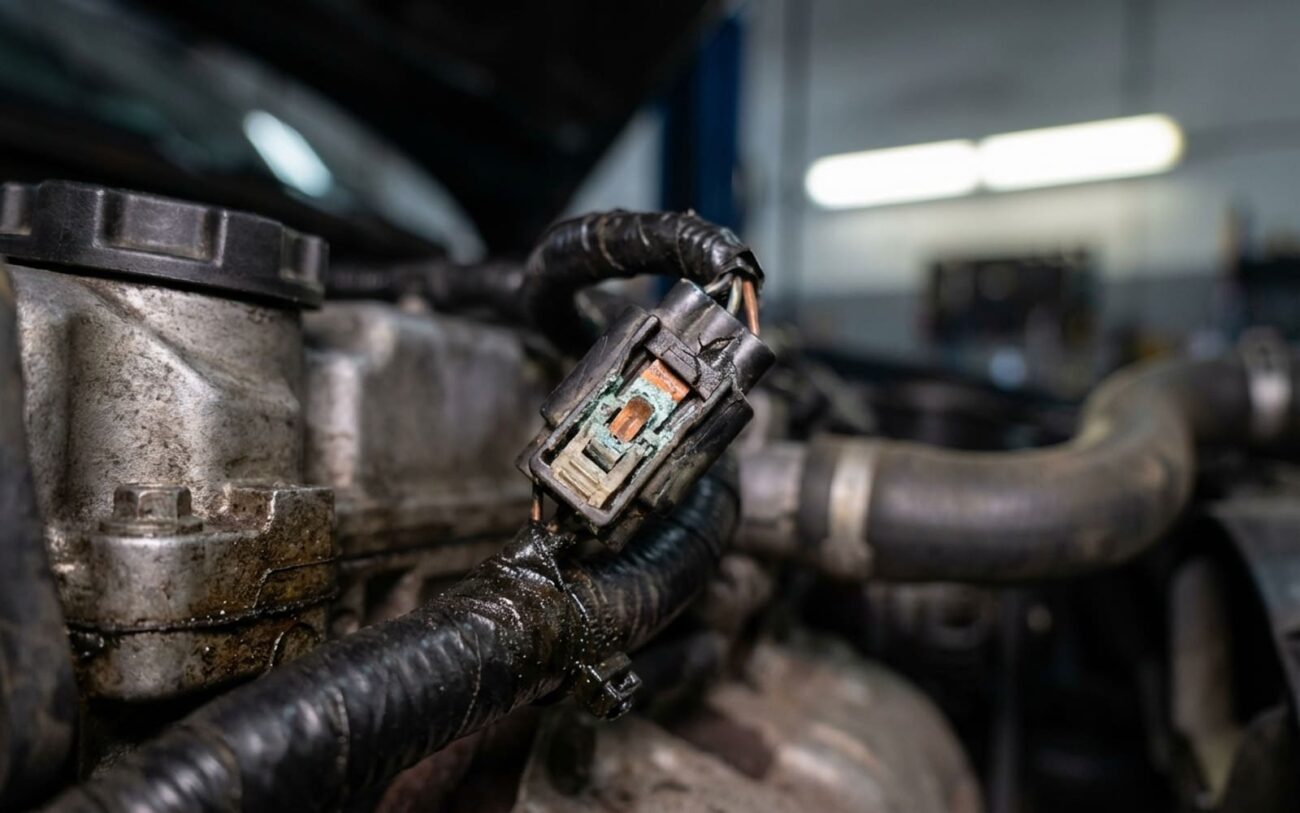
The main transmission harness connector is a prime suspect. It’s often exposed to road debris, heat, and moisture. Over time, corrosion loves to build up on those pins. I’ve replaced dozens of connectors where road salt or just plain moisture turned clean copper into a green, powdery mess. Wiring damage from chafing against sharp edges (like on the transmission case or frame) or, believe it or not, rodents chewing through wires, are also frequent culprits. Always check the harness carefully.
2. Network Electrical Faults: The CAN bus is a delicate system. It relies on proper termination resistance—usually two 120-ohm resistors at either end of the bus. If one of those resistors is missing or faulty, you get signal reflections, which corrupt the data. It’s like trying to talk in a room with a bad echo. Electromagnetic interference (EMI) can also be a problem. A failing alternator, for example, can put out so much electrical noise that it drowns out the digital signals on the bus. I’ve seen it happen.
3. Module Internal Failure: If you’ve ruled out power, ground, and the network itself, then you’re looking at an internal module failure. This means the TCM or ECM has a bad processor, a failed CAN transceiver chip, or some other internal component has given up the ghost. Before you condemn an expensive module, though, you must rule out everything else. I’ve seen too many brand-new modules replaced unnecessarily because someone skipped the basics.
Getting It Fixed: Resolution Pathways
This is Often Pro Territory
Internal network faults, especially, and module programming require factory wiring diagrams, a breakout box, and an oscilloscope. Most modern modules aren’t plug-and-play; they need VIN writing and calibration matching via specialized J2534-2 compliant tools. Don’t underestimate the complexity here.
External Connector Repair DIY Feasible
Wiring & Network Isolation Professional Only
Module Replacement & Programming
Post-Repair Validation: Don’t Skip This
My Validation Checklist
-
No U-codes return after three full ignition cycles. This is critical; sometimes codes are “soft” and need a few cycles to reappear.
-
All TCM and ECM data (RPM, speed, gear position) is plausible and consistent in live data. Look for any erratic readings.
-
A thorough 10-minute road test confirms smooth, timely shifts through all gears, including torque converter lock-up.
-
Any necessary clutch fill adapts and throttle learn procedures are completed without errors.
Cost, Risk, and Making the Call
| Repair Type | DIY Cost | Shop Cost | Success Rate | Secondary Risk |
|---|---|---|---|---|
| Harness Connector Repair | $30–$60 | $200–$500 | High | Recurring corrosion if not properly cleaned and sealed. |
| CAN Wiring Repair | $100–$300 | $500–$1,500 | Moderate | Incorrect splice or repair can introduce new network issues. |
| TCU/ECM Replacement | $1,000+ | $1,500–$3,500 | High | Improper programming or calibration will disable the car or cause new problems. |
Prevention & Monitoring
I always tell my customers to inspect the transmission harness regularly, especially for chafing near the oil pan or exhaust. A quick visual check of the main TCM connector for oil seepage or moisture can catch issues early. Intermittent communication faults often show up as stored or pending codes long before they become hard failures that put you in limp mode. Get those checked out!
