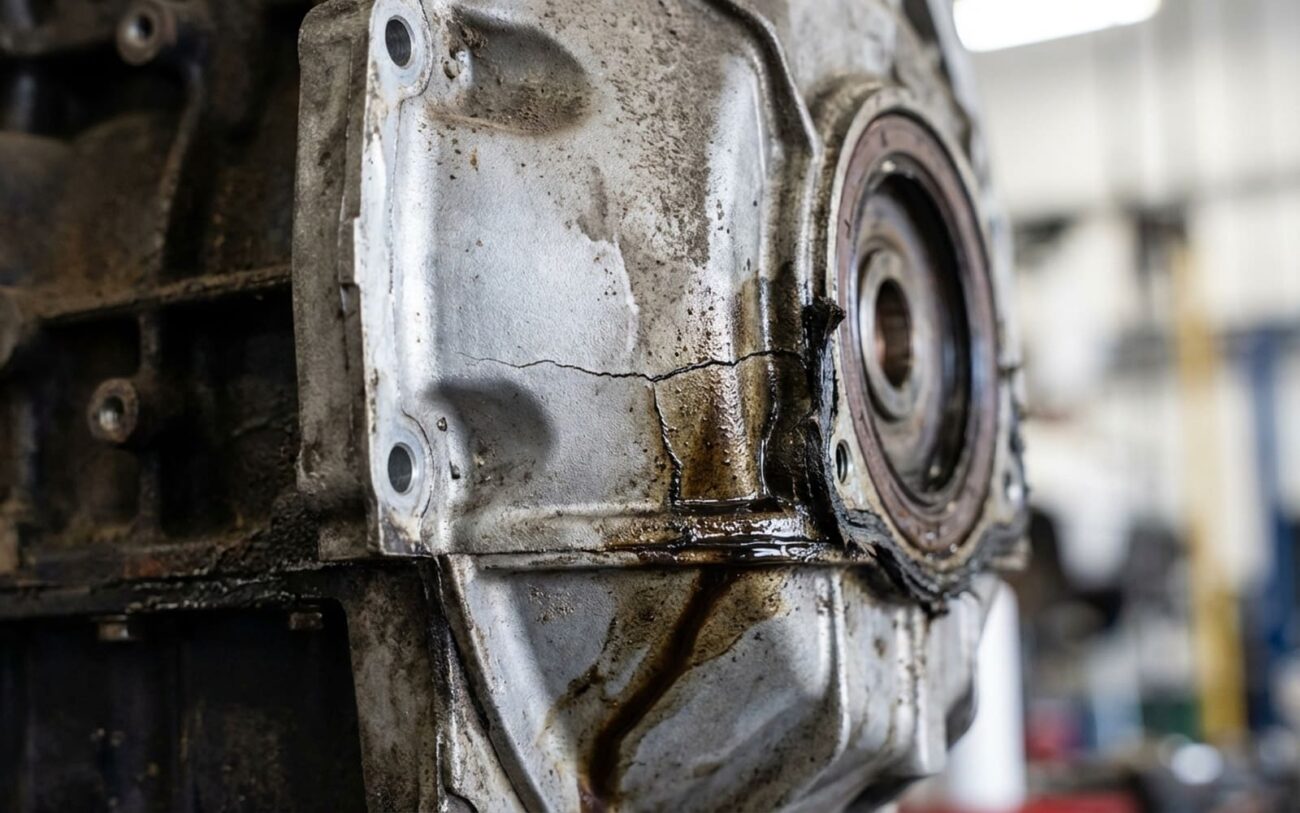
When a Crash Messes Up More Than the Paint: Powertrain Misalignment
You just had a fender bender, or maybe something a bit worse, and now your car feels… off. Not just a cosmetic issue, but a deep vibration, a shudder when you accelerate, or it just feels plain unsteady, even sitting still. I’ve seen this play out countless times in my 25+ years in the shop. People think it’s just a bent bumper, but often, that impact has twisted the car’s frame or unibody, throwing the whole engine and transmission out of whack.
These aren’t just quirks you can ignore. They’re often warning signs that the collision has compromised the structural integrity of your vehicle. Specifically, it can throw off how your engine and transmission are aligned with the rest of the chassis. It’s a problem that’s easy for a quick cosmetic repair to miss, but it’s critical to address.
Offset: 4.2mm
This dashboard shows exactly what I’m talking about. A 4.2mm offset might not sound like much, but when your engine and transmission are designed to sit perfectly square, even a few millimeters can cause major headaches. Here, the engine is clearly pulling against the right frame rail, which means constant stress on that side.
The Concept
“Think of it like trying to slide a drawer shut when the cabinet frame is twisted—it just won’t line up.”
What You’ll Feel: Recognizing the Symptoms
So, what does this misalignment actually feel like? The biggest giveaway is a strong, rhythmic vibration. You’ll feel it right through the floor, the seats, and the steering wheel. What really sets this apart from a simple driveline issue – like a bad U-joint or a worn tire – is that it’s there even when you’re stopped. If you’re sitting in Park or Neutral and you rev the engine, and the whole car starts shaking in time with the RPMs? That’s your powertrain telling you it’s not sitting right. It’s pulling against its mounts, fighting the structure of the car.
Another big red flag is abnormal shifting behavior. If you’ve got a manual transmission, the shifter might feel stiff, notchy, or just refuse to engage gears smoothly. Automatics might clunk harshly when you shift into Drive or Reverse. Usually, this isn’t a transmission failure itself; it’s geometry gone wrong. A bent subframe or a distorted unibody can shift the transmission’s position relative to the shift linkage or cable, making proper engagement a real struggle.
Diagnosing It Right: My Step-by-Step Approach
Before we jump to conclusions about a bent frame, we need to be smart. A lot of common mechanical problems can mimic powertrain misalignment, and I’ve seen too many people waste money chasing the wrong fix. My approach is always systematic: rule out the easy stuff first.
Common Symptoms & How I Pinpoint the Real Problem
Severe Powertrain Vibration (Idle & Load)
If you’ve got a severe vibration at idle and under load, and it feels like the whole powertrain is shaking, that’s a prime suspect for frame rail or unibody misalignment causing the engine and transmission to sit at an angle. But hold on – it could also be an imbalanced flexplate or flywheel, a failing torque converter, or even an internal engine imbalance.
The definitive test here is a 3-point powertrain alignment check using a laser alignment system. That’ll tell you if the engine and transmission are truly out of line with each other and the chassis.
Gear Engagement Issues with Vibration
For those gear engagement issues, where the shifter feels stiff or clunky, especially with a manual, it might be subframe distortion altering the transmission’s position relative to the shift linkage or cables. But don’t forget about a worn clutch, low transmission fluid, internal transmission wear, or damaged shift cables.
To really know, disconnect the shift linkage at the transmission and try to manually engage the gears. If it shifts smoothly by hand, your problem is external to the transmission itself, likely in the linkage or its mounting.
Driveline Vibration Varying with Load
And if you’re feeling a driveline vibration that changes with load – like when you accelerate – that could be a twisted chassis altering driveshaft operating angles and creating a harmonic imbalance. But again, check the basics first: worn U-joints, an imbalanced driveshaft, or damaged CV joints.
The real test? Get an inclinometer and measure those driveline angles. They need to be within spec. (You can find more on driveshaft vibration here.)
Why It Happens: How a Crash Twists the Metal
So, why does this happen? It’s not like a part just broke; it’s about the fundamental geometry of your vehicle. Most modern cars use unibody construction, where the body is the frame. When you have a collision, those crumple zones are designed to absorb energy. But sometimes, that energy gets redirected, twisting or bending the main structural members – the frame rails, the subframe, or even the strut towers – and that shifts the critical mounting points for your engine and transmission.
This is a critical point I hammer home to my customers:
A failed motor mount is almost always a symptom, not the actual disease. If the frame or subframe is bent, that mount is being constantly stressed and twisted into an unnatural position. It’s going to fail, and fail quickly. I can’t tell you how many times I’ve had a customer come in after replacing three sets of motor mounts in a year, completely baffled, only for us to put it on the frame rack and find the whole front end is out of whack. You’re just wasting money if you don’t fix the underlying structural issue.
The Fix: What a Real Shop Does (and Doesn’t Do)
Alright, so you’ve got structural damage. Can it be fixed? Sometimes. But let me be absolutely clear: this is NOT a DIY job. You need specialized equipment – computerized frame alignment systems, hydraulic pulling towers, and technicians who know how to use them – to safely restore factory dimensions. Trying to eyeball this or ‘persuade’ metal with a sledgehammer is a recipe for disaster and can make the car unsafe.
This is Professional Territory Only
Structural repair requires computerized frame alignment systems and hydraulic pulling equipment to restore factory dimensions safely. Do not attempt this at home.
After the Repair: How to Know It’s Done Right
So, the work’s done. How do you know it’s actually fixed? Don’t just take their word for it. You need proof. A reputable body shop should provide you with printouts from their computerized frame measurement system, showing the control points before, during, and after the repair. We’re talking about getting back to OEM tolerances, usually within a tight ±1.5mm. Anything more than that, and you’re still going to have issues.
My Post-Repair Checklist
-
Always insist on a pre-repair 3D frame measurement after any moderate impact.
-
When replacing structural components, make sure they’re using OEM parts; aftermarket stuff can have slight dimensional variations that mess everything up.
-
After the repair, verify that a four-wheel alignment can be completed within factory specifications. If it can’t, something’s still bent.
-
Keep an eye (and ear) out for any return of those vibrations or shifting problems within the first 500 miles post-repair. If they come back, you know the repair wasn’t complete.
The Hard Truth: Cost, Risk, and Making the Call
Now for the tough part: the economics. Structural repairs aren’t cheap, and the cost can vary wildly depending on the severity. Subframe realignments might run you $500 to $1,500. Sectioning a unibody rail? That’s easily $2,000 to $6,000, and often more. Major structural corrections can blow past $8,000. And even then, there’s a risk the car might never drive quite right again, or that new issues will crop up down the line.
| Repair Type | Typical Shop Cost | Success Rate (My Experience) | Secondary Risk if Not Fully Fixed |
|---|---|---|---|
| Subframe Realignment | $500 – $1,500 | High | Accelerated driveline wear, recurring vibration. |
| Unibody Rail Sectioning | $2,000 – $6,000+ | Medium-High | Corrosion, reduced structural integrity, future alignment issues. |
| Major Structural Correction | $8,000+ | Low-Medium | Vehicle may never drive smoothly; significant safety concerns. |
The 50% Rule I Use
This is why I always tell folks about the ‘50% Rule’: if the repair estimate is more than half of what your car was worth before the accident, you really need to think hard about whether it’s worth fixing. Insurance companies might not total it until 75% of the value, but you’re the one who has to live with a potentially compromised vehicle for years to come.
