I’ve been fixing blind spot monitoring systems for over 25 years—long enough to see the shift from mechanical mirrors to radar-guided safety nets. And let me tell you, when these systems start crying wolf, it’s not just annoying. It’s dangerous. Because once drivers stop trusting the warning light in the mirror, they’ll ignore it when a real threat shows up. That’s when accidents happen.
False Alerts? That’s Radar Talking
When your BSM lights up for a guardrail 50 feet away or oncoming traffic across the median, the system is broken. Period. These sensors are designed to detect vehicles within a tight cone—roughly 3 to 5 meters alongside and slightly behind you. Anything outside that range? It should ignore it. So if it’s flagging distant or stationary objects, the radar sensor is either failing, misaligned, or contaminated.
I see this constantly—especially on vehicles that have had rear bumper work. A sensor that’s off by just a few degrees will pick up cross-traffic or roadside barriers it should filter out. And no, it’s not “just being sensitive.” That’s a malfunction.
Diagnose Like a Pro—Don’t Guess
Before you touch a wrench, you need data. A cheap OBD2 scanner won’t cut it. You need a scan tool that can talk to the BSM module, pull live radar data, and run calibration routines. Without that, you’re just swapping parts and hoping.
Start with the basics: clean the sensor. I’ve had customers come in with full BSM failures—turns out the lens was caked in road salt. Use a microfiber cloth and ammonia-free cleaner. No pressure washers, no abrasive pads. The radome is delicate.
Then check for DTCs. Codes like “Radar Sensor Performance,” “Signal Plausibility,” or “Alignment Fault” are red flags. But don’t stop there. On the 2016–2020 Fusions, I’ve seen U3000 codes point to wiring issues, not the sensor itself. Always verify power, ground, and CAN signals at the connector using a multimeter and factory wiring diagram.
| Symptom | Likely Internal Sensor Faults | Common External Causes (Mimics) | Definitive Test to Confirm Source |
|---|---|---|---|
| False alerts for distant stationary objects | RF oscillator drift, damaged antenna array, signal processor failure | Misaligned bracket, non-OEM bumper cover, lens obscured by dirt or paint |
Perform static calibration with OEM targets. If it fails repeatedly and external factors are ruled out, the sensor is bad. Confirm with live data showing impossible range or signal strength. |
| DTC for “Radar Sensor Performance” | Failed voltage regulator, degraded RF components, circuit board damage | Chafed wiring, poor ground, failing control module |
Test power, ground, and CAN signals. If all are good but the code returns immediately, the sensor is defective. |
What’s Inside That Black Box?
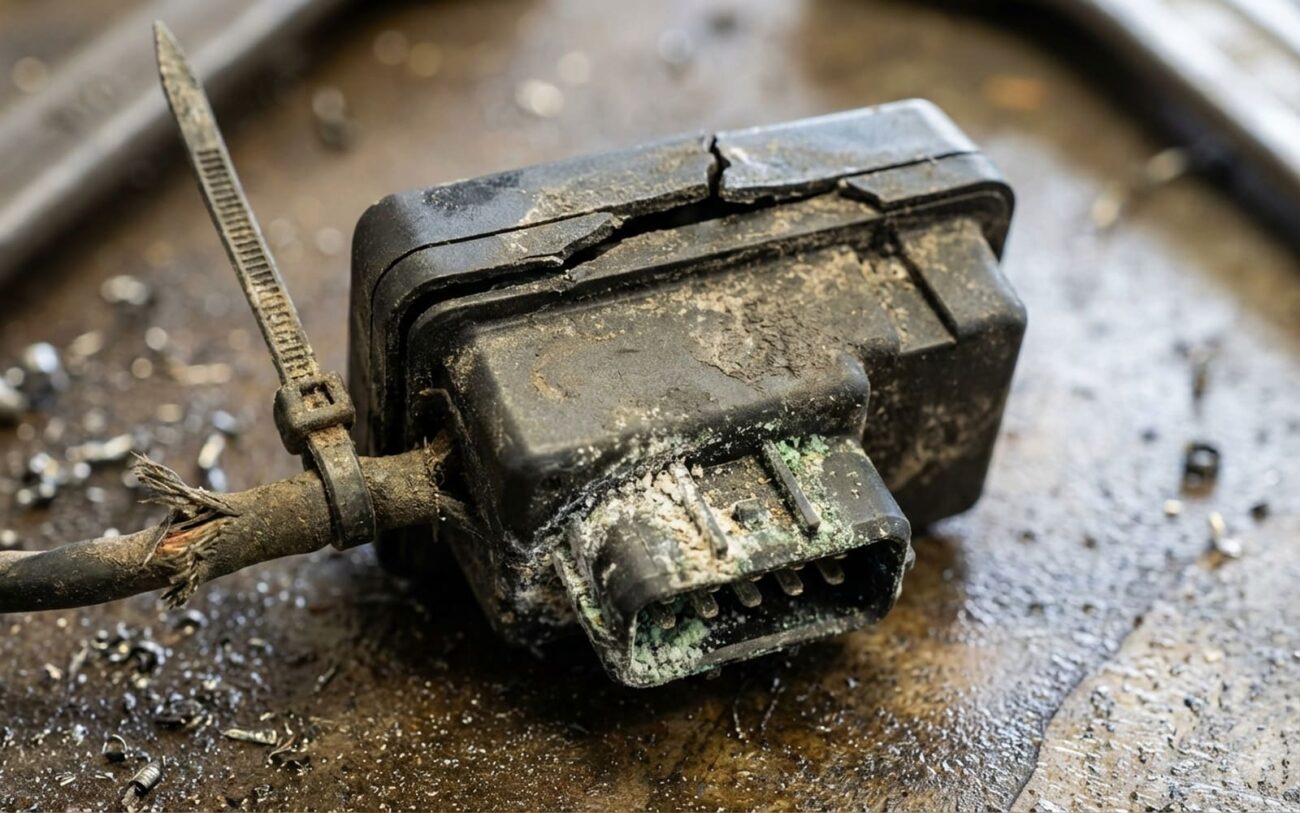
The radar sensor isn’t just a circuit board in a case. It’s a sealed unit with a radome designed to let millimeter waves pass through cleanly. If moisture gets in—common on rear bumper-mounted units after a deep wash or winter road spray—it’ll scatter the signal. I’ve pulled sensors apart (not for repair—just inspection) and found corrosion on the RF traces. That’s game over.
Thermal cycling kills these things over time. The sensor goes from -20°F to 140°F every day in some climates. Solder joints crack. Components drift out of spec. And a single pothole can shift the internal antenna array enough to throw off calibration—even if the bumper looks perfect.
Here’s the truth:
Most BSM failures aren’t the sensor’s fault. I’ve seen body shops reinstall bumpers a quarter-inch too high and wonder why the system’s blind. Or use thick paint that blocks radar transmission. And if the car’s been in a collision affecting rear alignment? Even a brand-new sensor won’t work right until the frame’s straightened. Always check the big picture first.
Fixing It Right
If cleaning doesn’t fix it and diagnostics point to internal failure, replacement is your only real option. These units are sealed. Don’t believe anyone who says they can “repair” the board. Opening it destroys the RF shielding and likely ruins the radome seal. It’s not worth the risk.
Installation is simple: two bolts (torque to 8 Nm), unplug the old, plug in the new. But here’s where most shops cut corners: calibration.
You need both static and dynamic calibration. Static means setting up alignment targets in a level, open space—usually 2 to 3 meters out, dead center. The scan tool guides you. Then, dynamic: a 15- to 30-minute drive with lane changes and passing traffic. Skip either step, and the system will misbehave. I don’t care if the light goes off—the data has to be clean.
This Is Not a DIY Job
The tools alone cost thousands. And without proper calibration, you’re driving with a false sense of security. If you’re not equipped, take it to someone who is.
If you’re not ready to replace it yet, disable the system in the driver assistance menu. But understand: you’re turning off a safety feature. From now on, you check your blind spot—every single time. No exceptions.
Did It Actually Work?
Don’t assume it’s fixed because the light’s off. Test it. Take a 30-minute drive: highway, city, roads with guardrails. The system should only alert when a vehicle is actually in your blind spot. No phantom warnings.
Then, scan it again. No DTCs. Live data should show smooth, logical updates as vehicles pass. If it says a car is 80 meters away when it’s right next to you, something’s wrong. Both road test and data check are mandatory. Skip one, and you might miss a failed calibration.
What’s This Gonna Cost?
Real talk: this repair isn’t cheap. You’re looking at $800 to $1,800 at a shop—parts, labor, calibration. The sensor alone can be $500–$1,200 depending on the make.
| Repair Type | DIY Cost | Shop Cost | Success Rate | Secondary Risk if Failed |
|---|---|---|---|---|
| Sensor Replacement & Calibration | Not Applicable (calibration tools and targets prohibit true DIY) | $800 – $1,800 (parts + labor + calibration) | >95% when using OEM-spec parts and proper calibration procedures | Recurring false alerts; failure to detect real vehicles; possible impact on adaptive cruise or lane-keeping if integrated. |
If the repair costs more than 40% of your car’s value, it might make sense to disable the system and rely on mirrors and head checks. But be honest with yourself: do you actually check your blind spot every time? Most people don’t. That’s why these systems exist.
How to Keep It From Happening Again
Prevention starts with awareness. During car washes, wipe down the sensor area—usually a smooth black panel on the rear bumper. No thick waxes, no vinyl wraps, no aftermarket paints over it. These block radar.
If your bumper gets repaired, insist on OEM materials. Some aftermarket covers use plastic blends that scatter radar. I’ve seen this on Accords and Camrys—new bumper, fresh paint, and suddenly the BSM’s blind. Switch back to OEM, and it works fine.
And if the system starts acting up after bodywork or a minor hit? Don’t wait. Get it checked. Early diagnosis can save you a $1,000 sensor down the road.
