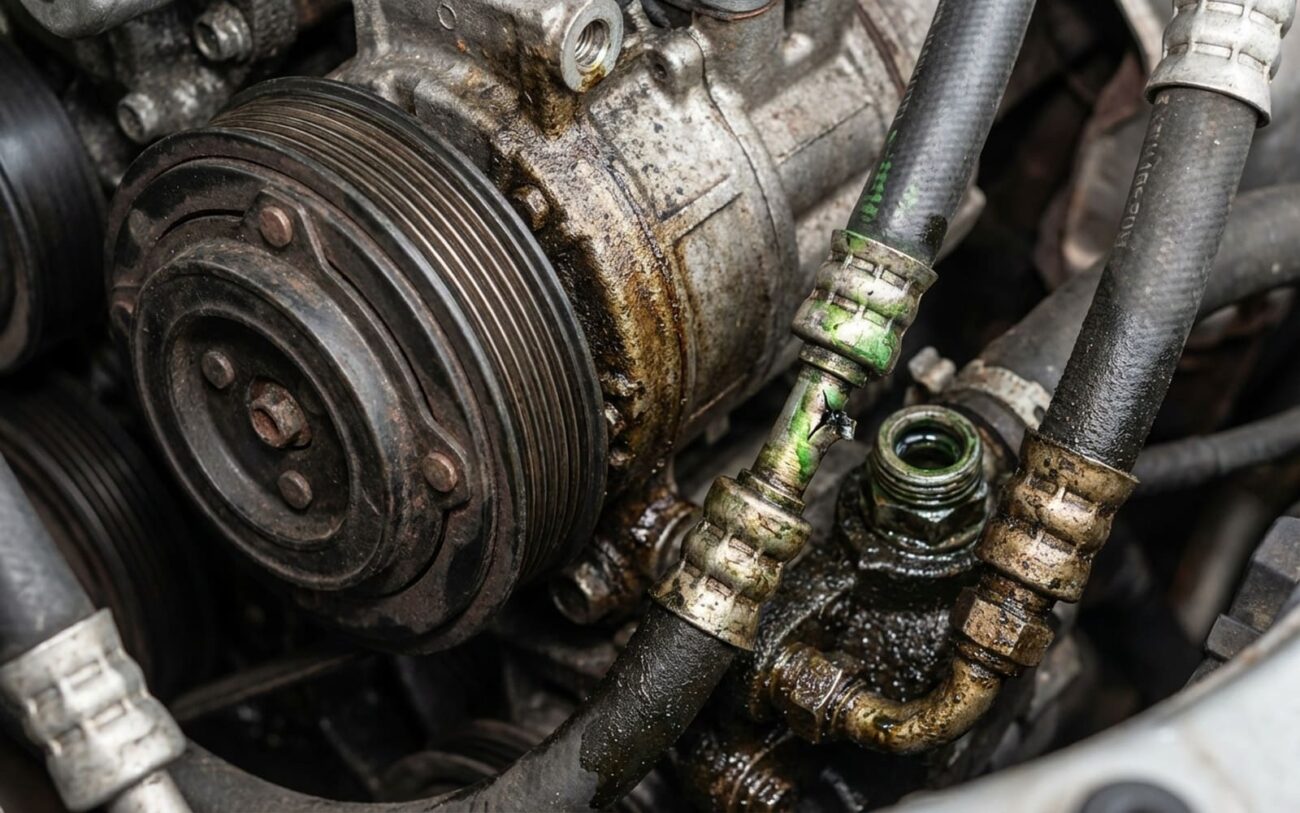
Alright, let’s talk about R1234yf systems and why you absolutely cannot put R134a in them. I know, that jug of 134a looks a whole lot cheaper, and maybe you just grabbed the wrong hose in a hurry. But trust me, that ‘bargain’ can turn into a multi-thousand-dollar nightmare faster than you can say ‘cold air.’ Modern automotive A/C isn’t just a simple mechanical loop anymore; it’s a sophisticated system managed by computers, and it knows when something’s off.
The Immediate Aftermath: What You’ll See
If your A/C worked for five minutes and then just quit, like it hit a brick wall, you’ve almost certainly got a cross-charge situation. What you’re seeing is usually the Refrigerant Control Module (RCM) or the main ECM throwing a big red flag. These systems are smart, really smart. They use highly sensitive Pressure/Temperature (P/T) sensors that are constantly feeding data to the computer.
R134a has a completely different pressure-to-temperature curve than R1234yf. So, when the computer sees, say, 110 psi on a 90-degree day, but it expects 125 psi based on what the ambient temp sensor is telling it, it knows something is chemically out of whack. It doesn’t just shrug it off; it triggers a permanent software lockout. This isn’t a bug in the system; it’s a built-in feature designed to protect expensive components, mainly the compressor seals and valves, from being utterly destroyed.
Sometimes, if you’ve really overcharged it with R134a, the system might run for a bit, but then you’ll trip a high-pressure cutoff. R134a can run significantly higher head pressures in a system tuned for R1234yf. I’ve seen it put an 11-out-of-10 stress level on the condenser and discharge lines. That’s just asking for trouble.
Diagnosing the Disaster: Is It the Gas or a Bad Part?
You can’t just guess here. Replacing a $600 compressor when all you’ve got is the wrong gas is a mistake you only make once. We need to figure out if it’s a true “failed part” or just “bad chemistry.”
| Symptom | Likely Cause (R1234yf System) | Common External Mimics | How I Confirm It |
|---|---|---|---|
| No A/C clutch engagement | Module Lockout DTC P1A90 / P053F |
Blown relay, bad clutch coil, wiring damage (rodents love wiring) |
Use a bidirectional scan tool. If you command the clutch “ON” but see zero volts at the compressor, that’s a module software block.
|
| Weak or “Laggy” cooling | Contaminated Refrigerant R134a Mix |
Dirty cabin filter, restricted condenser airflow, low charge (actual leak) |
Refrigerant Identifier: This is the only 100% way to know what’s in there. I use a Robinair 18970 in my shop.
|
| High side pressure spikes | R134a Overcharge / Incompatibility | Non-condensable air in system, cooling fan failure, restricted orifice tube/expansion valve |
Manifold gauges + OEM P/T Chart. If your pressures don’t track with the manufacturer’s chart, especially at idle, the gas is the culprit.
|
Why It’s So Bad: The Chemistry Lesson
I’ve heard guys say, “It’s all just cold air.” That’s old-school thinking that will absolutely cost you thousands. The chemistry inside these lines is delicate, and it’s not interchangeable. R1234yf is an HFO (Hydrofluoroolefin), while R134a is an HFC (Hydrofluorocarbon). They are different molecules entirely, and that difference matters a whole lot.
The Oil Incompatibility Nightmare
This is the real killer, the thing that turns a simple mistake into a total system meltdown. R1234yf systems almost exclusively use a very specific, highly refined POE (Polyolester) oil or a specialized, double-end-capped PAG-46/100. R134a, on the other hand, typically carries standard PAG oil.
When these two types of oil mix, or when R134a interacts with R1234yf-specific oil, it can create a chemical sludge. This “goo” loses its ability to lubricate the compressor’s critical components, like the swash plate. I’ve personally seen compressors seize solid in less than 50 miles of driving after a cross-charge. It’s not a slow death; it’s often sudden and catastrophic.
Seal Degradation and Material Science
Per SAE J2843 standards, the seals, O-rings, and internal hose linings in an R1234yf system are specifically “tuned” for that refrigerant. R134a, with its slightly different molecular structure, can actually permeate these seals or cause them to shrink. While it might not leak today, a cross-charged system is a ticking time bomb for a “slow leak” that you’ll never find with a standard UV light. It’s a headache waiting to happen.
The Fix: Getting the Poison Out
If you’ve confirmed there’s R134a in an R1234yf system, stop turning the A/C on. Immediately. Every second it runs is just more damage. Here’s how we get the “poison” out of the system, assuming the compressor hasn’t completely grenaded itself yet.
Full System Recovery (The Only Way) Professional Only
You absolutely cannot use your standard R1234yf machine to recover mixed gas. If you do, you’ve just contaminated your $5,000 machine and the $1,000 worth of virgin gas inside it. You need a dedicated recovery tank and a “dirty” recovery pump for contaminated refrigerant.
-
Step 1: Recover all gas into a scrap tank. This is hazardous waste and needs to be disposed of properly.
-
Step 2: Flush the entire system with Oxygen-Free Nitrogen (OFN). I like to do several “burst” flushes to really knock any stagnant, contaminated oil out of the low spots in the lines and evaporator.
-
Step 3: Replace the receiver/drier or desiccant bag. This is non-negotiable. The desiccant has already absorbed the wrong oil and moisture, and it’s now compromised.
-
Step 4: If the oil you recovered looks dark, or if you suspect significant contamination, you have to pull the compressor, drain it, and measure exactly what came out. Then, replace it with fresh, OEM-spec POE oil. Don’t guess on the amount.
-
Step 5: Perform a deep vacuum, pulling down to 500 microns. Let it hold for a good 15-20 minutes to ensure all moisture is boiled out. Then, recharge by weight (never by pressure alone) using pure R1234yf.
The “Total Loss” Scenario
If the compressor has already started making a “death rattle” – that tell-tale grinding or knocking sound – you’re looking at a full component replacement. This means the compressor, the condenser (which acts like a giant filter you can’t truly flush clean), and the expansion valve. Trust me on this: if you leave even a teaspoon of that R134a-tainted oil in the evaporator, it’ll kill your brand new compressor in six months. It’s just not worth the risk.
Proving It’s Fixed: Post-Repair Validation
Don’t just kick it out the door and hope for the best. You need to prove the system is healthy. In my shop, we use a three-tier “pass” criteria to make sure the job’s done right.
Validation Criteria
-
The 500-Micron Test: The system must pull down to 500 microns and hold that vacuum for at least 5 minutes with the pump off. If it rises, you’ve either got a leak or residual “boiling” refrigerant still lurking in the oil.
-
The Vent Temp Standard: At 1500 RPM, with 90°F ambient air, that center vent should be pumping out 40°F-44°F air. Anything higher than that means your efficiency is still compromised, and you need to investigate further.
-
The Scan Tool Reset: You MUST clear the “Incorrect Refrigerant” DTCs. On some European cars, you actually have to perform a “re-learn” or “adaptation” procedure for the A/C compressor regulator valve after a lockout event. Don’t skip this.
Cost, Risk, and the Economic Decision
Let’s be real: R1234yf is expensive stuff. A simple mistake, like a cross-charge, can turn what might have been a $150 “top-off” into a $3,000 overhaul. Here’s what the damage usually looks like at a reputable shop:
Evac, Flush, & Recharge
Success Rate: High (99%) if caught early. Risk if Ignored: Minor oil contamination might shorten compressor life, leading to future failure.
Full Component Replacement
Success Rate: Total (100%). Risk if Ignored: Financial pain, but the car is back to factory spec. This is usually the only option if the compressor is already damaged.
The “Old Car” Rule
If your car is over 10 years old and worth less than, say, $8,000, and you’ve “blacked out” the A/C system with the wrong gas and a failed compressor, you’re often better off trading it in or just living without A/C. The labor to pull the dash and properly flush the evaporator core often exceeds the actual value of the vehicle. It’s a tough call, but sometimes you have to cut your losses.
Prevention: Don’t Let It Happen
The best way to fix this whole mess is to never let it happen in the first place. R1234yf service ports are supposed to be different sizes, specifically designed to prevent cross-contamination. But I’ve seen people use hammers, “universal” adapters, or just sheer force to get an R134a hose on there. Don’t be that guy. Always read the yellow sticker under the hood. If you see “HFO-1234yf,” put the R134a can back on the shelf.
And for my fellow techs out there: never connect your expensive A/C machine until you’ve run a sample through a refrigerant identifier. People are putting all sorts of junk in these systems these days – propane, R134a, stop-leak concoctions. Protecting your machine is just as important as protecting the car, because if your machine gets contaminated, you’re out of commission and out a lot of money.
