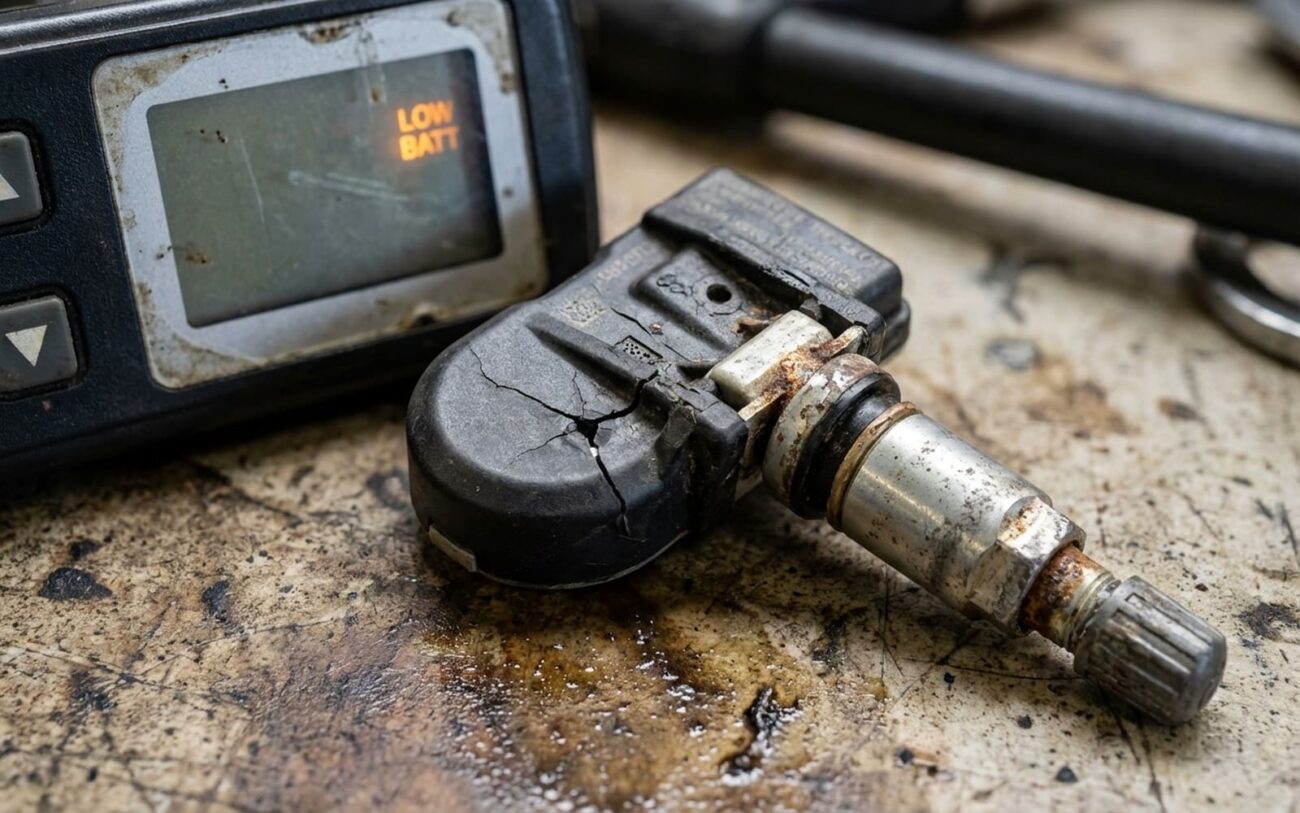
I’ve been turning wrenches for over 25 years, and TPMS issues? They walk through my bay door every other week. Most people think that warning light means a flat tire — and yeah, sometimes it does. But when you check the pressure and everything’s fine? That’s not a tire problem. That’s a dead sensor battery talking to you. And if you don’t know how to listen, you’re gonna waste time, money, and probably throw parts at it hoping something sticks. Let me save you the headache.
Symptoms That Scream “Dead Sensor”
If the TPMS light comes on and your tires are inflated to spec — verified with a calibrated gauge, not the one at the gas station — you’re not dealing with air loss. You’re dealing with electronics. Period.
Here’s what I look for:
-
Light is solid: likely a sensor with a dying battery. The ECU sees the sensor ID during startup, but data drops out intermittently. Classic lithium coin cell fade — can’t sustain transmission voltage.
-
Light flashes for 60–90 seconds after ignition, then goes solid: that’s a system fault code. One or more sensors aren’t communicating at all. Total blackout. Dead battery is top suspect.
-
Digital display shows “– –” or “N/A” on one wheel: this isn’t a slow leak. That sensor is silent. No signal. No data. It’s done.
And before you say it — yes, I’ve seen guys replace valve cores, rotate tires, reset the system a dozen times. Doesn’t fix it. Because the tire isn’t the issue. The sensor is.
Drive like this and you lose your early warning system. No alerts if a tire actually goes flat. You’re flying blind. I’ve pulled in customers with 18 psi on a rear tire — didn’t even know. Tread wear? Fuel economy? Handling? All suffering. And one pothole or highway stretch could mean a blowout.
How I Diagnose It — No Guessing
You can’t fix this with a $30 OBD2 scanner. That thing won’t talk to TPMS sensors. You need a real tool — something that sends low-frequency signals to wake up each sensor and read live data. I use a Schrader TPMS tool or an ATEQ VT56. Some high-end scan tools work too, but make sure they support sensor interrogation, not just code reading.
Here’s how I walk through it in the bay:
| Symptom | Likely Cause | Mimics | Definitive Test |
|---|---|---|---|
| TPMS light on, all tires at correct pressure | Dead or failing sensor battery | Slow leak at valve core, corroded circuit, impact damage |
Use TPMS tool. If sensor shows “no response” or “battery low,” it’s dead. If pressure reading drops slowly but signal is present, check for leak — valve stem or bead seal. |
| One tire shows “– –” or N/A | Dead battery in that sensor | Sensor damaged during mounting, wrong ID programmed, out of range |
Trigger sensor at the wheel with activation tool. No signal? Dead battery or physical damage. If it responds but car doesn’t recognize it, relearn needed. |
| Flashing TPMS light | Multiple dead sensors or system fault | Receiver module failure, broken antenna, system not relearned |
Scan all sensors. If some respond and others don’t, likely battery failure. If none respond, check receiver power, ground, and antenna. Also verify relearn was done after tire rotation. |
I can’t stress this enough: tool-based diagnosis prevents wasted labor. I once had a guy come in after replacing all four sensors — turns out his 12V battery had died and the TPMS system just needed a relearn. He’d thrown $600 at a $10 fix. Don’t be that guy.
Why the Battery Dies — And What’s Not the Cause
These sensors run on a small lithium coin cell — usually CR1632 or similar. Non-rechargeable. Sealed inside the unit. It powers the pressure transducer and radio transmitter, sending data every few minutes and during driving events. Designed for 5–10 years, but physics wins eventually.
The real killers?
-
Electrochemical exhaustion: The battery just wears out. No surprise there. Continuous low-current draw for years — it’s not built to last forever.
-
Increased internal resistance: Even if the battery reads 2.8V off-load, it can’t deliver peak current when the sensor tries to transmit. Voltage collapses. Signal fails. That’s why some sensors “come back” after sitting overnight — they recover under no load — but die again under driving conditions.
Critical clarification:
Water damage ≠ battery failure. If the sensor’s seal fails — from age, corrosion, or impact — moisture gets in and fries the circuit board. The battery might still have charge, but the sensor’s toast. That’s a physical failure, not a battery issue. Also, indirect TPMS (uses ABS wheel speed sensors) doesn’t have batteries at all — so if your car uses that system, this whole conversation doesn’t apply. And no — a leaking valve core won’t kill the battery. It’ll cause low pressure, sure, but the sensor keeps talking.
How I Fix It — Real Talk
Battery Replacement? Forget It.
I’ve seen techs try to replace just the battery. You have to break the crimp seal, desolder the old cell, solder in a new one, then reseal with high-temp epoxy. One slip — and the circuit board is junk. Even if you pull it off, the seal integrity is compromised. Moisture gets in, and six months later it fails again. Success rate? Less than 10%. OEMs like Schrader and Continental seal these for a reason. This is PROFESSIONAL-ONLY — and honestly, not worth the risk.
Replace the Whole Sensor DIY-FEASIBLE
This is the right move — and yes, you can do it yourself if you’ve got the tools. Here’s what you need:
-
OEM or quality aftermarket TPMS sensor (don’t cheap out — Denso, Continental, Schrader only)
-
TPMS service kit: rubber grommet, valve nut, nickel-plated valve core
-
Valve core tool
-
Torque wrench — 4–8 Nm. Over-tightening shears the stem. I’ve seen it happen.
-
TPMS relearn tool or access to the vehicle’s relearn procedure
Use proper tire mounting lubricant on the grommet — never silicone spray. It degrades rubber. And if you try to replace the battery and kill the sensor? NON-REPAIRABLE → REPLACE SENSOR.
As for temporary fixes? There aren’t any. You can drive with the light on — but you’re responsible for checking pressures manually every month. I’ve had customers promise they’ll do it — then show up with a shredded sidewall because they forgot. Don’t gamble.
Did It Work? Here’s How I Know
Replacing the sensor isn’t the end. You’ve got to validate it.
Step one: Operational check. Use a TPMS trigger tool at each wheel. All four sensors should respond with real-time pressure and temperature. Confirm the IDs match what you programmed.
Step two: System relearn. Follow the vehicle-specific procedure — could be via OBD2 tool, dashboard menu, or drive cycle. Drive above 25 mph for 10–20 minutes. TPMS light should go off. All pressures should display.
If it doesn’t work, don’t assume the sensor’s bad. Check:
-
Correct sensor ID programmed
-
Relearn sequence followed exactly
-
Receiver or antenna issues (rare, but possible — especially if all sensors are dead)
Your tools are just as important as your torque wrench. Without them, you’re guessing.
Cost vs. Risk — How I Decide
| Repair Type | DIY Cost | Shop Cost | Success Rate | Secondary Risk |
|---|---|---|---|---|
| Attempt Battery Replacement | $10–$30 (battery + tools) | N/A | <10% |
Complete sensor failure — now you’re buying a new one anyway. |
| Full Sensor Replacement (DIY) | $50–$150 per sensor + $100–$500 for TPMS tool | $100–$250 per sensor | >95% |
Over-torquing damages stem; incorrect relearn leaves system dead. |
| Full Sensor Replacement (Shop) | N/A | $100–$250 per sensor | >98% |
Minimal — assuming they know what they’re doing. |
Here’s my rule: if replacing all four sensors costs more than 40% of the car’s current value, replace them one at a time as they fail. You’ll live with the light between fixes — but you’re not over-investing in a car that’s on its way out. Just promise me you’ll check pressures monthly. That’s not optional.
Always check your EV battery warranty status before authorizing repairs.
Can You Prevent This? Not Really — But You Can Plan
These sensors are sealed. No maintenance. No battery swaps. Lifespan is 5–10 years, depending on climate and use. But you can stay ahead of it.
When new sensors go in — with new tires or a repair — write down the date. Start checking battery health around year 7. Every tire rotation, ask the shop to run a TPMS system check. Most modern TPMS tools can read battery voltage or flag “low battery.” If it’s below 2.5V, replacement is coming.
This isn’t expensive. Often included in premium service packages. But it stops surprise failures. Don’t wait for the light. By then, you’re already driving unprotected.
