Alright, let’s talk about EV range in winter. I’ve been turning wrenches for over 25 years, and with EVs becoming more common, I see a lot of folks get worried when the mercury drops. The thing is, most of what you’re seeing with reduced range isn’t a problem; it’s just physics at work. But sometimes, it is a problem, and knowing the difference can save you a lot of headache—and money.
The Cold Truth: Normal Winter Range Loss vs. Real Trouble
Look, if your EV’s range drops by 40-50% when it’s below 20°F, that’s not a glitch. That’s just how these things work in the cold. The main reason isn’t a bad battery; it’s your battery thermal management system doing its job. Lithium-ion batteries, like the ones in your EV, are happiest around 77°F (25°C). When it gets cold, they just don’t perform as well—internal resistance goes up, and they can’t accept a charge as efficiently.
To combat this, the car fires up the battery heater. And let me tell you, that thing pulls some serious juice. We’re talking 3–7 kW, sometimes for quite a while after you start up or when you precondition the car. That energy draw shows up directly on your trip computer. You might see your efficiency drop from your usual 3.5–4.0 mi/kWh down to 2.0–2.5 mi/kWh. That’s not a fault; it’s the system keeping your expensive battery healthy.
You might also hear a low hum from under the car, especially after a cold start. A lot of owners panic, thinking something’s broken. But in most cases, that’s just the PTC (Positive Temperature Coefficient) heater in the battery coolant loop doing its thing. It’s a good sound, actually. It means the system is alive and protecting your battery. If you didn’t hear it when it’s cold, then you’d have bigger issues, like not being able to fast charge.
Isolating the Problem: Battery Heater vs. Everything Else
Now, not all winter range loss is the battery heater. Before you point fingers, you’ve got to rule out other big power consumers. The cabin heater, especially if it’s a resistive PTC type, can pull even more power than the battery heater—sometimes up to 9 kW. Add in the extra drag from winter tires, reduced regenerative braking (because a cold battery can’t take much charge), and even snow buildup, and suddenly that big range drop makes perfect sense, even if every system is working perfectly.
The trick is to figure out what’s drawing power. In my shop, I use an OBD-II scanner that can read OEM-specific PIDs (Parameter IDs). This lets me see real-time power draw for both the battery and cabin heaters. If I see 5–7 kW going to the battery heater after a cold start, that’s normal. But if the cabin heater is pulling 8 kW and the battery heater is at 0 kW, then your range loss is almost certainly HVAC-related, not a battery system issue.
Here’s a quick reference for what symptoms usually mean what:
| Symptom | Points to Battery Heater (Normal) | Common Mimics (Other Issues) | How I Confirm |
|---|---|---|---|
| High Energy Consumption & Range Loss | Heater is working hard (3–7 kW) to warm a cold battery. | 1. Cabin HVAC PTC heater (5–9 kW). 2. Winter tires, snow drag. 3. Limited regen braking. |
Tool: OEM-capable OBD-II scanner. Test: Monitor Battery Heater Power (kW) and Cabin Heater Power (kW).
|
| Audible Humming from Undercarriage | PTC battery heater is energized, heating coolant. | 1. Battery coolant pump. 2. Heat pump compressor. 3. Transmission/motor oil pump. |
Tool: Stethoscope. Test: Pinpoint sound to battery coolant manifold. Command heater OFF via PID to see if sound stops. |
| Slow DC Fast Charging Speed in Cold | Battery heater FAILURE: Can’t get battery to optimal ~77°F (25°C), limiting charge acceptance. | 1. DC charger limitations. 2. High state of charge (SOC >80%). 3. BMS software derate. |
Tool: OBD-II scanner. Test: Check Battery Heater Power. If it shows 0 kW and temp isn’t rising during charging, it’s failed.
|
When the Battery Heater Actually Fails: Root Causes
Okay, so you’ve confirmed the heater isn’t just working hard, it’s actually dead. What usually happens? In my experience, it almost always comes down to an electrical issue. The PTC heating element itself goes through a lot of thermal cycling—heating up, cooling down, over and over. That stress can cause the ceramic element to crack, leading to an open circuit. When that happens, you lose all heating function, and the BMS (Battery Management System) will throw a fault code like P0E1F00: High Voltage Heater for Battery Open Circuit. I’ve seen this code enough times on VW ID.4s that there are even service bulletins about it, often pointing to moisture getting into the connector.
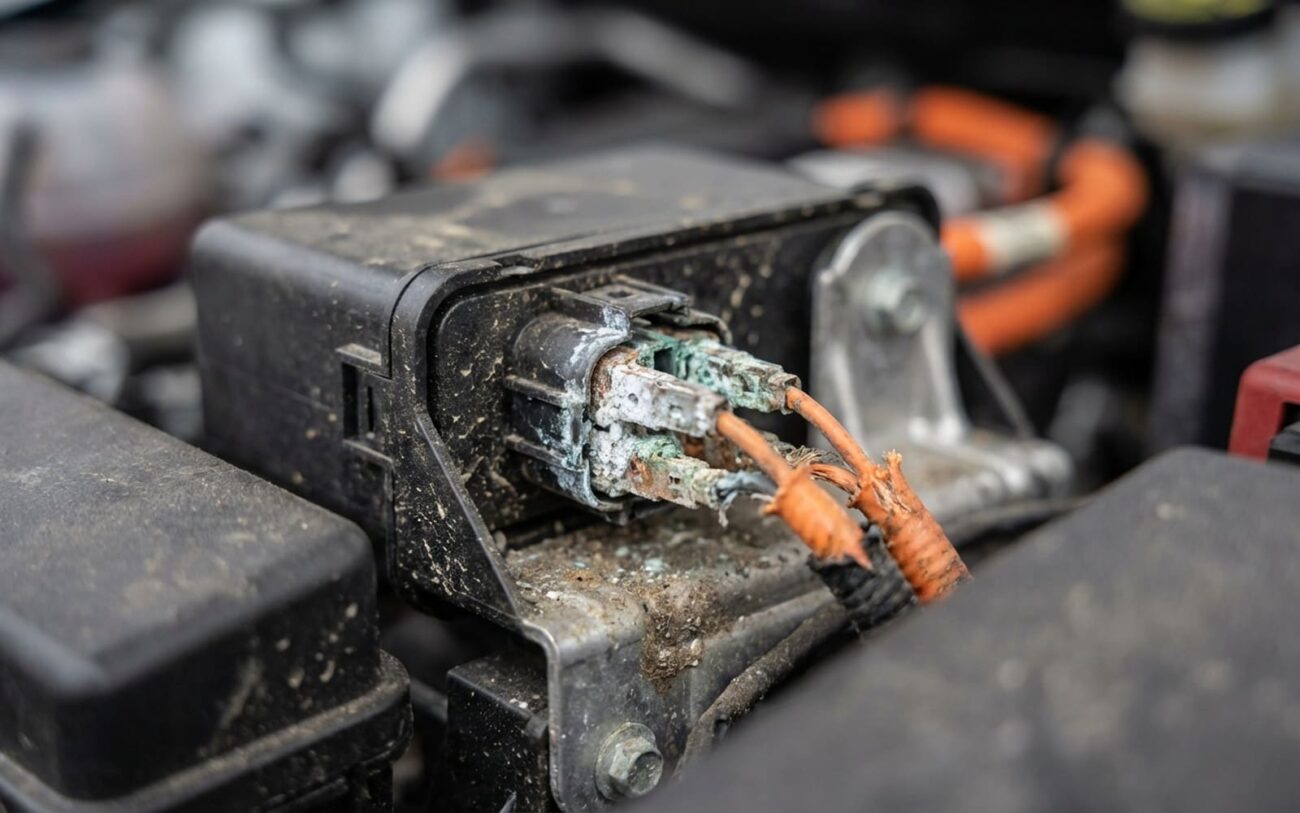
Another failure I’ve seen is an internal short. If the insulation around the high-voltage terminals degrades, the element can short to ground. The BMS is smart enough to detect this and will disable the heater for safety. And don’t forget connector corrosion. Especially in places that use a lot of road salt, or if coolant leaks past a seal (which isn’t uncommon in some thermal loop designs), that can corrode the electrical contacts. I’ve had cars come in where the heater itself was fine, but the connector was soaked and corroded, breaking the circuit.
Important Distinction:
A dead heater means the heating element or its immediate electrical circuit is compromised—either open, shorted, or disconnected. Low coolant, a failed coolant pump, or software limiting the heat? Those are system-level issues, not a failed heater. Don’t confuse them.
Fixing It Right: This is a Pro Job
WARNING: HIGH VOLTAGE SYSTEM – PROFESSIONAL ONLY
If you’ve confirmed an internal heater failure, the repair path is clear, but it is absolutely NOT for the DIYer. You’re dealing with circuits that can deliver lethal current. Improper handling risks electrocution, serious injury, or fire. Even disconnecting the service plug doesn’t eliminate all risk; capacitors in the system can hold a charge for a long time. Don’t mess with this unless you’re trained and properly equipped.
Full Assembly Replacement Professional Only
Connector or Seal Service Professional Only
Is there a temporary fix for a dead heater? No. If it’s dead, the battery stays cold. That means you’ll have severely limited DC fast charging, reduced power output in cold weather, and you’re potentially setting yourself up for long-term battery degradation if you keep charging it cold. You can drive the car, but its winter usability takes a serious hit.
Post-Repair: Trust, But Verify
Putting in a new part isn’t the end of the job; it’s just the beginning of making sure everything works right and, more importantly, is safe. Here’s what I always do:
-
Confirm Functionality: Get the battery cold, say below 50°F. Then use your scanner to watch the
Battery Heater PowerPID. You should see an immediate draw—3–7 kW—and the minimum battery temperature should climb steadily, about 1–2°C per minute, until it hits its target. -
Safety Verification: Perform a high-voltage insulation resistance test. This is critical. The reading needs to be above 10 megaohms. Anything lower means you’ve got a potential ground fault or moisture in the system, and that’s a huge problem.
-
Pressure-Test the Loop: I’ll hold 1.5 bar of pressure for at least 30 minutes, looking for any drop. Air in the coolant loop is a killer; it causes poor heat transfer and can lead to overheating. I’ve seen techs skip this, and the car comes back weeks later with a “thermal runaway” warning, all because of a tiny air pocket they missed.
The Bottom Line: Cost, Risk, and Making the Call
Let’s talk money, because this isn’t a cheap fix. And given the risks involved with high voltage, it’s not a place to cut corners.
| Repair Type | DIY Cost | Shop Cost | Success Rate | Secondary Risk if Failed |
|---|---|---|---|---|
| Full Battery Heater Assembly Replacement | N/A (HV Risk) | $1,800 – $3,200 | >95% | Fatal shock, fire, or thermal runaway from improper HV handling. |
| Connector/Seal Service per TSB | N/A (HV Risk) | $300 – $600 | >80% | Intermittent connection, arcing, or recurring fault codes. |
| No Repair (Operate as-is) | $0 | $0 | N/A | Severely limited DC fast charging and potential long-term degradation. |
The decision usually comes down to your warranty and how you use the car. If it’s still under the 8-year/100,000-mile battery warranty, this repair should be covered, no question. If not, you need to ask yourself: do you rely on long-distance winter driving or regular DC fast charging? If so, living with a failed heater just isn’t practical. Some folks try to work around it by preconditioning the battery using grid power before they leave—that’s a smart move for improving cold weather range overall. But if you’re regularly hitting those DC fast chargers in cold climates, a working battery heater isn’t optional; it’s absolutely essential.
Keeping It Healthy: Prevention and Monitoring
You can’t stop a PTC heater from eventually failing entirely; it’s a high-stress component, it’s going to happen eventually. But you can definitely extend its life and catch issues early. First off, always, always use the OEM-specified coolant. Mixing fluids or skipping changes can lead to internal corrosion, degraded seals, and those connector failures I mentioned. For a lot of EVs, including the VW ID.4, that means G65 coolant, and you need to follow the factory service intervals.
For monitoring, get comfortable with your car’s energy flow display. On a cold morning, you should see power being directed to the battery for heating, even before you start driving. If it’s 20°F outside and that display shows zero battery heating, that’s your first red flag. Pair that with slow DC charging in winter, and you’ve got a strong indicator that the heater has failed.
Pro Tip: Keep Your Software Updated
Lastly, keep your car’s software updated. Automakers like Volkswagen are constantly refining the battery thermal management system through over-the-air updates. These tweaks can improve heater efficiency, optimize preconditioning, and even adjust regenerative braking limits based on battery temperature. I’ve seen updates that restored 10–15% of perceived winter range just by improving how the system manages heat distribution. It won’t fix a failed heater, but it’s one of the best ways to maximize your EV’s range in cold weather without spending a dime.
Understanding the difference between normal winter range loss and a genuine hardware failure is crucial for any EV owner. While the battery heater is a high-stress component that will eventually fail, proper monitoring and timely professional intervention can keep your vehicle performing safely and efficiently through the coldest months of the year. Don’t guess; diagnose it right.
