Renault dCi Power Loss? DPF or EGR Light On? Let’s Get Real About It.
Alright, if you’re driving a Renault 1.5 or 1.6 dCi and it feels like it’s running on fumes, or you’ve got that DPF or EGR light staring you down, you’re in good company. I’ve been turning wrenches on these engines for decades, and I can tell you, these aren’t just random hiccups. They’re usually a direct result of how these modern diesel emissions systems are designed to work – or, more accurately, how they struggle with real-world driving conditions.
The Diesel Particulate Filter (DPF) and the Exhaust Gas Recirculation (EGR) system? They’re supposed to be a team. But when one starts acting up, it almost always drags the other down. And yeah, these dCi engines, especially the 1.5 and 1.6, seem to be particularly prone to it. Short trips, wrong oil – these are the usual suspects. I’ve seen this pattern play out hundreds of times in my shop.
The good news is, we can usually get to the bottom of it and fix it right. The bad news? If you ignore those lights and that loss of power, you’re looking at repair bills that can easily make you question if the car’s even worth it. So, let’s talk about what’s really going on and what you can actually do.
First, Let’s Understand Why These Things Break
Before we dive into symptoms and fixes, it’s critical to understand the root causes. These failures aren’t just bad luck; they’re often a consequence of design compromises inherent in modern diesel emissions control, especially on engines like your Renault 1.5 or 1.6 dCi.
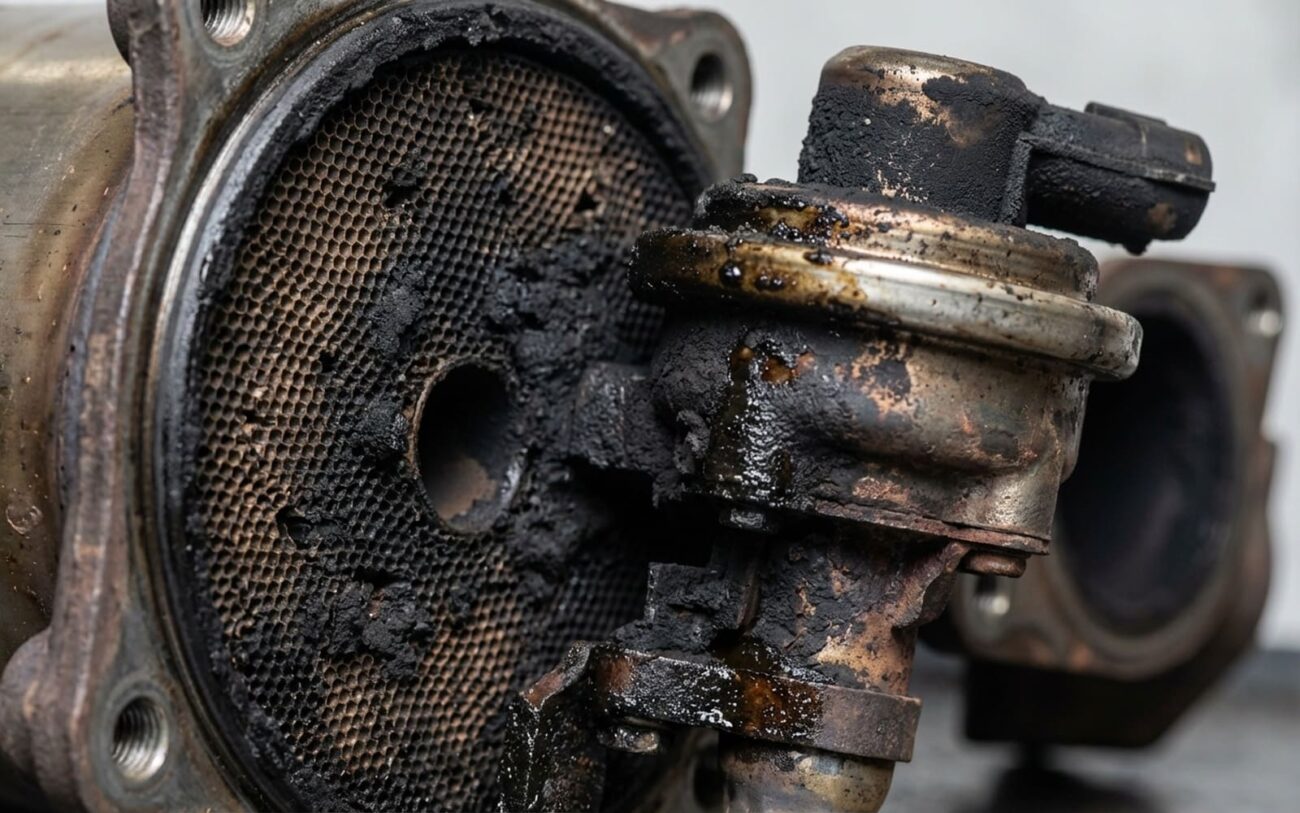
For the DPF, it almost always boils down to two things: oil ash and failed regeneration cycles. That ash? It comes from engine oil additives. If you’re not running the specific Renault RN0720 low-ash (low-SAPS) oil, you’re leaving behind non-combustible residue every time the engine burns even a tiny bit of oil. Over time, that ash builds up in the DPF – and unlike soot, you can’t burn ash off. Once it hits about 60 grams per liter, that filter is pretty much done for.
Then there’s thermal damage. Short city trips are a DPF killer. The engine never gets hot enough, long enough, for passive regeneration to happen. So the ECU tries active regenerations more often. But if those cycles are constantly interrupted or never completed, soot builds up, temperatures spike, and you end up with a melted or cracked ceramic substrate. I’ve seen it more times than I can count – a $1,500 part becomes a $3,000 problem because someone kept driving with the light on.
EGR problems? They’re a different beast, but just as nasty. The EGR cooler takes hot exhaust gas and chills it before sending it back into the intake. That cooling creates condensation, which then mixes with soot. What do you get? A thick, corrosive sludge that clogs up the cooler’s tiny passages and gums up the EGR valve itself. The valve is constantly opening and closing, exposed to extreme heat and carbon, so wear and sticking are inevitable.
And here’s a nasty one: a cracked EGR cooler. If the internal core cracks, it leaks coolant directly into the exhaust stream. That’s not just bad for your coolant level; it’s a recipe for disaster for the DPF and even the turbocharger. It’s a vicious cycle: EGR issues lead to more soot, which then clogs the DPF faster. See? They’re always connected.
My Two Cents on Driving Habits:
Look, I see this problem most often on cars used for short city commutes. Low engine temps, poor-quality diesel – it all adds up. And remember, when one of these systems starts to fail, it puts extra stress on the other. It’s a domino effect.
Symptoms: What Your Car Is Telling You (And What It Really Means)
Okay, so you’ve got a warning light or a performance issue. The DPF and EGR can cause similar problems – reduced power, warning lights – but the underlying causes are different. Knowing the typical symptoms helps you narrow it down before you even plug in a scan tool.
DPF issues usually scream “restriction.” The most obvious sign is the DPF warning light itself, or sometimes just the generic check engine light. If you scan it, you’ll likely see codes like P2002 (DPF efficiency below threshold), P242F, or P2463. These are all pointing to a blocked filter. When you’re driving, the car feels like it’s struggling to breathe: reduced power, hesitation, and often it’ll drop into limp mode. This isn’t just annoying; it’s the engine control unit (ECU) trying to protect itself from dangerously high exhaust backpressure.
EGR problems present differently. You’ll often notice a rough or unstable idle, especially when the engine is cold. There might be a shudder, almost like a misfire, and sometimes you’ll see darker exhaust smoke because of incomplete combustion. The engine might smooth out a bit once it warms up, but the ECU will usually log codes like P0401 (insufficient EGR flow) or P0402 (excessive flow). A common scenario is a stuck-open EGR valve, which dumps too much exhaust gas into the intake at idle, diluting the air-fuel mix and causing poor running. This extra soot, by the way, goes straight into the DPF, accelerating its clogging. See? They’re always connected.
Real Diagnosis: Don’t Just Replace Parts, Test Them Properly
This is where most people go wrong. They see a code, they replace the part. But a lot of DPF and EGR issues are misdiagnosed because the real culprit is a sensor, a hose, or just carbon buildup somewhere else. You need to rule out the mimics before you start throwing money at it. Here’s how I approach it in the shop.
Diagnosing DPF Issues
For DPF codes like P2002, P242F, or P2463, the first thing I’m looking at is backpressure. The car thinks the filter is blocked, but is it really? Or is the sensor lying?
| Symptom / DTC | Likely DPF Component Issue | Common External Mimics | Definitive Test to Confirm |
|---|---|---|---|
| P2002 / P242F / P2463 | Ash-loaded or damaged filter substrate | Faulty differential pressure sensor, exhaust leaks before/after DPF |
Attempt a forced regeneration with a capable scan tool. Monitor the differential pressure. If you’re seeing over 25 kPa at 2,500 RPM, even after a regen attempt, you’ve got a physical blockage. |
| High pressure reading at low soot mass | Internal blockage or cracked substrate | Blocked, kinked, or leaking pressure sensor hoses |
This is a classic. Swap the two small hoses on the DPF pressure sensor. If the high-pressure reading suddenly shifts to the other side, your problem is in those hoses or the sensor itself, not the DPF. I’ve caught so many false positives this way. |
Diagnosing EGR Issues
For EGR problems, it’s rarely just the valve. Carbon buildup in the intake manifold or a failed cooler can mimic valve failure perfectly. You need to isolate the problem.
| Symptom / DTC | Likely EGR Component Issue | Common External Mimics | Definitive Test to Confirm |
|---|---|---|---|
| P0401 (Insufficient Flow) | EGR valve stuck closed or cooler clogged with carbon | Carbon buildup in intake manifold or ports |
Command the EGR valve open at idle using your scan tool. If the engine RPM doesn’t change or barely stumbles, you’ve got a blockage. Now you need to determine if it’s upstream (cooler) or downstream (intake manifold). |
| P0402 (Excessive Flow) | Valve stuck open or internal leak | Faulty EGR position sensor or wiring |
Command the valve closed. If the idle remains rough, you’ve got a leak. I usually apply low-pressure air to the EGR outlet and listen for air escaping, or use smoke to find the exact leak point. |
| Coolant loss with no external leak | Internal crack in EGR cooler core | Cylinder head gasket failure or cracked head (yes, this happens) |
Pressure test the cooling system. If you see coolant seeping from the exhaust side of the EGR cooler, or even just smell it in the exhaust, that cooler is cracked. |
Repair Options: What I’ve Seen Work (And What’s a Waste of Time)
Once you’ve definitively diagnosed the problem, it’s time to talk solutions. Your choices range from quick fixes to full-on replacements, and the best path depends on the exact condition, your budget, and how long you plan to keep the car. Just remember, some of these jobs are definitely in professional territory.
DPF Repair Strategies
If your DPF is clogged with soot but the ceramic substrate is still intact and the ash levels aren’t too high, professional off-vehicle cleaning can be a lifesaver. Shops use specialized thermal baking and chemical flushing to get rid of the buildup. But I’m going to be realistic with you: cleaning won’t fix a filter that’s heavily loaded with ash or physically damaged. If the substrate is melted, cracked, or the ash mass is simply too high, you’re looking at replacement. There’s no magic bullet for ash.
When replacing a DPF, pay close attention to installation. Torque matters. The turbo-to-DPF clamp needs to be at 25 Nm, and the mounting brackets at 40 Nm. And make sure you follow the correct sequence. Get that wrong, and you’ll be chasing exhaust leaks or vibration damage down the road.
EGR Repair Strategies
For the EGR valve, if it’s just gummed up with carbon, you can try removing it, cleaning it with a dedicated cleaner, and reinstalling it with a new gasket (torque bolts to about 10 Nm). But in my experience, this is often a short-term fix. The valve was already worn, and cleaning doesn’t fix internal mechanical wear. A new valve is almost always a more reliable, long-term solution.
If the EGR cooler is clogged or, worse, leaking internally, that’s a much bigger job. It means draining the coolant, removing the intake manifold, and careful reassembly. When you put the new cooler in, torque it to the cylinder head at 25 Nm in a criss-cross pattern. You don’t want to warp it.
Temporary Measures & What to Avoid
Can you use additives? A good quality diesel fuel additive can help keep injectors and EGR passages cleaner, sure. But it won’t magically free a stuck valve or unclog a cooler that’s already packed with carbon. For the DPF, a long highway drive might trigger a regeneration if the system is still somewhat functional – but if that DPF light is solid, the ECU has likely given up trying. At that point, a forced regeneration via a capable scan tool is the next step, but again, that’s not going to fix physical damage or excessive ash loading.
And please, whatever you do, don’t fall for “DPF delete” or “EGR blanking” kits. They’re illegal in most places, horrible for the environment, and will cause you endless headaches with emissions tests and potential fines. Not to mention, they often mess with the engine’s tuning in ways that cause other problems down the line.
Verifying the Fix: Don’t Skip This Step!
This is non-negotiable. A repair isn’t truly done until you’ve confirmed it actually fixed the problem and didn’t just clear a code. I always tell my apprentices: trust, but verify.
DPF Post-Repair Checks
After any DPF cleaning or replacement, you absolutely need to perform a forced regeneration using a capable scan tool. While it’s running, monitor the differential pressure across the filter. A healthy, properly functioning DPF should show less than 15 kPa at 2,500 RPM under load. The ECU’s calculated soot load should also reset to near zero. If that pressure stays high, or the soot load doesn’t reset, you still have a blockage or a sensor issue that needs addressing.
EGR Post-Repair Checks
Once an EGR valve or cooler has been replaced (or even just cleaned), clear the ECU adaptations. Then, run an actuation test with your scan tool. The actual valve position should match the commanded position within a tight 3–5% margin across its full range of motion. Here’s a good real-world test: command the EGR valve to about 50% opening at idle. The engine RPM should drop by 100–200 RPM – that’s your proof that exhaust gas is actually flowing and being recirculated as intended.
If you replaced the EGR cooler, you’ve got another critical step: perform a 20-minute cooling system pressure test at 1.2 bar. You’re checking for any internal leaks. No pressure loss after 20 minutes? Then you’re good to go.
The Hard Truth: Is This Repair Even Worth the Money?
This is often the toughest conversation I have with customers. The cost of these repairs, especially if both systems are involved, can quickly start to rival or even exceed the car’s market value. You need to be brutally honest with yourself here.
DPF Repair Costs & Risks
| DPF Repair Type | DIY Cost (Approx.) | Shop Cost (Approx.) | Success Rate (My Observation) | Secondary Risk |
|---|---|---|---|---|
| Professional Cleaning | N/A (Specialized equipment needed) | $300 – $600 | 70–80% (If ash load is low) | Discovering the filter is melted or too ash-loaded during the cleaning process. |
| DPF Replacement | $800–$1,500 (Part only) | $1,800 – $3,000 | 95%+ (If root cause addressed) | Improper installation leading to exhaust leaks, sensor damage, or even turbo issues. |
EGR Repair Costs & Risks
| EGR Repair Type | DIY Cost (Approx.) | Shop Cost (Approx.) | Success Rate (My Observation) | Secondary Risk |
|---|---|---|---|---|
| Valve Clean/Service | $50 (Cleaner, gasket) | $200 – $400 | ~50% (Often a short-term fix) | Valve re-sticks quickly, potentially damaging a newly cleaned or replaced cooler. |
| Valve Replacement | $200 – $400 (Part only) | $500 – $800 | ~90% (If cooler/intake are clear) | Faulty new valve (rare), or damage to wiring/connector during installation. |
| Cooler Replacement | $300 – $500 (Part only) | $900 – $1,500 | ~95% (If done correctly) | Improper coolant bleeding leading to overheating or air pockets. |
Here’s the reality check I give my customers: if the combined DPF and EGR repairs are going to cost more than, say, 60% of your car’s private-party value, you really need to ask yourself if it makes financial sense. I’ve seen too many people spend $4,000 on a car worth $7,000, only to face turbocharger or injector issues a year or two down the road. Sometimes, the smarter move is to cut your losses and put that money towards a newer, more reliable vehicle.
Keeping These Systems Healthy: Prevention Is Always Cheaper
Look, the best repair is the one you don’t have to do. These DPF and EGR systems can last a long time, but only if you respect their limitations and give them the right care. Prevention is always, always cheaper than repair. Trust me on this one.
My Essential Maintenance Checklist
-
For the DPF: Use ONLY low-ash, Renault-spec RN0720 oil. This isn’t optional, folks. Even one oil change with the wrong spec oil adds ash that will stay in that DPF forever. It’s non-combustible. Get it right.
-
Regeneration Drive: At least once a month, take your car for a good 30-minute highway drive. Keep the speed steady and the engine warm. This allows for passive regeneration and helps burn off accumulated soot before it becomes a problem.
-
For the EGR: Use Top Tier diesel fuel. It’s got better detergents and burns cleaner, which means less soot from the get-go. Less soot means less gunk in your EGR system.
-
Regular Checks: Change your air filter regularly – a restricted air filter means more soot. And at every service, have your mechanic (or yourself) check the EGR valve connector for any signs of soot or oil residue. Early detection is key.
