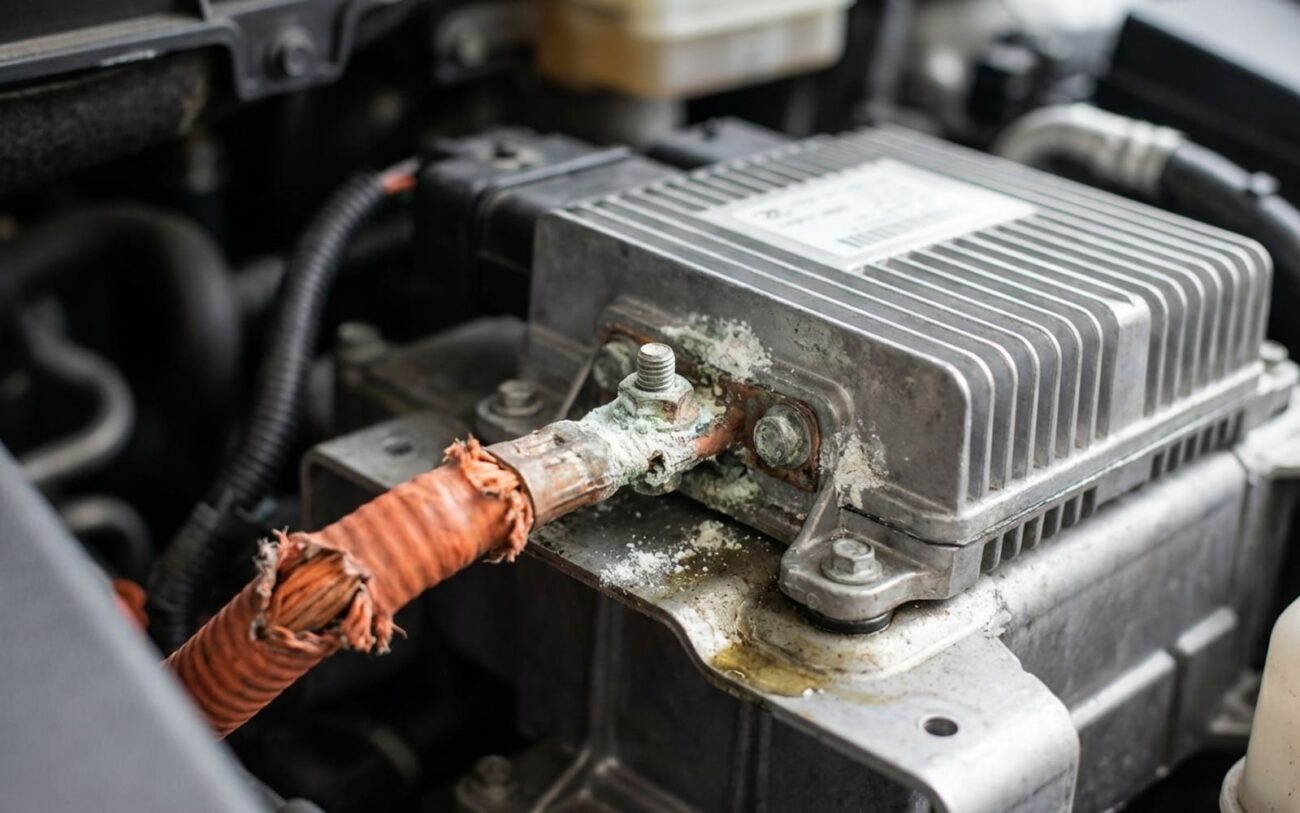
Alright, let’s talk hybrid vehicles and that pesky DC-DC converter. After 25 years under the hood, I can tell you this component is often misunderstood, and misdiagnosing it can cost folks a lot of money. When a hybrid starts acting up, especially when the gasoline engine seems to run for no good reason just to keep the 12-volt system alive, that’s usually my first clue the DC-DC converter might be on the fritz.
I’ve seen it dozens of times in the shop: a customer pulls in, frustrated, saying their 12V battery is dead after sitting in “Ready” mode for just ten minutes. But then, as soon as the engine fires up, everything comes back to life. That, my friends, is the classic red flag.
Symptoms I Look For
The most common complaint is a consistently draining 12-volt auxiliary battery when the car is in “Ready” mode but the gasoline engine isn’t running. Think about it: you’re idling in a parking lot with the A/C on, enjoying the quiet electric operation, but the converter isn’t doing its job. Over time, that 12V battery just gives up, leading to a no-start, a blank dashboard, or even a complete system shutdown while you’re driving. And let me tell you, when the 12V system goes completely dead, you lose power steering, brake assist, and all those critical control modules. That’s a real safety risk, not just an inconvenience.
Now, before you jump to conclusions and blame the converter, remember this: a dead 12V battery could also be from a failing battery itself, a parasitic drain somewhere else in the system, or even a faulty battery current sensor. But repeated deep discharges will kill that auxiliary battery permanently through sulfation, so don’t ignore it.
Another symptom I often see is the engine starting unexpectedly at low speeds or refusing to shut off during EV driving. This usually happens when there’s a high electrical load – like when you’ve got the headlights on, the defroster blasting, and the A/C running all at once. The Hybrid Vehicle Control Module (HV ECU) sees that low 12V voltage and forces the engine on. It does this to activate the DC-DC converter or, in some older models, to run a traditional alternator. Again, don’t jump to conclusions. This behavior can also be caused by a weak high-voltage battery, a faulty thermostat, or even just high cabin heating demand. We need to test, not guess.
Finally, your vehicle will almost always give you a heads-up. You might see a “Check Hybrid System” message, a “12V Battery Charge” light, or a pop-up telling you to start the engine or visit a dealer. These are system-level alerts indicating abnormal voltage conditions, but they don’t tell you why it’s happening. That’s where proper diagnosis comes in.
How I Isolate the DC-DC Converter Fault
Here’s the hard truth from my side of the counter: the symptoms of a bad DC-DC converter overlap with a bunch of other issues. Replacing a $2,000 converter when the real problem is a $150 12V battery is a costly mistake I’ve seen too many times. You’ve got to rule out the simple stuff first.
The key is isolation. I use targeted testing to figure out if the problem is truly the converter, the 12V system, or something else in the hybrid network. Below is how I break down common symptoms and differentiate between converter failures and their common mimics.
| Symptom | What This Usually Means for the Converter | Other Stuff That Looks Like It | My Go-To Test to Pinpoint the Problem |
|---|---|---|---|
| 12V Battery Drains in Ready Mode (Engine Off) | The converter isn’t putting out any charging voltage, even though the high-voltage system is active. It’s just sitting there, doing nothing. | A truly dead 12V battery (sulfated), something else drawing too much power (parasitic drain), a bad battery current sensor, a blown fuse to the converter, or a corroded ground connection. |
First, get the vehicle into “Ready” mode with the engine off. Measure the voltage right at the 12V battery terminals. If it’s below 13.0V, you’re not getting a charge. Next, carefully back-probe the DC-DC converter’s low-voltage output terminal. If you see 13.5–14.5V there, but the battery’s still low, then your problem is in the wiring, a fuse, or a connection between the converter and the battery. |
| Engine Runs for No Good Reason at Low Speed | The Hybrid Control Module (HCM) is forcing the engine to start because it’s seeing low 12V voltage, or it’s not getting the “converter active” signal from the DC-DC unit. | The high-voltage battery itself is low on charge, you’ve got a massive thermal load (like full defrost in winter), the engine’s just trying to warm up, or a coolant temperature sensor is lying to the computer. |
You’ll need a professional-grade scan tool for this one. Monitor the DC-DC converter’s status and its output voltage/current PIDs (Parameter IDs). If your tool has bidirectional controls, try commanding the converter ON. If it just sits there, refusing to respond despite the command and a clear electrical load, then you’re looking at a bad converter or a fault in its enable circuit. |
What Actually Breaks Inside These Things?
Once you’ve confirmed the converter is the problem, the next question is always: what’s actually broken inside? It’s not a simple on/off switch – it’s a complex power electronics module with several known failure points.
First off, those internal power semiconductors, usually IGBTs or MOSFETs, can just give up. They’re the workhorses, handling all the high-frequency switching between the high-voltage battery and the 12V system. Overcurrent, voltage spikes, or just plain old prolonged thermal stress can kill them. When they fail, the converter usually stops regulating altogether.
Second, the DC link capacitors degrade over time. These are the big boys on the high-voltage input side, smoothing out voltage ripple. As the electrolyte dries out – especially in units that run hot – they lose capacitance. This increases ripple, and eventually, they can short-circuit, taking the whole module down with them.
Third, I’ve seen planar transformers develop internal shorts or opens. This is often due to insulation breakdown from all that thermal cycling. These transformers operate at high frequency and are really sensitive to heat. A fault here usually means no output, or really erratic voltage readings.
Lastly, solder joint fatigue is a well-documented issue. Repeated heating and cooling cycles can crack the solder joints on high-current components, leading to intermittent connections. For example, some Toyota hybrids, especially older Prius models, have had issues with cracked solder on internal current sensors. This triggers specific DTCs related to converter output monitoring, and the converter will work intermittently – driving customers absolutely crazy.
It’s also important to remember what isn’t a converter failure. A blown high-voltage fuse, a failed battery contactor, or a shorted 12V wiring harness can prevent power from even reaching the converter, making it look dead. Similarly, a failing 12V battery with high internal resistance can overload a perfectly healthy converter. Always verify the entire circuit before condemning the module itself.
How Do You Fix It? Your Repair Options
Professional Territory Only
Look, working on a high-voltage DC-DC converter isn’t for the faint of heart. It demands specialized tools, proper HV safety training, and the right personal protective equipment (PPE). Those high-voltage capacitors can store enough energy to be lethal, even when the car is completely off. There’s no safe shortcut here.
Module Replacement Professional Only
Enable Circuit Repair Professional Diagnosis
Post-Repair Verification: How I Know It’s Fixed
Replacing the converter isn’t the end of the job; it’s just the beginning of the validation process. You absolutely have to confirm that the repair worked under real-world conditions. I never let a car leave the shop without doing these checks.
First, I start with a functional voltage test. Get the car in “Ready” mode with the engine off. Turn on a heavy electrical load: headlights, blower fan on high, rear defroster. Measure the voltage at the 12V battery terminals. It should read a stable 13.5V to 14.5V. If it’s sitting at 12.6V or lower, that converter isn’t charging, and you’ve still got a problem.
Next, I use my scan tool to verify the data PIDs. The DC-DC converter status should read “ON,” and you should see the output current increase as you add more electrical loads. All related DTCs (Diagnostic Trouble Codes) should clear and, crucially, remain clear after a good drive cycle. If your scan tool has bidirectional controls, use them to command the converter on and off – this confirms that communication and control are fully intact.
Finally, I perform a stress test. Cycle the vehicle through multiple “Ready” mode entries, engine starts, and shutdowns. Monitor the voltage stability throughout. For a more rigorous check, I’ll use a carbon pile load tester to simulate a 30-amp draw on the 12V system and watch how the converter responds. The tools you’ll need for this are a quality digital multimeter, a good scan tool with hybrid system access, and if you want to be thorough, that carbon pile load tester.
Cost, Risk, and Economic Considerations
Let’s be realistic—this isn’t a cheap fix. You really need to weigh the repair cost against the vehicle’s overall value and how much life it has left in it.
| Repair Type | DIY Part Cost (Approx.) | Shop Cost (Approx.) | My Success Rate | Secondary Risk if Not Done Right |
|---|---|---|---|---|
| DC-DC Converter Assembly Replacement | $800–$2,000 (for an OEM or quality remanufactured part) | $1,200–$3,000 (this includes labor, fresh coolant if needed, and calibration) | High (I’d say >95% if diagnosed correctly) | Improper handling can lead to a high-voltage arc flash, nasty coolant leaks, or even damage to the inverter, the HV battery, or other control modules. It’s serious business. |
Here’s a rule of thumb I use: if the repair cost – especially when you factor in the condition of the high-voltage battery – starts to creep above 40% of the car’s current market value, it’s time to seriously reconsider. A Toyota Prius with a failing converter and a weak hybrid battery might just cost more to fix than it’s worth. On the other hand, a well-maintained Ford Escape Hybrid with low mileage might still be a solid investment. Always assess the full picture, not just the single component.
Prevention and Early Detection Strategies
The DC-DC converter isn’t typically a scheduled maintenance item, but there are things you can do to extend its life and catch issues early, before they leave you stranded.
If your converter is liquid-cooled – and many modern hybrids are – you absolutely need to stick to the factory coolant service intervals. Overheating is a major killer for these units. And only use the OEM-specified coolant; anything else can cause silicate drop-out or corrosion that will clog the micro-channels in the cooling plate.
Proactive Monitoring Tip
Make this a habit: once a month, start the car in “Ready” mode (engine off). Turn on a few accessories like the headlights and the fan on medium. Then, check your 12V system voltage with a multimeter. You’re looking for a stable reading above 13.5V. If you start noticing it dropping—say, from 13.8V down to 13.2V or lower over a few months—that’s a clear sign the converter’s output is weakening. That’s your window to investigate before you’re stuck.
Also, be mindful of how you use accessories. In “Accessory” mode (key on, but not “Ready”), the DC-DC converter is usually inactive. So, if you’re sitting in the car listening to the radio or charging devices, you’re just draining that 12V battery with no way to recharge it. This is especially risky if you’ve got high-draw aftermarket gear like big amplifiers. If you need to idle with electronics on, always put the car in “Ready” mode so the converter can actually maintain the 12V system.
