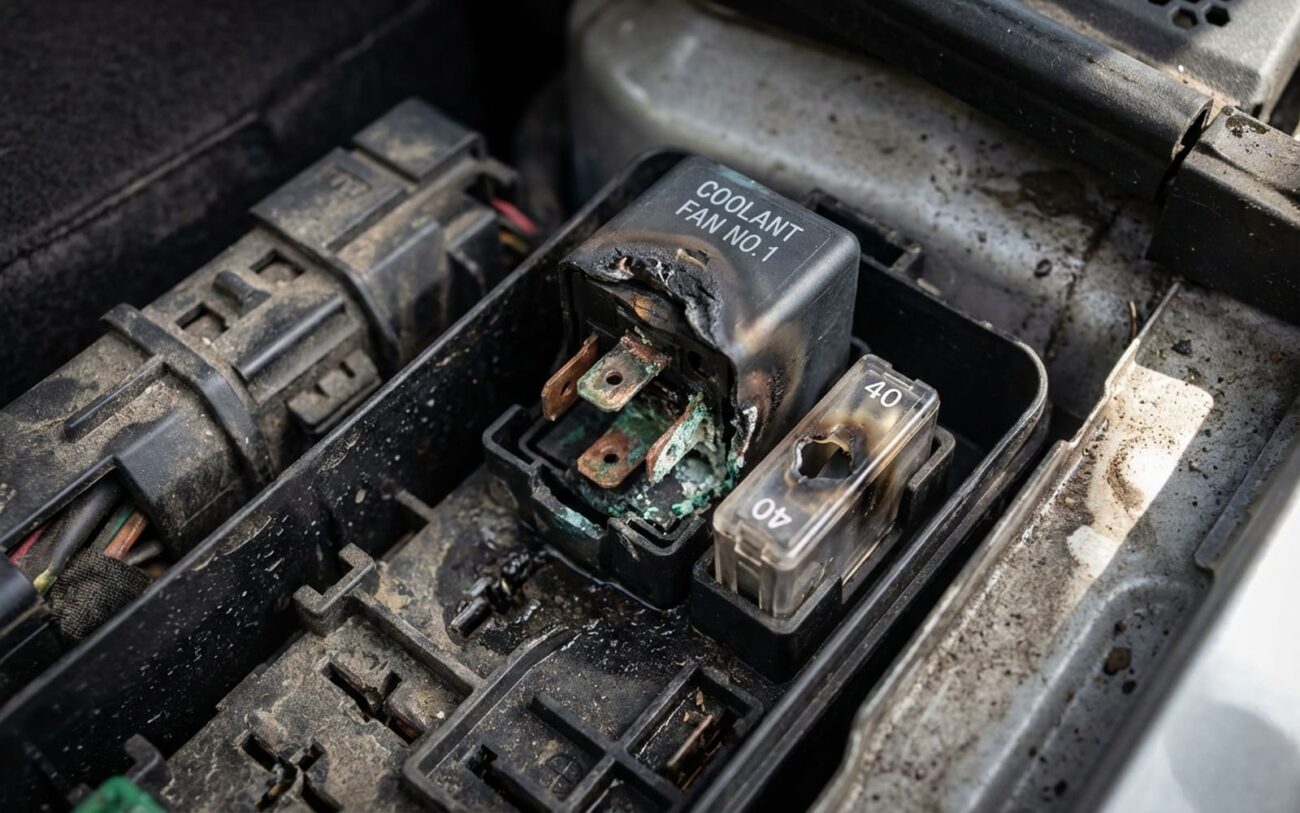
Alright, let’s talk cooling fans on your VW or Audi with that 2.0L TSI engine – especially the EA888 platform. I’ve seen more than my fair share of these come into the shop, and a dead cooling fan relay or a blown fuse is a common culprit. But here’s the deal: it’s not always as simple as it seems, and ignoring it can turn a cheap fix into a catastrophic engine rebuild. Let’s dig in.
What You’ll See, Hear, or Feel
When your cooling fan system throws a fit, the symptoms are usually pretty clear, but they can trick you into thinking it’s something worse. The most obvious sign? Those radiator fans just aren’t spinning when they should be. You’ll notice your temperature gauge creeping up, sometimes right into the red zone, especially when you’re stuck in traffic, idling at a light, or moving slowly. The moment you get some speed, though, and air starts flowing through the grille, that temperature gauge drops back to normal. That pattern—overheating at low speed or idle, normal temps on the highway—is a dead giveaway for a fan problem.
Another big clue, and one that often gets overlooked, is your air conditioning. The A/C condenser sits right in front of the radiator, and it relies on those same fans to pull heat away. If the fans aren’t working, the A/C system’s high-side pressure shoots up. The compressor then shuts off to protect itself, and suddenly you’re getting warm air from the vents, even with the A/C cranked. It’s frustrating, but it’s a symptom.
Now, sometimes it’s the opposite: the fans run continuously at high speed from the moment you turn the key, even when the engine is stone cold. That’s a classic sign of a stuck relay or a control circuit fault. And trust me, you don’t want to leave that unchecked; it’ll drain your battery overnight faster than you can say “tow truck.”
My Approach to Diagnosis: Don’t Just Swap Parts
Just because the fans aren’t spinning doesn’t automatically mean the relay or fuse is bad. I’ve seen countless DIYers, and even some newer techs, throw parts at this problem only to find it still exists. The real issue could be a seized fan motor, a chewed-up wire, a faulty coolant temperature sensor, or even a glitch in the Engine Control Module (ECM). That’s why you need a methodical approach. Here’s how I break it down:
Scenario 1: Fans Are Dead Silent, Fuse Looks Good
This is probably the most common. The engine’s hot, the A/C is on, but the fans are just sitting there. First thing I do is grab my scan tool – something like VCDS or ODIS is ideal for VW/Audi. I go into the engine module and try to command the fans on manually, both low and high speed. While I’m doing that, I’m listening closely. Can I hear the relay click? Sometimes I’ll even put my hand on the relay itself (usually labeled J271, a black cube-style in the under-hood fuse box) to feel for the click.
If the scan tool commands the fans on, and I hear the relay click, but the fans still don’t spin, then I know the relay is getting its signal. My next step is to pull that relay and check for power. Terminal 30 should have constant battery voltage. Terminal 85 should get a ground signal from the ECM when commanded. If those are good, I check terminal 87 – that’s the output to the fans. If there’s no voltage coming out of 87 when the relay is clicked, but power is going in on 30, then that relay is toast. It’s either got a failed coil or the internal contacts are welded or burned open.
If the relay clicks and has output, but the fans still don’t run, then I’m looking at the wiring from the relay to the fan motors, or the fan motors themselves. An open circuit in the wiring or a failed motor is the next logical step.
Scenario 2: The Fuse Keeps Blowing
A blown fuse (often the 40-amp fan circuit fuse, labeled SA6 in the under-hood box) isn’t the problem; it’s a symptom. The fuse is doing its job, protecting the circuit from excessive current. If you just slap a new fuse in there, it’ll likely blow again, or worse, cause damage.
When I see a blown fuse, I immediately suspect a short-to-ground somewhere in the power feed, or more commonly, a fan motor that’s seized or drawing way too much current. To confirm, I’ll perform a current draw test. I put my multimeter in series at the fuse holder, set to the 10A or higher scale (some meters have a 20A or 30A setting, or you need a clamp meter for higher amps). Then I command the fans on at low speed. A healthy combined draw for both fans is typically between 10–25 amps. If I see it jump to 40 amps or higher, that tells me a motor is failing or there’s a serious short. If the draw is normal but the fuse still blows, then I’m looking at resistance in the fuse holder itself or poor terminal contact, which generates heat and melts the fuse.
Scenario 3: Fans Won’t Shut Off
This one’s annoying, especially when it drains your battery. If the fans are running constantly, even when the engine is cold or the key is off, the first thing I do is pull the fan relay. If the fans stop, that tells me the relay is stuck closed internally (contacts welded shut). If they keep running even with the relay out, then you’ve got a short in the power circuit that’s bypassing the relay entirely – that’s a wiring nightmare.
If pulling the relay stops the fans, I then check terminal 85 (the control side) for a constant ground signal with the key on. If the ECM or a sensor (like a coolant temperature sensor or A/C pressure sensor) is incorrectly commanding the fans on, you’ll see a persistent ground signal there. A scan tool is crucial here to monitor live data from those sensors. If the coolant temp reads -40°C or 150°C, that’s a bad sensor telling the ECM to panic and run the fans.
Why These Parts Fail: The Root Causes
So, why do these relays and fuses give up the ghost? It’s usually a combination of heat, current, and time. Take the J271 fan relay. Every time those big fans kick on, the relay’s internal contacts handle a pretty significant inrush current – sometimes over 30 amps momentarily. That surge creates tiny electrical arcs across the contacts. Over thousands of cycles, this arcing erodes the contact surface. Eventually, those contacts either become so pitted they can’t conduct electricity (no fans) or they weld themselves together from the heat (fans run constantly). The coil inside the relay can also fail open due to constant heat soak under the hood, especially on turbocharged engines like the EA888 that just run hot.
Then there’s corrosion. Moisture and road grime, especially in areas where they salt the roads, love to creep into the fuse box over time. This leads to oxidation on the relay and fuse blades. Corrosion increases electrical resistance, and resistance generates heat. I’ve pulled relays where the plastic housing was partially melted and the fuse box socket was discolored brown. That’s not just a failed part; that’s a warning sign of a growing electrical problem that’s been cooking for a while.
Here’s a known issue I’ve seen:
Volkswagen Group actually issued service guidance for some 2013–2016 models with the 2.0L TSI. They acknowledged that the original J271 relay could fail prematurely in high ambient temperatures because the contact rating wasn’t quite enough. So, if you’ve got a MK6 Golf GTI, an Audi A3 2.0T, or a similar model from that era, this isn’t just a possibility – it’s a recognized pattern.
As for the 40-amp fuse, it usually fails from thermal fatigue caused by repeated heating and cooling cycles, or from poor contact at the fuse holder. But always remember: a blown fuse is almost always a symptom, not the root cause. If a fan motor is seizing up and trying to pull 80 amps, that fuse is doing its job by blowing. Replace the fuse without fixing the motor, and you’re just setting yourself up for the exact same failure again, usually at the worst possible time.
The Fix: Your Repair Options Explained
Some of This is Pro Territory
Look, swapping a fuse or a relay can be a DIY job, and I encourage folks to learn. But when you start dealing with melted fuse box sockets, seized fan motors, or complex wiring issues, you’re stepping into professional territory. You need specialized tools, a solid understanding of electrical safety, and the right PPE. There’s no safe shortcut for complex electrical work, and you can cause more damage than you fix.
Once you’ve diagnosed the problem, here’s how to proceed based on what you find:
Path A: Simple Relay or Fuse Swap DIY-Feasible
Path B: Melted Fuse Box Socket Professional Only
Path C: Repeated Failures Professional Diagnosis Required
A Dangerous Temporary Measure Last-Resort
After the Fix: Validation and Prevention
Once you’ve completed any repair, whether it’s a simple relay swap or a full fan motor replacement, you absolutely have to validate it. Don’t just assume it’s fixed. Start the car, let it warm up, and keep an eye on that temperature gauge. Turn on the A/C to max – that should definitely trigger the fans. If you have a scan tool, monitor the coolant temperature and fan speed percentages. Make sure the fans kick on when commanded and bring the temperature down effectively.
To keep this problem from coming back, I recommend a few simple habits:
-
When you install a new relay or fuse, put a small dab of dielectric grease on the terminals. It helps block moisture and slows down corrosion, which is a big killer of these components.
-
Every now and then, take a look at your fan blades. If they’re clogged with leaves, debris, or feel stiff when you try to spin them by hand (with the engine off, of course!), clean them out. Any extra strain increases current draw, and that shortens the life of your motors and relays.
-
Listen to your car. On a hot day, after you shut off the engine, it’s totally normal to hear the cooling fans run for a minute or two. If that sound suddenly disappears, that’s your early warning system telling you to investigate.
-
And finally, every time you check your oil, take an extra second to peek at the fuse box. Look for any signs of browned plastic, warped relay sockets, or a faint burnt smell. Catching a minor overheat early can save you from a $1,000 fuse box replacement down the road. This kind of attention is what keeps these TSI engines running strong for 150,000 miles and beyond.
Costs and The Hard Economic Truth
Repair costs can swing pretty wildly depending on what’s actually failed. Here’s a realistic breakdown of what I typically see:
Relay/Fuse Replacement
DIY cost for OEM parts.
Fuse Box Socket Repair
DIY cost for repair kit or new fuse box.
Shop Repair (Complex)
For fuse box repair, fan motor replacement, or complex diagnostics.
The real economic decision comes when you’re facing Path C—repeated failures, or if the diagnostics point to a failed fan motor or a damaged wiring harness. If the total repair cost starts creeping up towards 60% of your car’s market value (check KBB or similar for a realistic appraisal), it’s time to seriously weigh your options. Pouring $800 into a 12-year-old MK6 GTI with other aging systems might not make financial sense. Sometimes, the smartest move is to cut your losses and move on to something newer.
Cost-Saving Tip
Independent European specialists often have far more experience with these specific electrical issues than a general repair shop. They can often offer more targeted, cost-effective repairs. Always get a detailed diagnostic report before you authorize any major work.
