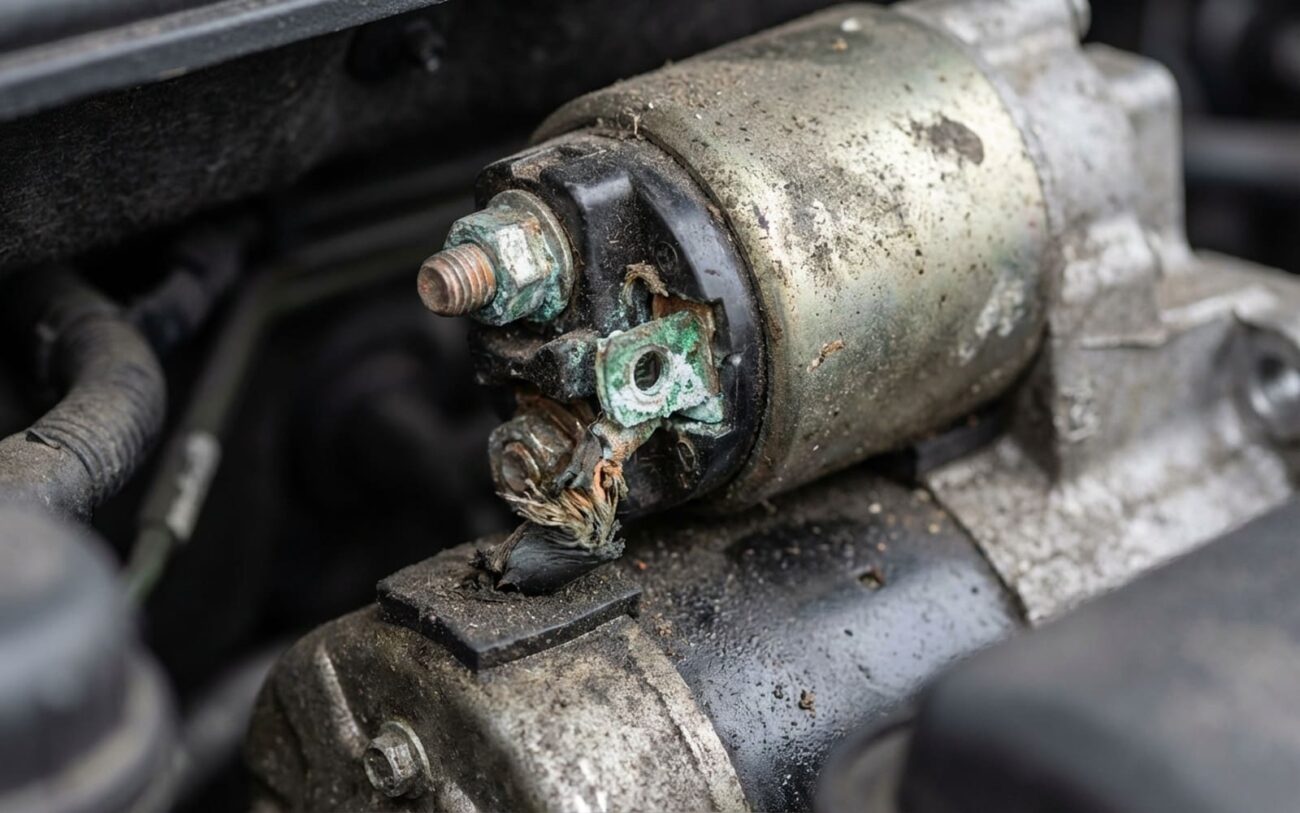
Key Turns, Nothing Happens (Or Just a Click)
Alright, let’s talk about one of the most common headaches in the shop: you hop in, turn the key, and… nothing. Or maybe you get a single, lonely click. Sometimes it’s a rapid chattering sound. Most folks immediately think “dead battery,” and yeah, that’s always the first thing I check too. It’s logical.
But if you’ve already confirmed your battery’s got plenty of juice — headlights are bright, accessories aren’t sluggish — then you’re probably looking at one of two distinct problems. Either you’ve got a failing starter motor, or something much more modern and sneaky: a CAN Bus communication fault.
Knowing the difference early on can save you a ton of time, money, and frustration. One’s a pretty straightforward mechanical fix, the other can send even experienced DIYers (and some less experienced pros, frankly) down a rabbit hole. So, let’s figure out what your car’s trying to tell you.
CRANKING DIAGNOSTIC
Status: ACTIVE
What Your Car’s Sounds Are Telling Me
Before I even grab a wrench or a scan tool, my ears are my first diagnostic tool. The sounds — or the complete lack of them — when you turn that key are huge clues. They tell me exactly where to start digging.
The Single, Solid “CLICK”
A Nasty Grinding Noise
Whirring or Spinning, No Engine Turn
Complete Silence. Crickets.
My Diagnostic Approach: Pinpointing the Real Problem
Okay, so you’ve listened to the car. Now it’s time to confirm what’s really going on. Here’s my go-to diagnostic table, based on what I’ve seen over the years. This helps cut through the noise and get to the root cause quickly.
| What I Hear/See | My First Suspect | What Else It Could Be | How I Confirm It (The Definitive Test) |
|---|---|---|---|
| Single “Click,” No Crank | Internal starter failure (solenoid contacts, seized armature). | A truly seized engine (rare, but possible), low battery voltage (even if it seems good), or a poor ground connection to the starter. |
Perform a voltage drop test at the starter’s small “S” terminal (the solenoid activation wire) while someone turns the key. You should see more than 10.5V. If you do, and it still only clicks, the starter itself is bad. |
| Grinding Noise | Worn starter pinion gear or bendix. | Damaged teeth on the engine’s flywheel ring gear. |
Remove the starter and use a borescope (or just a flashlight if you can see) to inspect the flywheel’s ring gear through the starter mounting hole. Look for missing or chewed-up teeth. |
| Whirring/Spinning, No Crank | Failed starter drive (bendix) mechanism. | Rarely, a seized engine that the bendix can’t overcome, but usually it’s the bendix itself. |
This symptom pretty much is the test. If the motor spins but the engine doesn’t, the bendix is slipping. Replacement starter is the next step. |
| Complete Silence (No Click, No Crank) | CAN Bus network fault (short/open circuit) or an upstream electrical issue. | Blown fuse for a module, faulty ignition switch, neutral safety switch, or a failed gateway module. Internal solenoid failure is rare if there’s no click at all. |
First, check for 12V at the starter’s “S” terminal while cranking. If you get 12V, it’s likely a bad starter (internal solenoid). If there’s NO voltage, the problem is upstream. For CAN Bus diagnosis, measure resistance between OBD-II pins 6 (CAN High) and 14 (CAN Low). It should be around 60 ohms. If it’s 120 ohms, one of the two termination resistors is open. If it’s 0 ohms, you’ve got a short. |
Why These Things Go Bad (And How to Spot It Coming)
Understanding why something fails helps you prevent it from happening again, or at least gives you a heads-up. Starters, for instance, are pretty common failures, mostly due to mechanical and electrical wear and tear.
Inside the starter, you’ve got carbon brushes that wear down over time, eventually losing contact with the commutator. And the solenoid contacts take a real beating. Every time you start the car, there’s an electrical arc that pits and burns that metal. I see this a lot on high-mileage vehicles, or cars that do a lot of short trips where the starter gets used constantly.
The Network Concept
Think of the CAN Bus like a big group chat for your car’s computers. If the wires are cut, or one module starts “screaming” noise onto the network, then nobody can hear the “Start” command. It just gets lost in the static.
CAN Bus failures are a whole different beast. These are often caused by physical damage: chafed wiring rubbing against sharp brackets, corrosion in connectors (especially in damp areas), or even rodents chewing through a harness. The network needs two 120-ohm termination resistors to work right; if one of those goes bad, communication collapses. I’ve seen cases where a tiny bit of water getting into a body connector caused enough corrosion to completely brick the starting system. It’s wild how sensitive these systems are.
Getting It Fixed: DIY vs. Pro Territory
Starter Motor Replacement DIY Feasible (Usually)
CAN Bus Issues: This is Professional Territory
Look, if you’ve diagnosed a CAN Bus fault, this is almost always a job for a professional technician. We’ve got specialized tools — like oscilloscopes — and the training to properly diagnose and repair these complex networks. It often involves carefully splicing twisted-pair wires (and they have to be spliced just right) or replacing and then reprogramming failed ECUs (Electronic Control Units). Messing this up can literally brick your vehicle’s entire electrical system, turning a bad day into a very, very expensive one.
Confirming the Fix: Don’t Skip This Step
How I Verify the Repair:
For a starter motor replacement, I always verify that there’s less than a 0.5-volt drop in the control circuit during cranking. That tells me the new starter is getting all the power it needs. For CAN Bus repairs, I use an oscilloscope to confirm a clean, stable signal waveform on the network. And crucially, I make sure all those “U” codes (network communication codes) are cleared and don’t come back after a few drive cycles. If they do, I know the problem wasn’t fully resolved.
What’s This Going to Cost You?
Alright, let’s talk brass tacks. Nobody likes unexpected car bills, but knowing what to expect helps. These are general ranges I see in my shop and from what customers tell me about other places.
Starter Replacement
This is for parts and labor at a typical shop. If you’re doing it yourself, parts usually run $80–$300, depending on the vehicle and whether you go new or remanufactured.
CAN Bus Wire Repair
This cost varies wildly. It’s highly dependent on how long it takes to isolate the fault – finding a tiny break in a wire can be incredibly time-consuming. Sometimes it’s a quick fix, sometimes it’s hours of tracing.
ECU Replacement & Programming
This includes the cost of a new module (which can be pricey) plus the specialized labor for programming it to your specific vehicle. Some high-end modules can push this even higher.
My Advice: Keep It From Happening Again
-
Keep your battery healthy. A weak battery makes the starter solenoid work harder, causing those contacts to wear out much faster. It’s cheap insurance.
-
Protect those wiring harnesses. When you’re doing other repairs, or even just replacing trim panels, be super careful not to pinch or rub wires. That’s how a lot of CAN Bus issues start.
-
Don’t ignore intermittent issues. A flickering gauge, a window that acts up sometimes, or a random warning light that comes and goes? Those are often the first subtle signs of a failing CAN network. Get it checked before it leaves you stranded.
And just a quick thought: EVs and hybrids don’t use their starter motors nearly as much, if at all, for propulsion. That’s one big reason why their brake pads last so much longer, too — less wear from frequent stops thanks to regenerative braking. Less starter use means related components generally last longer, which is a nice perk.
