When Your Transmission Starts Lying to Itself
If you’re dealing with a transmission that’s acting up—erratic shifts, maybe a check engine light glaring at you, and a scan tool spitting out a bunch of transmission codes—you’re probably looking at what seems like a complex problem. I’ve seen countless vehicles come into my shop with P0750-series codes (shift solenoid faults) or P0841 (pressure sensor circuit issues), and the owner (or sometimes even another tech) is ready to throw parts at it. But here’s the thing: often, those codes are just symptoms of a deeper, simpler issue.
The transmission control module, or TCM, is smart, but it’s only as good as the information it gets. Think of it like a captain navigating a ship: if the lookout is giving bad intel about the speed or direction, the captain’s going to make all the wrong moves. In your transmission, those “lookouts” are the input shaft speed (ISS) and output shaft speed (OSS) sensors. If they’re feeding the TCM bad data, the module starts making decisions based on lies. That’s when you get what I call “ghost codes”—false trouble codes for components that aren’t actually faulty.
The ISS sensor is the TCM’s window into the front of the transmission, telling it how fast the engine side is spinning. The OSS sensor is its eyes on the output, showing how fast the wheels are turning. When one goes blind, the TCM starts guessing—and it usually guesses wrong, leading to an impossible gear ratio calculation.
The symptoms are often telltale: erratic, delayed, or jarring shifts, especially noticeable under light load. You might even feel a harsh engagement or a complete loss of drive in certain gears. If you’ve cleared codes, replaced a solenoid, and the problem or the codes come right back, that’s a huge red flag for me. It means the TCM isn’t reacting to a real mechanical issue; it’s trying to correct for a data error.
I often see this play out on older Honda Accords or some GM vehicles where the OSS sensor is particularly exposed. A P0700 (transmission control system malfunction) often accompanies these false codes, acting as a general warning that the TCM is in distress.
Slip: 420 RPM
My Approach to Diagnosing Speed Sensor Faults
Guessing is expensive, plain and simple. You need a good bi-directional scan tool—not just a code reader—that can graph live data PIDs (Parameter IDs). This is your most critical tool here. I’m looking specifically at ISS RPM, OSS RPM, commanded shift solenoid states, and line pressure if the vehicle provides it. The whole game is comparing what the sensors say is happening to what should be happening, and to what the vehicle is actually doing.
When I’m diagnosing, I’m looking for discrepancies. A healthy speed sensor signal will be smooth and consistent. What you often see with a failing sensor are sudden drops to zero, erratic spikes, or a signal that’s present but clearly incorrect when compared to other related PIDs like engine RPM or vehicle speed.
Key Diagnostic Tests I Run:
-
For Output Speed Sensor (OSS) issues (P0720/P0722/P0723): I’ll graph OSS RPM against ISS RPM during a steady cruise. The ratio between them should hold pretty constant for a given gear. If the ratio stays consistent but the OSS signal itself is spiking or dropping out, that’s almost always a bad sensor. On some vehicles, you can also compare OSS to wheel speed sensors.
-
For Input Speed Sensor (ISS) issues (P0716/P0717/P0718): This one’s a bit different. I graph ISS RPM against Engine RPM, especially when the torque converter clutch (TCC) is locked up. When the TCC is locked, ISS should match Engine RPM almost perfectly. If there’s a significant difference, you’re either looking at TCC slippage (a mechanical issue) or a faulty ISS signal. If the TCC is definitely locked and the ISS is erratic, that points to the sensor.
-
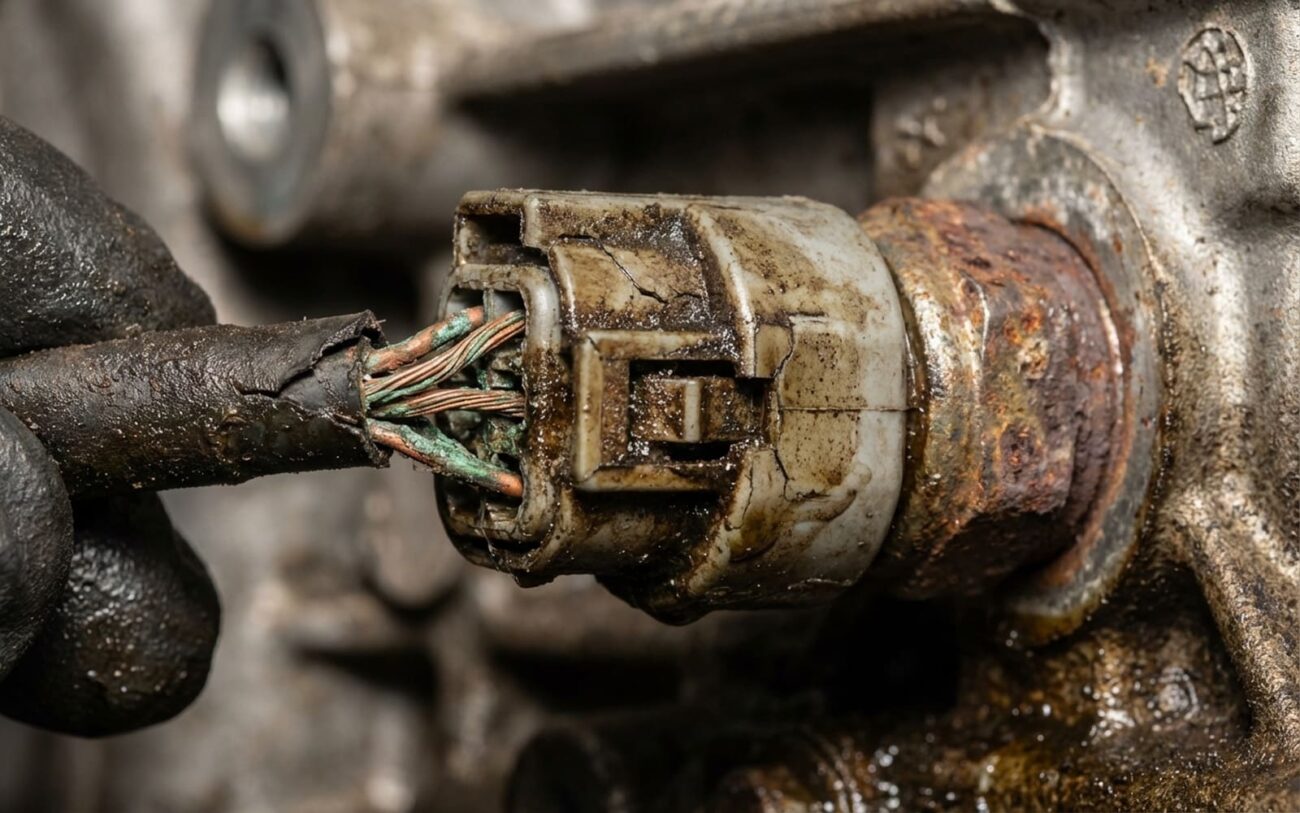
Wiring Check: Before I condemn any sensor, I always do a quick visual check of the wiring harness and connectors. Corrosion, chafing, or a loose connection can mimic a sensor failure perfectly. I’ve been burned by this early in my career, so it’s a mandatory step now.
| Common DTCs | Likely Sensor Cause | Mechanical Mimics | My Definitive Test |
|---|---|---|---|
| P0720/P0722/P0723 (Output Speed) | Internal sensor circuit failure or tone wheel damage. | Damaged wiring, connector corrosion, or internal slippage. |
Graph OSS vs. ISS at steady cruise. Look for signal spikes/dropouts where ratio should be stable. |
| P0716/P0717/P0718 (Input Speed) | Failed Hall-effect sensor or cracked circuitry. | Wiring fault, TCM issue, or TCC slippage. |
Graph ISS vs. Engine RPM during TCC lockup. ISS should match Engine RPM. |
Why These Sensors Give Up the Ghost
These speed sensors live in one of the nastiest environments under the hood: constant high heat, relentless vibration, and they’re constantly bathed in transmission fluid. It’s a miracle they last as long as they do, honestly. Over my career, I’ve seen them fail in a few primary ways:
-
Internal Circuit Failure: This is probably the most common. The tiny solder joints on the sensor’s circuit board just can’t handle the thermal cycling—heating up, cooling down, day after day. Eventually, they crack. This usually shows up as an intermittent signal loss or erratic voltage output.
-
Physical Sensor Tip Damage: If you’ve ever had internal transmission damage, even minor metal debris can score the face of the sensor. Even a small nick can cause signal dropouts because the sensor can’t accurately read the tone wheel (reluctor ring) it’s designed to monitor.
-
Magnet Degradation: For older magnetic pickup type sensors, prolonged exposure to heat can slowly demagnetize them. This weakens the signal, often making it unreliable, especially at lower speeds.
Watch for moisture:
Moisture intrusion is a known issue, particularly in certain GM and Ford transmissions. Water can seep into the sensor’s internal connector, leading to corrosion. When I reinstall these, I always use a good dab of dielectric grease in the connector to prevent this from happening again. It’s cheap insurance.
Your Repair Options: What It Takes to Fix It
Once you’ve definitively diagnosed a speed sensor issue, your repair path depends heavily on where that sensor lives. Some are external and easy to swap; others are buried deep inside the transmission.
External Sensor Replacement DIY Feasible
Internal / Valve Body Service Professional Only
It requires meticulous cleanliness—one speck of debris can ruin an expensive valve body—and specific torque sequences to prevent warpage. You’ll also need to perform a full transmission service, including new gaskets and fresh, OEM-specified fluid.
Tone Wheel (Reluctor Ring) Repair Professional Only
Verifying the Fix and What It’ll Cost You
Don’t just clear the codes and call it a day. That’s a rookie mistake. A proper repair isn’t done until you’ve verified it. I always take the vehicle on a thorough test drive, making sure to hit all gears, including highway speeds, and put it through various load conditions.
During this test drive, I’m back on the scan tool, graphing ISS and OSS RPM in real time. I’m looking for smooth, stable signals, no sudden dropouts or “noise.” If I worked inside the transmission, I’ll also perform a “loss of signal” check if available, just to ensure the TCM correctly identifies an open circuit if one were to occur, rather than throwing unrelated solenoid codes again.
Cost Considerations:
External Sensor
Includes OEM part and labor for accessible sensors. This is the cheapest fix.
Internal Repair
Covers valve body access, fluid service, and internal sensors. Labor is the main cost here.
Full Replacement
This is the cost of misdiagnosis or catastrophic internal failure. Always diagnose first!
My Expert Advice on Repair Value:
Here’s a hard truth I tell my customers: if the estimated repair cost for an internal transmission issue exceeds half the car’s current market value, you need to pause and seriously consider your options. Dropping $2,000 into an internal repair on a $3,000 car is a gamble. Sometimes, the smartest move—though it stings—is to cut your losses and look for a different vehicle.
Keeping It From Happening Again
Proactive Maintenance
-
Follow the severe service interval for your transmission fluid changes. That’s typically every 30,000–50,000 miles, not the “lifetime fluid” nonsense some manufacturers push. Fresh fluid prevents varnish buildup on sensors and keeps internal components happy.
-
Use only OEM-specified fluid. I can’t stress this enough. Generic or “universal” fluids often lack the specific friction modifiers and properties your transmission needs, leading to increased heat and poor shift quality, which can stress sensors.
-
If you have access to a scan tool, occasionally monitor ISS and OSS PIDs. Catching signal noise or intermittent dropouts early can prevent a full-blown breakdown and save you a lot of money.
