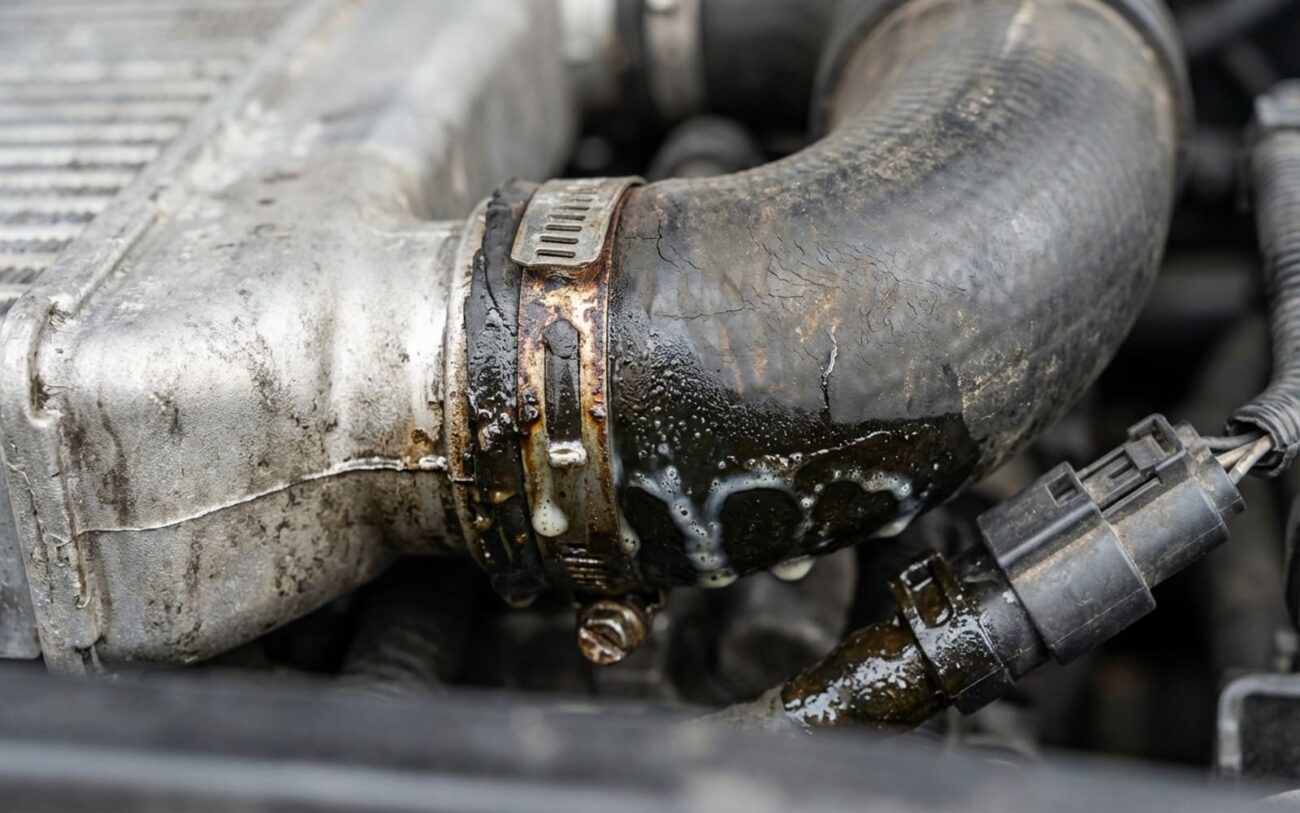
Oil or Water in Your Intercooler Hose? Here’s How I Diagnose It
Alright, let’s talk intercooler hoses. You popped the hood, saw some oil residue, maybe a little condensation, or even a drip, and now you’re wondering if your turbo’s toast or if it’s just a leaky hose. I see this all the time in the shop. These big hoses — running from the turbo to the intercooler and then to the intake manifold — are common trouble spots on any turbocharged engine.
First off, a little oily mist inside these hoses? Totally normal, especially on modern direct-injection engines. That’s just crankcase blow-by (vapors from the PCV system) condensing in the cooler air stream. Don’t panic over a light film. But when you’ve got actual puddles under the car, visible leaks, or a steady drip from the hose ends, that’s when my ears perk up. The trick isn’t just seeing the leak; it’s figuring out if the hose itself is the problem, or if it’s just the messenger pointing to something much worse.
What You’re Seeing & What It Really Means
So, you’re seeing something. Let’s break down what it could mean. True intercooler hose failure shows up in clear ways, but a lot of other problems can mimic those symptoms.
Oil Leaks
If it’s oil, and it’s coming right through the hose material, or from a crack in the hose body itself — especially along a seam or a molded coupling — then yeah, the hose is probably shot. I’ve seen them degrade from the inside out due to long-term oil exposure and underhood heat, making them porous or causing the internal liner to fail.
But here’s the kicker: nine times out of ten, that oil is actually coming from a failing turbocharger center cartridge oil seal, a leaky oil feed or return line to the turbo, or a crankcase overpressure situation from a clogged PCV system. The hose is just catching the overflow, or the oil vapor is condensing heavily inside it. Don’t just replace the hose and call it a day; you’ll be doing it again soon.
Fluid Drips or Excess Condensation
If it’s watery, sometimes it’s just normal condensation on the outside of the hose from the cold charge air, which is fine. But if it’s actually seeping through the hose wall, or dripping steadily from a connection, that’s a problem. On air-to-water intercoolers, that drip could be the intercooler core itself leaking engine coolant. Or, honestly, it could just be your A/C evaporator drain doing its job, especially on a humid day. I’ve seen plenty of misdiagnoses here.
Sometimes, a hose will swell up under pressure, becoming soft or “ballooned” in the middle. That’s usually a sign of internal liner failure or material degradation from oil exposure, making it more permeable to fluids.
Hissing, Whistling, or Loss of Power
This is a classic boost leak. If you hear a hiss under acceleration, a distinct whistle, or the car feels sluggish with reduced acceleration, you’ve got a pressure problem. It could be a puncture, split, or a loose clamp on the hose itself. If the sound tracks right to a section of hose and you can feel air escaping, you’ve likely found your culprit. But I’ve also chased these down to leaking intercooler end tanks, a faulty diverter or bypass valve, or even a cracked intake manifold gasket. It’s rarely just the hose itself unless it’s obviously torn.
How I Pinpoint the Real Source of the Leak
Alright, enough guessing. Here’s how I definitively confirm whether the leak is in the hose or coming from a connected component. Diagnosis starts with isolation.
For Oil Leaks
First, clean everything thoroughly. I mean spotless. Degrease the hoses, the turbo housing, and any surrounding components. Then, if you have it, spray some leak detection powder (or even just talcum powder) around the suspected area. Drive it for a bit, get some boost into it, then check again. If the oil is tracking directly from the hose material itself, especially a seam or a molded section, then the hose is probably toast.
But if it’s weeping from the turbo’s center housing, or from a connection to the turbo, you’ve got a turbo seal or oil line issue. And always, always check your PCV system. A clogged PCV valve will pressurize the crankcase, forcing oil past seals and into the intake. Don’t skip this step; it’s a very common cause of “oil in the intercooler” that isn’t the hose’s fault.
For Water/Fluid Drips
If you suspect coolant (on an air-to-water intercooler, for instance), pressure test the engine’s coolant circuit. If the intercooler is part of that circuit, any leaks will show up. For the hose itself, you can remove it, cap one end, fill it with water, and pressurize it with about 25 psi of air (don’t go crazy, you’ll blow it up). Submerge it in a bucket of water. Bubbles from the hose wall mean it’s porous. If it’s just condensation, it’ll evaporate. If you’re not sure if it’s coolant or just water, grab some coolant test strips – they’re cheap and tell you instantly.
Pro Tip: Don’t forget the A/C drain. I’ve had customers swear their engine was leaking water, only to find it was just the air conditioning condensate dripping onto a hot exhaust pipe and evaporating, or running down a hose. Check the A/C drain tube location first.
For Boost Leaks (Hissing/Power Loss)
This is where a proper boost leak test comes in. You’ll need a boost leak tester kit that fits your intake. Seal off the intake system after the Mass Air Flow (MAF) sensor and pump in regulated air, usually around 20-25 psi. A smoke machine is ideal for finding tiny leaks, but you can also spray soapy water on all the connections, hoses, and intercooler end tanks. Look for bubbles. If you hear a hiss and feel air escaping from the hose body itself, you’ve found your culprit. But make sure it’s not just a loose clamp or a connection that’s popped off. I’ve seen plenty of technicians replace a perfectly good hose because they didn’t check the clamps first.
Why Intercooler Hoses Fail — And When It’s Not Their Fault
Okay, so you’ve confirmed it’s the hose. Why did it fail? Usually, it falls into a few categories.
- Material Fatigue: This is the big one. Heat, oil vapor, and constant pressure cycles just wear them out. Older rubber hoses get hard and crack, or they soften and swell up like a balloon. Even silicone hoses, which are tougher, can degrade, especially if they’re exposed to petroleum products or cheap cleaners.
- Physical Damage: Sometimes it’s just bad luck. A hose rubbing against a sharp bracket or frame will wear through. Road debris can cause punctures. Improper clamps – like standard worm-drive types that cut into the hose bead – can cause premature failure.
- Manufacturing Defects: Yeah, it happens. I’ve seen brand new hoses delaminate at the couplings, or molded ends with micro-porosity that weeps under pressure.
- Known Patterns: On certain vehicles, it’s a known issue. For example, those 2017-2019 Ford F-150s with the 3.5L EcoBoost? I’ve replaced countless turbo outlet hoses that split right at the seam, causing a loud whistle and major power loss. It’s a design flaw that shows up under boost. While I can’t give you a TSB number off the top of my head, many manufacturers have service bulletins for these kinds of high-stress charge air path failures.
But again, check the source. Just because there’s oil in the hose doesn’t mean the hose caused it. If your PCV system is clogged, it’s going to force oil vapor everywhere. If your turbo seals are shot, oil will get past them. And if you’re chasing coolant or oil leaks from the engine block itself, that’s a whole different, much bigger problem. Don’t confuse an intercooler hose issue with a deep engine problem.
How to Fix It: Temporary Patch vs. Full Replacement
So, you’ve found the problem. Now, how do we fix it? The approach depends on where and how the hose failed.
TEMPORARY Patching (Emergency Only)
NON-REPAIRABLE Full Replacement (The Only Real Fix)
Complex Access: When to Call a Pro
Be honest with yourself about access. Some of these hoses are buried deep – behind the radiator support, engine mounts, or even requiring turbo assembly removal. If you’re looking at needing an engine support bar, specialized swivel sockets, and having to disassemble half the front end, this is a job for a professional. One wrong move and you’ve cracked a brittle plastic intake or damaged a sensor, and suddenly your $100 hose job just turned into a $1,000 headache. On some models, it’s more cost-effective to pay for labor than risk a bigger repair.
Did It Work? How to Verify Your Repair
Okay, new hose is on, clamps are tight. Don’t just close the hood and call it a day. Never assume the job is done once the hose is back on. The real test comes under operating conditions.
- Road Test: Take the car for a drive. Get it up to operating temperature, and then do some moderate to full-throttle pulls. Listen for any hissing, whistling, or odd noises. When you get back, pop the hood and inspect the area for any new oil residue or wet spots.
- Live Data (The Pro Way): The best way to confirm a boost leak fix is with an OBD-II scanner. Monitor your ‘Actual Boost Pressure’ against ‘Requested Boost Pressure’ (sometimes called ‘Target Boost’). Under load, these numbers should be within 1 PSI of each other. If there’s a significant gap, you still have a leak somewhere.
- Static Boost Leak Test: If you did a temporary patch, or if you’re still chasing a phantom leak, do a static boost leak test. You’ll need a boost leak tester kit that fits your intake. Seal the intake after the MAF sensor, pump in about 20 PSI of regulated air, and watch your gauge. If the pressure drops more than a pound or two over a minute, you’ve still got a leak. This is also a great way to verify any boost leak repair.
Cost Breakdown & Prevention: Is the Repair Worth It?
Alright, let’s talk brass tacks. Here’s a realistic look at the costs and risks involved.
| Repair Type | DIY Cost (Parts) | Shop Cost | Success Rate | Secondary Risk if Failed |
|---|---|---|---|---|
| Replace main charge air hose | $80 – $300 | $250 – $600 | Near 100% when correct part and procedure are used | Unmetered air leads to lean condition, misfires, turbo overspeed, and potential engine damage. |
A simple intercooler hose replacement can run you anywhere from $80-$300 for the part if you DIY, or $250-$600 at a shop. The huge swing in shop cost is almost entirely due to access. A hose on top of the engine? Thirty minutes. One buried behind the subframe? Three hours, easily. If it’s just a hose, absolutely, it’s worth it.
But if you’re constantly chasing boost leaks or oil in the intake on a high-mileage vehicle, you need to look at the bigger picture. Is the turbo on its way out? Is the PCV system completely shot? If you’re pouring money into a car where the repairs are starting to exceed 40% of its market value, it’s time for a serious conversation about keeping it versus moving on. I’ve had that talk with plenty of customers.
How to Prevent Future Intercooler Hose Problems
This is where you save yourself headaches down the road. Prevention starts with understanding the root causes.
- Maintain Your PCV System: This is probably the single most important thing. A clogged or failed PCV valve increases crankcase pressure, forcing more oil vapor into your intake, coating everything, and accelerating hose degradation. That sludge can even hydro-lock a turbo. Replace that PCV valve as part of routine maintenance on turbo engines – many manufacturers recommend it every 60,000 to 100,000 miles, but in harsh conditions, it may need it sooner. It’s cheap insurance.
- Regular Inspection: Make it a habit to check these hoses during oil changes or any time you’re under the hood. Look for cracks, abrasions, swelling, or hardening. Give them a squeeze, feel for soft spots, and check clamps for tightness and corrosion. Catching a small crack early means a $100 hose swap instead of a $2,000 engine repair down the road.
- Use Proper Cleaners: If you’re cleaning your engine bay, be careful with petroleum-based dressings or degreasers around rubber or silicone hoses. They can break down the material. Use silicone-safe protectants only.
- Consider an Oil Catch Can: For performance setups, or even just daily drivers, an oil catch can can significantly reduce the amount of oil vapor making its way into your intercooler and intake system. It’s not a magic bullet, but it definitely helps extend the life of your hoses and intercooler.
